Food activities can build curiosity, vocabulary, and connection when they make room for children’s dietary needs, family practices, and sensory preferences. The Picnic Food Categories: Cut-and-Paste Sorting Activity Buy Now $1.49 offers a way to explore food through pictures without requiring tasting; invite children to discuss familiar foods and add examples from their own families. For guidance on nutrition, food labels, preparation, and dietary needs, explore ChildCareEd’s Nutrition Essentials for Child Care Providers  Buy Now $16.00. When planning also involves food allergies and emergency readiness, Prevention of and Response to Allergic Reactions Buy Now $8.00 offers focused learning. Read on for ways to plan an engaging experience that respects each child’s needs.
Why does inclusive food learning matter?
Food is never just an ingredient list. It can reflect family identity, religious or cultural practice, health needs, sensory experience, and a child’s developing autonomy. An activity that assumes every child can handle or eat the same food may unintentionally exclude a child or create avoidable risk. Thoughtful planning, by contrast, communicates that each child belongs and that differences are expected rather than inconvenient.
Food exploration also offers rich learning opportunities beyond eating. Children can compare colors and textures, count pieces, measure ingredients, describe smells, take turns, and learn where foods come from. A child who chooses to observe, use a picture card, or handle a safe tool is participating meaningfully even if they do not touch or taste the featured food. As the guidance on playful food exploration emphasizes, exposure can be positive without pressure to eat.
Inclusive planning can also strengthen trust with families. Caregivers bring essential knowledge about a child’s allergy plan, medical diet, familiar foods, and preferences. NAEYC’s discussion of individuality and inclusive practices underscores the value of responding to each child and family’s strengths and context. When providers listen first, activities are more relevant, safer, and more welcoming.
- Support #belonging by offering multiple ways to participate.
- Build #curiosity through sensory, language, and problem-solving experiences.
- Protect #safety with plans, supervision, and appropriate materials.
What should you learn about children’s dietary needs before planning?
Begin with the information already held by the program, then confirm details with families and authorized health professionals as needed. Distinguish among food allergies, intolerances, medical diets, religious or cultural practices, and preferences. These needs may look similar at snack time but can call for different accommodations. Do not diagnose, interpret unclear medical instructions, or assume a child’s needs based on a label; ask the family to clarify and follow documented guidance.
Before choosing ingredients or materials, check each child’s current health and allergy documentation, approved substitutions, emergency instructions, and relevant program procedures. If food preparation or tasting is part of the activity, confirm what is safe for the whole group and how cross-contact will be prevented. A recipe that is “free from” one ingredient is not automatically safe for a particular child, since products and preparation environments vary.
- Ask families what foods, ingredients, utensils, or contact surfaces must be avoided.
- Clarify whether the child may handle a food, be near it, or only join with pictures or pretend materials.
- Check whether a substitute is approved and whether the family prefers to provide it.
- Review allergy action plans and ensure responsible staff know where they are kept.
- Consider sensory needs, communication preferences, mobility, and developmental readiness.
Share the activity plan with families early, including ingredients, preparation steps, and the option to participate without tasting. Keep medical information private and accessible only to staff who need it. State requirements vary - check your state licensing agency, particularly when food is prepared, served, or used in classroom activities.
How can you choose an activity that works for the whole group?
Choose a learning goal first, then decide whether real food is necessary. If children are learning to classify by color, shape, or where foods grow, photographs, toy foods, or drawings may meet the goal while reducing allergen exposure. If the objective is measuring or mixing, consider a recipe only after checking individual plans, ingredients, equipment, and cross-contact controls.
A flexible activity offers different entry points rather than one expected outcome. For example, a “food detectives” invitation can include food photographs, clean toy foods, descriptive word cards, and a small selection of verified ingredients for children who are cleared to handle them. Children might sort pictures by color, describe a texture, draw a family food, or help count scoops. Tasting can be optional and should never be the test of participation or success.
- Food-picture sorting: compare color, shape, origin, or meal use.
- Garden-to-table sequence: order images showing seed, plant, harvest, and preparation.
- Family food story: invite children to share a food name or story with family permission.
- Texture vocabulary: use safe objects or pictures to explore words such as smooth, crisp, or soft.
- Recipe math: count, compare, or measure approved ingredients with close supervision.
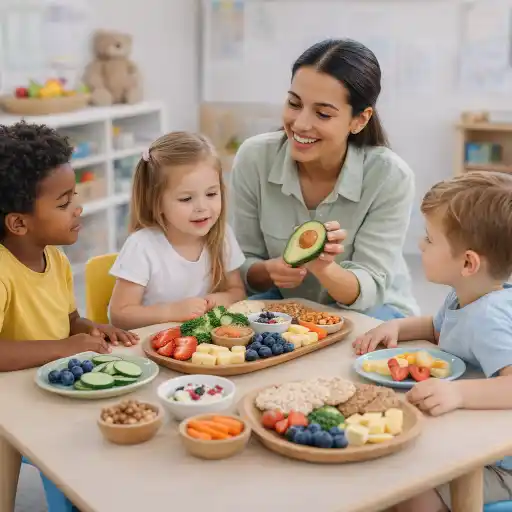
Include familiar foods alongside new examples and represent varied cuisines without treating one culture’s foods as unusual or exotic. Family input can help ensure that food names and traditions are represented respectfully. Resources on culturally diverse food exploration and cultural competence offer useful reminders to plan with community context in mind.
How do you manage safety during preparation and exploration?
Safety needs to be built into the activity plan, not added once the materials are on the table. Assign an adult to verify ingredients and labels, another role for supervising children if staffing allows, and a clear routine for handwashing, cleaning, and tool use. Follow the child’s written health plan and program policy. Do not rely on memory or on a product’s front-of-package claims; check the complete ingredient information each time, because products may change.
Prevent cross-contact by separating approved items from other foods, using clean and appropriate utensils, and cleaning food-contact surfaces according to program procedures. Keep children from sharing food, cups, and tools. Supervise closely, select age-appropriate equipment, and prepare food in forms that reduce choking risk. Children should wash hands with soap and water; staff should follow the program’s hygiene and cleaning practices before, during, and after the activity.
- 🧼 Wash hands and prepare clean work surfaces before materials are distributed.
- Read ingredient labels and confirm any planned substitute with the appropriate family or health plan.
- Use separate, clean tools and serving containers where required by the child’s plan.
- Keep emergency information and prescribed medication accessible to authorized staff.
- Offer non-food alternatives when ingredients, sensory materials, or safety details are uncertain.
Never promise an allergen-free environment unless your program has established and can substantiate that standard. Instead, explain the precautions being used and invite families to discuss concerns. For more program-level guidance, see ChildCareEd’s practical article on keeping children safe from food allergies. Providers who want focused training on preparation and response can also review the course Food Preparation and Nutrition Buy Now $32.00.
How can you make participation respectful and developmentally appropriate?
Set the expectation that children may observe, talk, sort, draw, smell, or touch only when it is safe and comfortable for them. Do not require tasting, praise a child for eating, or frame refusal as misbehavior. Pressure can make an activity feel like a performance rather than exploration. Instead, notice children’s thinking: “You found two foods that are round,” or “You chose to watch before joining.”
Use open-ended prompts that invite conversation without quizzing: “What do you notice?” “How could we group these?” “What does your family call this food?” Accept pointing, home-language words, gestures, and other forms of communication. For children with sensory sensitivities or disabilities, adapt seating, tools, visuals, time, and materials. A child might use tongs rather than hands, choose a photo instead of handling produce, or participate with a peer or adult partner.
Keep nutrition language neutral and accurate. Avoid dividing foods into moral categories such as “good” and “bad,” or implying that a child’s family choices are inferior. Focus on attributes, sources, preparation, and the role foods play in different meals and traditions. Food diversity can invite cultural learning, but avoid asking a child to represent an entire culture or explain family practices on demand. Participation should feel safe, voluntary, and connected to children’s interests.
Observe the learning process rather than whether a child ate. A note that a child compared textures, named a food in a home language, or took a turn measuring offers useful information for curriculum planning and future invitations.
What common planning mistakes should providers avoid?
Even caring educators can overlook a detail when an activity is exciting or preparation is rushed. A brief planning check helps prevent avoidable problems and makes the experience smoother for children and staff.
- Assuming a substitute is automatically safe: Confirm it with the family or written plan; do not make medical decisions on your own.
- Checking a label only once: Review the exact product and current ingredient list each time it is used.
- Using food in sensory play without considering contact: Review ingredients and exposure risks, and choose non-food materials when uncertain.
- Making tasting the activity’s goal: Offer multiple forms of participation and accept observation as engagement.
- Planning around one child’s needs without family partnership: Communicate in advance and agree on practical accommodations.
- Overlooking cultural assumptions: Invite family perspectives and represent foods respectfully, without treating any cuisine as a novelty.
Directors can build consistency by using a short activity-planning form: learning objective, children’s dietary and accessibility needs, ingredient or material list, safety measures, staff roles, family communication, and alternatives. Review the plan with classroom staff before the activity and debrief afterward. If an incident or near miss occurs, follow program procedures, document facts, inform the appropriate people, and use the review to improve systems rather than assign blame.
Professional learning can support this work. ChildCareEd’s On My Plate: Children’s Nutrition Buy Now $24.00 addresses nutrition and meal planning, while Wellness in Action: Teaching Healthy Habits to Children Buy Now $55.00 includes age-appropriate, inclusive food learning. Check course details and your state’s training rules before selecting training for a specific requirement.
Conclusion: How can you plan a food-learning activity for different dietary needs?
Start with children’s documented needs and family knowledge, choose a clear learning goal, and decide whether real food is necessary. Offer varied, pressure-free ways to participate, represent family cultures respectfully, and build hygiene, label checks, cross-contact prevention, supervision, and emergency readiness into the plan. A child does not need to taste a food to learn from the experience.
For directors and providers, the practical goal is an activity where safety and curiosity reinforce each other. A well-planned invitation can support language, early math, sensory learning, cultural understanding, and peer connection while honoring each child’s health needs and choices. With communication, thoughtful adaptations, and consistent routines, food learning can be a genuinely shared experience.
- Nutrition Essentials for Child Care Providers
- Pediatric RSV First Aid & CPR/AED
- Emergent Learning & Development
- 45-Hour Infant and Toddler Curriculum
- Creating Engaging and Meaningful Learning Experiences
- Connections That Count: Building Relationships in Child Care
- Texas Director Credential
- Access for All: Inclusion and the ADA
- Wellness in Action: Teaching Healthy Habits to Children
- On My Plate: Children's Nutrition
- Eat, Play, Grow: Essential Nutritional Tips for Growing Minds
- How to Include Kids in the Kitchen
- CDA Certification en Español: Recursos y Consejos para Educadores Bilingües
- 💛🧩 ¿Cómo puedo hacer que mi enseñanza sea inclusiva para los niños con autismo?
- Cómo Abrir Una Quardería En Casa Sin Dinero?
- ¿Cómo incluir a niños con necesidades especiales en cuidado infantil? Guía práctica y sencilla
- Cómo Empezar una Guardería en Casa: Requisitos y Pasos
- Proporciones de Cuidado Infantil y Tamaños de Grupo por Edad en Maryland (Guía Rápida para Centros y Hogares)
- Proporciones de Cuidado Infantil y Tamaños de Grupo por Edad en Nueva Jersey (Guía Rápida para Centros y Hogares)
- Proporciones de Cuidado Infantil y Tamaños de Grupo por Edad en Virginia (Guía Rápida para Centros y Hogares)
- Lista para Guardería en Casa en Illinois: Cómo Iniciar una Guardería en el Hogar
- Lista para Guardería en Casa en Texas: Cómo Iniciar una Guardería en el Hogar
- Celebrando la amistad en el cuidado infantil durante el Día de los Mejores Amigos
- Canciones, juegos y preguntas de círculo para niños
- Which Active Supervision Strategy Should You Use During Transitions, Meals, Naps, and Outdoor Play?
- How Can Providers Talk About Food Variety Without Shaming Children’s Lunches?
- How Can You Make a Classroom Cooking Activity Accessible to Children with Different Abilities?
- How Can You Plan a Food-Learning Activity for Children with Different Dietary Needs?
