Young children already investigate the world when they watch a puddle shrink, compare rocks, or wonder why a ball bounces. With a few thoughtful routines, child care providers can turn these moments into meaningful practice in observation, prediction, and explanation; Basic Science in Early Childhood Buy Now $25.00 offers a focused next step, including practical guidance for planning purposeful science experiences and supporting children’s reasoning.
Why does early science belong in everyday classroom life?
Science in early childhood is less about memorizing facts and more about learning how to notice, ask questions, test ideas, and share what happened. A toddler dropping two different balls or a preschooler watching a seed sprout is engaging in the beginnings of scientific inquiry.
These experiences support development across domains. Children describe textures and changes, practice comparing and counting, coordinate their movements, and collaborate on ideas. They also learn that their questions deserve attention. When educators give children time and responsive support, an ordinary moment—wind moving a chime, ice melting in a tray—can invite sustained curiosity.
For providers and directors, science need not mean adding a complicated unit or expensive equipment. Short, repeatable invitations can fit into play, routines, outdoor time, and conversation. The goal is to make #curiosity welcome and to notice the #thinking children already bring to the classroom.
How can you build inquiry into familiar routines?
Start with children’s interests and everyday events. If a child is fascinated by a puddle, invite them to look again later. During snack, compare the shapes, colors, or textures of familiar foods. Outside, notice what moves in the wind. These unplanned moments are useful science opportunities because children can connect new observations to what they already know.
Use a simple inquiry cycle flexibly: notice, wonder, predict, try, observe, and talk about what happened. The steps do not need to follow a rigid order. Infants may explore through looking, reaching, listening, and repeating an action; preschoolers may add drawings, simple tallies, or comparisons.
- During water play, ask what might happen when a sponge, cup, or large toy goes into the water.
- On a nature walk, invite children to compare leaves by shape, color, or texture.
- When building, wonder aloud about what might make a tower more stable.
- Return to an observation later and ask what changed.
Keep the experience open-ended. Rather than racing to deliver an answer, give children space to revisit ideas and learn from what they see.
Which low-preparation activities help children investigate?
Useful investigations can begin with everyday materials and one clear question. Choose items that are safe, easy to handle, and suitable for the children’s ages and abilities. Present a small number of materials at a time; a tray with a few options can support focused exploration without limiting children’s ideas.
- 🧪 Sink or float: Offer a shallow water tub and a few large, safe objects. Invite children to predict, test, and sort the outcomes.
- Ramps: Use a sturdy cardboard ramp and toy vehicles. Change the ramp height or surface one at a time and compare how far the vehicles travel.
- Color mixing: With adult-managed, child-safe materials, let children combine colored water using droppers and describe what changes.
- Seed watching: Plant seeds in clear containers and observe them over several days. Children can draw or dictate what they notice.
- Soap and pepper demonstration: A closely supervised demonstration can prompt predictions about what happens when soapy fingers touch pepper sprinkled on water. Keep materials away from mouths and wash hands afterward; see Science in Classroom for activity details and safety notes.
Frame each activity around a question rather than a required result: “What do you notice?” or “What could we try next?” For more ideas and practical planning support, STEM for Preschoolers: Fun Activities That Encourage Curiosity offers additional examples of play-based exploration.
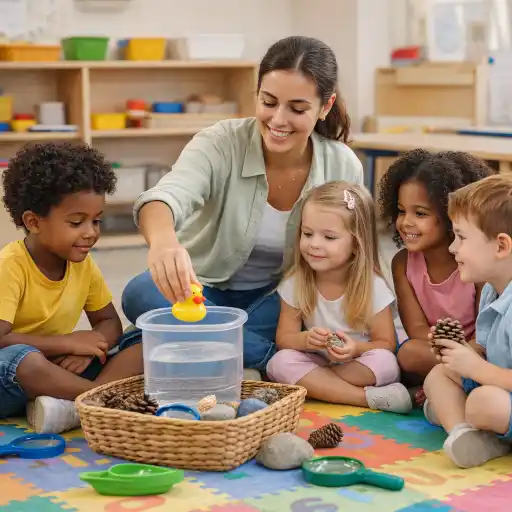
What can educators say and do without taking over?
The educator’s role is to create conditions for inquiry and help children make their thinking visible—not to direct every move or supply every answer. Observe first: notice what a child tries, repeats, or finds surprising. Then use a brief prompt that follows the child’s idea. The NAEYC article What Are You Thinking? Scaffolding Thinking to Promote Learning emphasizes the value of questions, time, modeling, and making children’s thinking visible.
- “What did you notice?”
- “What do you think might happen next?”
- “What could we change to find out?”
- “How is this one different from the other one?”
- “What makes you think that?”
Pause after asking. Some children need time to think; others may respond through gestures, drawings, building, or a home language. Model precise words naturally—such as observe, predict, compare, balance, and change—without turning the exchange into a quiz. If a test does not work as expected, treat the result as information: “The bridge bent when the block went across. What might we try now?” This supports #persistence and shows that investigation includes revising ideas.
How can you make a science-friendly environment safe and inclusive?
A science area can be a permanent table, a shelf, a portable cart, or a tray brought into play. Keep tools such as magnifiers, measuring cups, sturdy containers, paper, and drawing materials accessible when appropriate. Rotate a few natural or recycled objects to spark fresh questions, and display children’s observations so they can return to them. A classroom does not need a dedicated laboratory to support meaningful exploration.
Plan for safety as part of the invitation. Inspect materials, remove choking hazards, supervise water and tools, and keep substances that could be harmful under adult control. Match materials and procedures to children’s developmental needs, individual abilities, and program policies. State requirements vary - check your state licensing agency.
Inclusion also means offering more than one way to participate. Provide larger tools or stable surfaces when useful, use picture cues or predictable steps, and accept communication through words, signs, gestures, drawing, or construction. Label materials in children’s home languages when possible and include natural objects that are familiar and meaningful to the families in your program. Thoughtful setup supports #exploration while helping children feel capable and welcome.
How can you document learning and keep inquiry growing?
Documentation can be brief and still valuable. A photo, a child’s exact words, and a short observation can show how a child made a prediction, tested an idea, compared results, or changed a plan. The purpose is not to produce a large record for every activity; it is to notice learning and use it to plan a thoughtful next step.
- Record one question, prediction, or comment from a child.
- Photograph a process or a change, not only the finished product.
- Use a simple chart, tally, or drawing to revisit observations with children.
- Share a short note or photo with families and invite a related question at home.
- Reflect with colleagues: Who participated? What prompts helped? What might we offer next?
If children repeatedly explore how objects move down a ramp, for example, add a different surface or invite them to compare two vehicles. When they are curious about plants, return to the seedlings and notice changes over time. To deepen your professional understanding of developmentally appropriate activities and inquiry, explore Building Early Science Foundations  Buy Now $16.00, Tomorrow's Einsteins: Infant and Toddler Science Buy Now $16.00, and Enhancing STEM Education for Infants and Toddlers Buy Now $16.00. These courses offer focused learning for providers seeking to strengthen science and STEM practices.
Conclusion: What simple steps encourage early science skills?
Early science grows from children’s ordinary questions and their desire to explore. Providers can nurture these skills by offering safe, accessible materials; making room for sustained play; asking open-ended questions; and welcoming children’s predictions, observations, and revisions. Keep activities manageable and adapt them to each child’s age, interests, language, and abilities.
Begin with one question and a few materials. Watch what children do, listen to their explanations, and capture a small piece of evidence to help shape the next invitation. These practical steps can turn daily classroom moments into opportunities for children to practice #science, strengthen language, and discover that careful observation can lead to new ideas.
- CDA Bridge Bundle: Family Child Care without Portfolio Review
- CDA Bridge Bundle: Infant/Toddler without Portfolio Review
- CDA Bridge Bundle: Preschool without Portfolio Review
- Emergent Learning & Development
- Self-Regulation & Change: Helping Children Cope
- Creating Environments that Nurture Growth and Community
- Texas Director Credential
- Montessori Cultural Activities: Exploring the World Through Play and Learning
- Professional Integrity in Child Care
- Language for Our Littlest Learners: Building Communication From the Start
- How to boost fine motor skills: Holiday Edition
- How motor skills shape child development and creative ways educators can foster them.
- CDA Certification en Español: Recursos y Consejos para Educadores Bilingües
- Easy Ways to Add STEM to Your Preschool Classroom
- Learning Through Creative Daycare Activities
- How can I use STEM activities in my Preschool and Pre-K classroom?
- How Do Art Activities Support Cognitive Growth in North Dakota Preschoolers?
- Can Toddlers Do STEM in the Sandbox at Minnesota Daycares?
- How can child care providers use simple STEM activities with early learners?
- How can Florida educators build strong foundations for infants, toddlers and K–3 readiness together?
- What skills do preschoolers need to be ready for school?
- How can we explore sand, space, and science with young children in preschool settings?
- STEM for Preschoolers: Fun Activities That Encourage Curiosity
- What Are the Best Ways to Support a Child’s Speech Development?
- How Can You Set Up Learning Centers in a Preschool Classroom?
- What Learning Centers Should Every Preschool Classroom Have?
- How Can One Plant Help Children Notice Gradual Change Outdoors?
- What Are Simple Ways to Encourage Early Science Skills in the Classroom?
