A thoughtfully planned set of learning centers can turn a busy preschool room into a place where children choose, investigate, create, and practice essential skills through play. The Spicing Up the Classroom: Learning Centers course  Buy Now $16.00 offers focused professional learning to help you plan purposeful centers and strengthen your classroom practice. Read on for a practical guide to core areas and ways to adapt them to your children and space.
Why do learning centers matter in preschool?
Learning centers are defined areas stocked with materials that invite children to explore ideas and skills through hands-on activity. They translate curriculum goals into experiences young children can see, touch, discuss, and revisit. In a block area, for example, children may compare height, test balance, plan together, and negotiate which idea to try next.
Centers also support agency. When children can make meaningful choices and access materials independently, they practice decision-making, persistence, self-regulation, and care for shared resources. For educators, centers make learning visible: adults can listen to children’s thinking, notice strengths and questions, and offer a timely prompt without directing every move.
A strong setup does not require expensive equipment or a separate room for each subject. Clear purpose, accessible materials, responsive interaction, and safe supervision matter more than a perfect-looking space. These conditions give #preschoolers room to explore and help #teachers balance intentional planning with child-led #play.
Which core centers offer a well-rounded foundation?
Most preschool classrooms benefit from areas that address a range of developmental domains. The areas may be separate or combined depending on space, enrollment, and children’s needs. The list below is a flexible starting point—not a mandatory checklist.
- Books and literacy: Provide varied books, puppets, story props, and a comfortable place to look through books or retell a story. Add meaningful print in other centers, too.
- Writing and fine motor: Offer paper, crayons, markers, clipboards, envelopes, stamps, and child-safe tools for drawing, mark-making, and purposeful writing.
- Blocks and construction: Include blocks, tiles, vehicles, people, and open floor space. Children can design, test, count, compare, and collaborate.
- Dramatic play: Flexible props such as dolls, fabric, pretend food, and community-role materials encourage imagination, language, and social problem-solving.
- Art and creativity: Stock open-ended materials such as paint, collage supplies, clay, and drawing tools. Emphasize children’s choices and creative process rather than identical finished products.
Each area should reflect children’s developmental levels, home languages, cultures, abilities, and current interests. Literacy, math, and science can also appear throughout the room: a menu in dramatic play or measurement tools near blocks makes learning connections authentic.
How do math, science, sensory, and quiet areas extend learning?
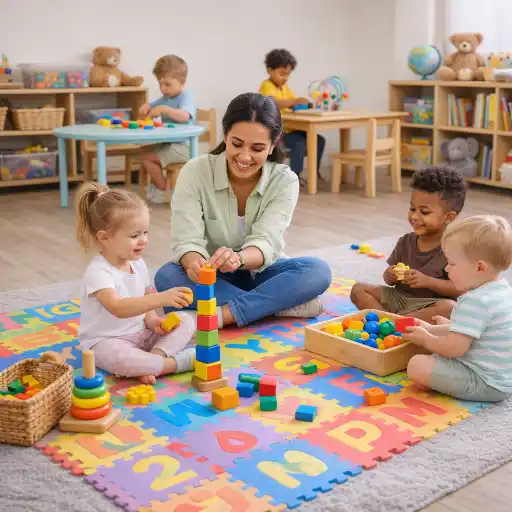
A math or manipulatives area might include puzzles, counters, sorting objects, shape materials, and measuring tools. Invite children to group objects in different ways, compare amounts, or explain how they made a pattern. These open-ended tasks encourage mathematical language and reasoning beyond finding one fixed answer.
A science or discovery area can feature magnifiers, natural objects, plants, simple tools, and books related to children’s questions. Add an open prompt—“What do you notice about these leaves?”—and paper for drawing or recording observations. Sensory experiences with play dough, water, or sand invite exploration of texture, movement, volume, and cause and effect. Choose materials appropriate for the children present, and follow supervision, sanitation, and choking-prevention practices.
A small quiet or cozy area is equally valuable. Soft seating, a few books, and calming visuals can give a child a lower-stimulation option when they need a pause. Teach that it is a supportive choice, not a punishment. Centers can overlap: measuring cups in dramatic play or nature books near science help children connect ideas across the room. A thoughtfully arranged #classroom makes room for energetic discovery and quiet focus.
How should centers be arranged and stocked?
Begin with a simple room map. Mark doors, sinks, storage, and main walking routes, then plan centers around visibility and movement. Place active areas such as blocks and dramatic play away from quiet reading or writing where possible. Put messy activities near washable surfaces and a sink when practical. Low shelves can define boundaries while keeping materials reachable and adult sight lines open.
- Use picture-and-word labels and consistent homes for materials so children can choose and help tidy up.
- Offer a few purposeful, open-ended materials at a time; store extras and rotate items as interest or learning goals change. A thoughtfully limited selection can also leave more room for imaginative play; explore why fewer toys can mean more imagination.
- Set a comfortable group size for each area and preserve clear pathways for children and adults.
- Adapt tools, seating, labels, and access so children with different abilities and language backgrounds can participate.
- Teach routines for using, sharing, cleaning, and returning materials; model them and revisit them as needed.
- 🧭 Identify one learning intention and one observation question for each center—for example, “How do children test whether their structure will stand?”
This keeps the setup purposeful without turning play into a scripted task. State requirements vary - check your state licensing agency when making decisions about room arrangement, materials, supervision, and capacity.
How can educators keep centers engaging, inclusive, and safe?
Children’s interests provide the best clues about what to add or adjust. Observe which materials they return to, what questions emerge, where frustration occurs, and who is not yet participating. Refresh one or two elements—perhaps a new prop, photo, book, or tool—rather than replacing everything. Familiar materials help children revisit an idea; a small invitation can extend it.
Adults have an active role without taking over. Move through the room, maintain supervision, listen closely, and join play when your presence can support language, peer interaction, or problem-solving. Try a brief open-ended prompt such as “What could you try next?” and allow time for children to respond. Use a short note, child quote, or work sample when helpful to plan a next experience.
Make representation and access routine parts of center planning. Choose books, dolls, family-play props, images, and materials that reflect children’s lives and broaden what they encounter. Offer different ways to participate, communicate, and use materials. Avoid common pitfalls such as overcrowded shelves, too much adult direction, inaccessible materials, or centers that remain unchanged despite fading interest. This responsive approach helps every child find a meaningful way into learning.
Conclusion: What centers should every preschool classroom have?
A well-rounded preschool classroom usually includes literacy, writing and fine motor, blocks and construction, dramatic play, art, math or manipulatives, science or discovery, sensory exploration, and a quiet or cozy option. These are flexible building blocks, not a universal formula: combine areas when space is limited and adapt them to children’s needs and program guidance.
The key is not the number of centers but their quality. Make each space purposeful, accessible, safe, open-ended, and responsive to children’s interests. Teach routines, protect meaningful time for play, supervise actively, and observe what children communicate through their choices. Begin with one practical change this week—simplify a shelf, add a book to a center, or clarify a pathway—and use what you notice to guide the next step. Thoughtful #centers invite children to learn through choice, connection, and discovery.
To build on your planning, explore these English-language ChildCareEd courses:
- Classroom Designers ONLINE Buy Now $24.00 — practical guidance on age-appropriate classroom design and material selection.
- Building Equity: Inclusionary Practices in Preschool Buy Now $10.00 — strategies for making preschool experiences welcoming and inclusive.
- Preschool Assessments & Observations Buy Now $24.00 — skills for observing children and using what you notice to inform learning experiences.
- Facilitating Learning in the Preschool Classroom Buy Now $35.00 — strategies for intentional planning and authentic, child-led experiences.
- 45 Hour Child Growth and Development
- Building Equity: Inclusionary Practices in Preschool
- CDA Bridge Bundle: Preschool
- Pediatric RSV First Aid & CPR/AED
- Emergent Learning & Development
- Texas Director Credential
- CDA Infants/Toddlers: Brain Development and Gene Expression
- CDA Infants/Toddlers: Stages of Development
- Spicing Up the Classroom: Learning Centers
- 😫🧸 ¿Qué hacer cuando un bebé no quiere dormir la siesta en el aula?
- 🩺 Cumplimiento de Salud e Inmunización en Cuidado Infantil de Nevada ✔️
- ¿Cuáles son las mejores actividades del Día de la Tierra para niños en casa o en el aula?
- How can I create engaging learning centers for preschoolers?
- Preschool Classroom Rules: How to Teach Expectations Without Constant Reminders
- Preschool Schedule That Works: When to Plan Centers, Circle Time, and Outdoor Play
- Why Is My Preschool Classroom So Chaotic? 7 Classroom Management Fixes to Try
- How Can Child Care Providers Create a Preschool Schedule That Supports Learning and Well-Being?
- Which Low-Cost Printables Make the Biggest Classroom Impact?
- How Can Child Care Providers Create Effective Learning Centers in Small Spaces?
- What Printables Should Every Preschool Classroom Have on Hand?
- Which Printable Activities Belong in Every Preschool Classroom?
- How Can You Link a Preschool Learning Center to a Clear Teaching Goal?
- How Often Should Preschool Teachers Change Classroom Activities?
- How Can You Set Up Learning Centers in a Preschool Classroom?
- What Learning Centers Should Every Preschool Classroom Have?
- When Do Too Many Materials Make a Learning Center Harder to Use?
- What Should a Daily Preschool Schedule Include?
- What Learning Centers Should Every Preschool Classroom Have?
- How Do You Set Up a Developmentally Appropriate Preschool Classroom?
