A leaf label matters to a preschooler when someone else can read it, learn from it, and respond. A classroom nature museum turns children’s observations into purposeful writing while building print awareness, vocabulary, and confidence; Understanding Print Knowledge in Preschool  Buy Now $16.00 offers practical ways to help children notice how print works. For a broader set of literacy-rich classroom strategies, explore Classroom Tools for Emergent Literacy Buy Now $25.00 as you plan an experience that invites visitors into children’s thinking.
Why does a leaf museum make writing meaningful?
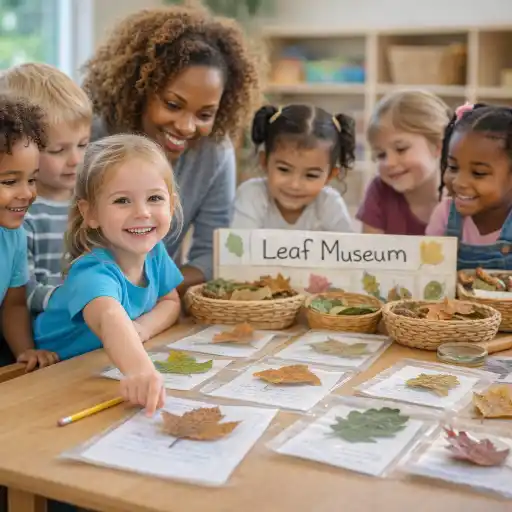
Preschoolers do not need conventional spelling or finely formed letters for their writing to have meaning. A drawing, a row of marks, a copied letter, or a dictated sentence can help another person understand what a child noticed. In a class leaf museum, writing has a clear purpose: identify an object, share a discovery, or guide a visitor through an exhibit.
This audience changes the feel of writing. Rather than completing a page only for an adult, children create something that classmates, families, or another classroom can read and discuss. Their work contributes to a shared project, encouraging the sense that their ideas are worth communicating.
The museum also brings literacy into an authentic science investigation. As children compare leaves, they can describe color, shape, size, texture, and veins; ask questions; and represent what they observe. Early science guidance emphasizes that inquiry can also nurture language, collaboration, motor skills, and early mathematical thinking. Nature investigations can therefore provide a rich context for meaningful writing, rather than treating literacy and science as separate activities.
- Children see that print and pictures can carry information.
- They practice describing and comparing real objects.
- They learn that their work can inform, welcome, or delight an audience.
How can providers create a leaf museum with children?
Begin with children’s curiosity, not a predetermined display. Take a short, supervised walk around the outdoor area or use leaves collected by staff. Invite children to notice similarities and differences, and ask what they would like visitors to learn. Children can help choose which leaves to exhibit and how to organize them.
Keep the setup simple and accessible. A table, trays or clear sleeves, paper, chunky writing tools, and a place for visitor comments are enough to start. If real leaves are unavailable, photographs or artificial leaves can still support careful observation and comparison.
- Gather a small selection of leaves from safe, familiar areas; check program procedures before collecting or bringing natural materials indoors.
- Offer magnifiers, sorting trays, clipboards, crayons, pencils, and drawing paper.
- Invite children to sort by a feature they choose, such as shape, size, color, or texture.
- Ask what the museum needs: a welcome sign, exhibit labels, a map, or a visitor book.
- Display children’s work at a height visitors can see and children can revisit.
Model the museum’s purpose by visiting a classroom exhibit together. Think aloud: “This label tells us what we are looking at. What could your label tell someone about your leaf?” Leave room for children’s ideas and revisions. A museum is not a craft template; its value lies in the shared process of looking, deciding, representing, and preparing to welcome others.
What should children write on labels and in a visitor book?
A useful exhibit label provides a reason to connect spoken language, marks, pictures, and print. It can be as simple as the child’s name or a dictated observation. Invite children to decide what information matters rather than requiring every label to follow the same formula. Some may draw the leaf; others may add a letter, a word, or a sentence dictated to an educator.
Try offering a few prompts that help children notice and communicate:
- “What do you notice about this leaf?”
- “How is it like—or different from—the other leaves?”
- “What would you like a visitor to know?”
- “Would you like to draw, make marks, write, or tell me your words?”
Write a child’s exact words when the child asks for help, and read them back to confirm the message. You might add a small word card with a relevant term, such as “vein,” without replacing the child’s own work. The visitor book gives the audience a role: visitors can draw, add a mark, dictate a comment, or respond to a question. 📝 Offer different ways to participate, including drawing or speaking, so the book is welcoming to children and adults with varied writing experiences.
Print knowledge grows when educators make print’s function visible. Point out that a label names or describes an exhibit, while a sign welcomes visitors and a visitor book records responses. These functional examples extend the everyday print children encounter in their classroom and support an understanding that written symbols communicate meaning.
How can educators scaffold writing without taking over?
Children’s writing develops along different paths. One child may dictate a detailed description while another experiments with lines, shapes, or a first letter. Both can participate as authors. Respond first to the child’s message and intentions; avoid turning the museum into a test of handwriting, spelling, or botanical knowledge.
Short, responsive scaffolds keep children in control:
- Model a label for your own observation, explaining why you are writing it.
- Offer to write a child’s dictated words, then read them aloud together.
- Provide picture-word choices or letter cards as optional supports.
- Invite children to revise if they notice a new detail or want to change their explanation.
- Include familiar words and, when appropriate, children’s home languages.
Questions should extend thinking, not test children’s memory. “What helped you notice that?” or “What would you like visitors to look for?” can prompt further observation. If a child is unsure how to describe a leaf, explore it together and use descriptive language naturally: “This one feels smooth, and its edge has little points.” The educator’s role is to make language and writing available while protecting children’s ownership of the message.
Make the experience accessible: offer larger tools, stable surfaces, photographs, tactile exploration, dictation, or a partner scribe when useful. Children can contribute through drawing, pointing, speaking, or mark-making. A genuine audience does not require one uniform product; it requires that the classroom treats each child’s contribution as meaningful.
How can directors support safety, inclusion, and meaningful documentation?
Directors can help staff plan the project with a few practical questions: Where will materials come from? How will exhibits be secured? Who will supervise the collection and display process? How can families or other classrooms visit without disrupting routines? Real leaves can be fragile, dirty, or unfamiliar, so staff should follow program hygiene and supervision practices, review relevant family information, and use safe, age-appropriate materials.
Inclusion means that each child can access the investigation and communicate an idea. Offer different ways to observe and respond, use clear visual supports, and invite home-language contributions. Families may recognize local plants or share names and stories, but participation should remain voluntary and respectful of family preferences.
Documentation can be brief and useful. With program consent and privacy practices in mind, save a label or photograph, record the child’s explanation, and note the support provided. This helps educators see growth in observation, vocabulary, print use, collaboration, and confidence without ranking children against one another.
- Keep the display uncluttered and materials within children’s reach.
- Use washable or replaceable materials and plan for cleanup.
- Ask visitors for comments that affirm children’s ideas and discoveries.
- Review children’s participation and adapt the next project step accordingly.
Common pitfalls include writing every label for children, overloading the exhibit with decorations, or focusing so much on the finished display that children have little time to investigate. Keep the process central, and remember that state requirements vary - check your state licensing agency.
How can the museum welcome a real audience and extend learning?
A real audience can be small: another classroom, program staff, or a few family members. Invite children to help plan the visit, decide how to greet guests, and choose whether they want to explain an exhibit. Some children may prefer to observe quietly, which is also a valid way to participate. The purpose is authentic communication, not a performance requirement.
Prepare visitors to respond in ways that sustain children’s ownership. They might ask, “What did you discover?” or leave a drawing or dictated message in the visitor book. Help children read the comments afterward and decide what they learned from visitors. A response can prompt a new question: Which leaves came from the same kind of tree? Do leaves change as they dry? What might we investigate next?
The exhibit can also become a bridge between classroom experiences. Revisit it during read-alouds, outdoor walks, art, sorting, or group conversation. Children might add new labels, revise an earlier idea, create a map, or compare leaves gathered at different times. Project documentation and displays can help make learning visible and support reflection; the Illinois Early Learning Project’s display and documentation techniques resource offers related examples.
When children’s labels are read and their ideas receive thoughtful responses, writing becomes part of a relationship between author and audience. The museum’s success is not measured by polished signs, but by children’s curiosity, agency, and willingness to communicate what they notice.
Conclusion: How does a leaf museum give preschool writing a real audience?
A class leaf museum gives preschool writing a meaningful purpose: children make labels, signs, and visitor-book entries to share observations with other people. Their messages may include drawings, marks, dictated words, or emerging conventional print. Each form can contribute to the exhibit and support children’s understanding that print communicates.
Start with children’s questions, provide accessible tools, and scaffold without taking over. Make the audience welcoming, document what children notice, and use their ideas to guide what comes next. With a simple display and genuine opportunities to communicate, a collection of leaves can become a lively meeting place for early writing, science, and community.
Courses for continued professional learning
- Understanding Print Knowledge in Preschool Buy Now $16.00 — explore how to build children’s understanding of print.
- Classroom Tools for Emergent Literacy Buy Now $25.00 — consider practical literacy materials and strategies for the classroom.
- Creating the Natural Outdoor Classroom Buy Now $16.00 — learn about planning nature-rich outdoor environments.
- Building Early Science Foundations Buy Now $16.00 — strengthen your understanding of inquiry and exploration through play.
- Reading Aloud and Storytelling Buy Now $16.00 — develop strategies for supporting language and early literacy.
References
- Understanding Print Knowledge in Preschool
- How can leaf-themed art and science activities deepen learning in my child care program?
- How Can Child Care Providers Create Print-Rich Early Childhood Environments?
- How Can Child Care Providers Support Early Writing Without Using Worksheets?
- The Making of an Art Museum: A Preschool Project | NAEYC
- What Happens at a Car Wash? | Early Childhood Research & Practice
- Science in Early Childhood Classrooms: Content and Process
- Investigating Nature | Eastern Connecticut State University
- The Project Approach: Display and Documentation Techniques
- Preschool Leaves and Trees Lesson Planning Ideas
- Simple Preschool Science: Leaf Matching Activity
- Science & Nature Activities for Ages 3–5
- 45 Hour Child Growth and Development
- Science of Reading Foundations in the Pre-K Classroom
- CDA Home Visitor Subject Area 3 Part 3 Birth to 5
- CDA Home Visitor Subject Area 2 Part 3 Birth to 5
- From Tantrums to Triumphs: Equipping Preschoolers with Self-Regulation Skills
- The ABCs of Behavior: Turning Challenges into Learning Opportunities
- CDA Bridge Bundle: Family Child Care without Portfolio Review
- CDA Bridge Bundle: Infant/Toddler without Portfolio Review
- CDA Bridge Bundle: Preschool without Portfolio Review
- 🚌❄️ Ideas de excursiones en Dakota del Norte
- 🚌🌄 Ideas de excursiones atractivas en Nevada
- 🚌❤️ Ideas de excursiones en Illinois
- Requisitos Para Ser Maestra Principal En Un Daycare: Lo Que Necesitas Para Empezar
- Recursos en Español sobre el Sueño Seguro del Bebé
- ¿Qué es la Certificación Child Development Associate (CDA)?
- 10 Ejemplos de Cómo la Cultura Influye en el Desarrollo Infantil
- Proporciones de Cuidado Infantil y Tamaños de Grupo por Edad en Nueva Jersey (Guía Rápida para Centros y Hogares)
- Proporciones de Cuidado Infantil y Tamaños de Grupo por Edad en Virginia (Guía Rápida para Centros y Hogares)
- Actividades de Otoño Fáciles para Preescolares esta Temporada
- Cómo Trabajar en el Cuidado Infantil en Carolina del Norte: Requisitos y Pasos
- Cómo Ser Maestra de Preescolar en Illinois
- Cómo Ser Maestra de Preescolar en Wisconsin
- Cómo Ser Maestra de Preescolar en California
- Cómo Ser Maestra de Preescolar en Maryland
- Celebrando la amistad en el cuidado infantil durante el Día de los Mejores Amigos
- Canciones, juegos y preguntas de círculo para niños
- Cómo simplificar la capacitación para sus empleados de daycare
- ¿Faltan Materiales o Falta una Nueva Estrategia? Cómo Revisar los Rincones del Aula
- How Can a Class Leaf Museum Give Preschool Writing a Real Audience?
