Combining #sand, #space, #science, #sensory exploration, and #preschool play creates rich opportunities for curiosity, language development, motor growth, problem-solving, and early STEM learning. With thoughtfully selected materials and simple prompts, children can investigate how sand changes with water, compare textures and quantities, build structures, explore planets and orbits through models, and practice predicting, testing, and describing what they observe. This practical guide helps child care providers and directors create low-preparation, high-impact learning stations that are safe, inclusive, developmentally appropriate, and easy to adapt for children with different interests and abilities.
To strengthen your approach to hands-on scientific inquiry, explore ChildCareEd’s self-paced online course Building Early Science Foundations  Buy Now $16.00. The course focuses on children’s natural curiosity and provides strategies for using play-based exploration, experimentation, and discovery to build foundational science skills. Providers can also take Environments That Inspire Independence and Exploration Buy Now $55.00 for guidance on arranging accessible learning spaces that encourage children to investigate materials independently and safely. State requirements vary, so always check with your state licensing agency.
How do we design safe, inviting learning spaces for mixed sand, space, and science play?
- 📏 Low shelves and labelled baskets: make materials accessible and tidy.
- 🪧 Visual cues: photos/rules at each zone so children anticipate routines.
- 💧 Safety stations: handwashing, water watcher signage, and shallow tubs for water play.
- 🌤️ Shade and rotations outdoors: short blocks on hot days; bring activities inside as needed—see ChildCareEd heat-safety tips in their summer activity guide.
Practical checks: sightlines for supervision, anchors on tall furniture, and simple storage so educators can swap invitations quickly. Design the space to invite wonder (open-ended loose parts, natural materials) yet limit choices to avoid overwhelm—fewer, well-curated materials mean deeper exploration (ChildCareEd: design).
What sand and sensory activities best support early science and development?
- 🎯 Sand investigator station: provide measuring scoops, funnels, sieves, and a magnifying lens. Prompt: “What changes when we add water?” (See sand-bin setup ideas at Lessons4Learners and ChildCareEd’s sensory bin guide.)
- 🧪 Ice-encased finds: freeze small toys in water blocks; give droppers and warm water to free them—great for prediction and fine motor control (also recommended in ChildCareEd’s summer activities resource).
- 🧱 Loose-parts sand construction: add shells, stones, tubes, and recycled bits so children engineer bridges and channels—connects to STEAM thinking (Fantastic Fun & Learning).
Set simple assessment prompts: Can the child pour without spilling? How do they describe what happens when water meets sand? Use observations to plan next invitations. Keep sand clean and covered when not in use and follow local health guidance—public sandboxes can harbor contaminants, so cover and inspect regularly (Slate: sandbox risks).
How can we bring space, astronomy, and “out-of-this-world” science to young children?
- 🚀 Sensory space table: black beans or dark sand as "space" base, glow-in-the-dark stars, small planet models—children dig for planets, sort by size, and create orbits.
- 🪐 Magnet painting for orbits: use magnetic marbles with paint to trace orbital paths (an idea from Pre-K Printable Fun). This connects physics (forces) to creative arts.
- 🔭 Observation and storytelling: short nightly stargazing prompts or a classroom telescope encourage observational language and turn questions into investigations. Use simple AR apps or NASA printable projects for older preschoolers to explore real images.
For a focused celebration, organize a Space Exploration Day activities with themed stations, short demonstrations, and family take-home projects to amplify engagement.
Keep explanations concrete: demonstrate with models (balls and strings) and encourage predictions: “Which planet do you think will roll fastest?” Keep timeframes short and allow repeated trials to build evidence-based reasoning—this supports early scientific inquiry as described in Karen Worth’s overview of science in early childhood (ECRP: Science in Early Childhood).
Why does combining sand, space, and science matter for young children?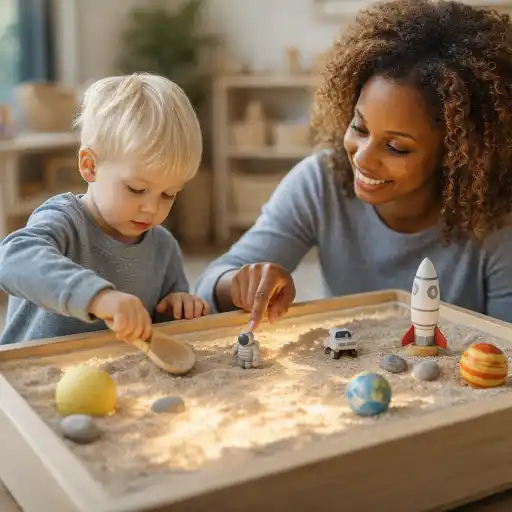
Why it matters:
1) Integration amplifies learning. When children use the same materials across contexts (a sand tray for a planetary model, an ice-encased meteor for an excavation task), they build transferable inquiry skills—predicting, testing, observing. Science in early childhood is most powerful when embedded in play rather than taught as abstract facts (Worth).
2) The approach supports multiple developmental domains simultaneously: language, motor, social, and cognitive. For example, a child building a sand channel to move water toward a model “planet” practices measurement, cooperation, and problem-solving. ChildCareEd emphasizes the power of play as the engine of learning and development—see their article on it.
3) Equity and access: classroom-based sand and space invitations give all children hands-on exposure to STEM phenomena they might not otherwise experience at home. Use low-cost materials (recycled containers, inexpensive scoops, printed planet cards) to keep activities accessible.
How do we plan, supervise, and avoid pitfalls (common mistakes and an FAQ)?
Plan with safety and developmental appropriateness at the center. Use the following enumerated checklist when you prepare stations:
- ⚠️ Safety-first setup: shallow water only; cover sandboxes when not in use; screen for animal intrusion—see Slate’s cautionary review and follow local public-health guidance.
- 🧑🏫 Staffing and active supervision: assign a named "water/sand watcher" during all water or sand activities; one adult per small group is ideal (ChildCareEd summer guide recommends 1:4–6 during messy stations: summer activities).
- 🧴 Hygiene and clean-up: immediate handwashing after sensory play (hand sanitizer does NOT remove worm eggs); empty and dry tubs between uses.
- 📋 Documentation & reflection: record observations and children’s words to inform the next invitation.
Common mistakes and how to avoid them:
- ❌ Overfilling invites at once. ✅ Keep 3–5 curated materials per station to avoid overwhelm.
- ❌ Leaving containers uncovered or unsupervised. ✅ Cover sandboxes; check for animal intrusion nightly.
- ❌ Using small parts with children who mouth objects. ✅ Use larger, safer materials or separate groups by age.
FAQ (quick answers):
- Q: How deep should water be at a preschool water table? A: A few inches at most; never leave children unattended—refer to ChildCareEd water-play guidance.
- Q: Can we do “space” lessons indoors? A: Yes—use sensory bins, magnet painting, and dramatic play; AR apps and NASA printables extend learning.
- Q: How often should materials be rotated? A: Rotate weekly or when interest drops; rotate to refresh curiosity and manage cleanliness.
- Q: Where do I find more activity templates? A: ChildCareEd's activity pages and Pre-K Printable Fun provide ready-made plans and printables (sensory bin, space theme). For ready-to-use celebration ideas, see ChildCareEd's Moon Day/Space Exploration Day activities for themed STEM and craft plans.
Conclusion
Exploring #sand, #space, and #science together gives children coherent, joyful ways to practice inquiry, language, and fine and gross motor skills. Start small: a covered sand tray with measuring tools, a simple sensory space table, and one short, repeatable space experiment can create huge learning returns. Use observation to guide the next steps, prioritize safety (cover sandboxes, watch water closely), and draw on resources from ChildCareEd and trusted partners for ready-made invitations and training. State requirements vary - check your state licensing agency. With intention, your learning spaces will invite wonder rather than chaos—and that matters for children and educators alike.
Sand and sensory play are not mere entertainment; they are contexts for investigation, fine-motor practice, and early math/science work. The evidence and practice base (see TTS-Group’s overview of sand and water play and ChildCareEd’s sensory-bin guidance) recommends open-ended invitations with tools for measuring, pouring, and testing hypotheses. Space-themed learning is modular: you can blend literacy, sensory, and inquiry easily. Use tactile models, dramatic play, and simple experiments to introduce planetary motion, phases, and forces. Pre-K-friendly lesson maps and activity packs (e.g., Pre-K Printable Fun and ChildCareEd resources) make planning easier—see Pre-K Printable Fun: Outer Space and the free NASA/Space resources for family and classroom extensions (Space.com: NASA projects). Design is the first lesson you teach. Thoughtful layout and materials selection communicate what children can explore and how. Use the idea of clear zones and visual boundaries (reading, sensory/sand table, science station, dramatic play) so children understand purpose and expectations. ChildCareEd provides practical principles on designing learning spaces that reduce chaos and increase independent engagement—consider these principles when you set up outdoor sand pits or an indoor sand table as part of learning-space design.
- Building Equity: Inclusionary Practices in Preschool
- 45 Hour Preschool Methods and Materials
- CDA Bridge Bundle: Preschool without Portfolio Review
- Texas Director Credential
- Building Early Science Foundations
- Building Vocabulary
- Access for All: Inclusion and the ADA
- Montessori Cultural Activities: Exploring the World Through Play and Learning
- Enhancing STEM Education for Infants and Toddlers
- Environments That Inspire Independence and Exploration
- CDA Certification en Español: Recursos y Consejos para Educadores Bilingües
- 🔍 ¿Qué ves cuando observas a un niño aprender?
- 💛🧩 ¿Cómo puedo hacer que mi enseñanza sea inclusiva para los niños con autismo?
- Proporciones de Cuidado Infantil y Tamaños de Grupo por Edad en Maryland (Guía Rápida para Centros y Hogares)
- Proporciones de Cuidado Infantil y Tamaños de Grupo por Edad en Nueva Jersey (Guía Rápida para Centros y Hogares)
- Proporciones de Cuidado Infantil y Tamaños de Grupo por Edad en Virginia (Guía Rápida para Centros y Hogares)
- Lista para Guardería en Casa en Illinois: Cómo Iniciar una Guardería en el Hogar
- Can Toddlers Do STEM in the Sandbox at Minnesota Daycares?
- Celebrando la amistad en el cuidado infantil durante el Día de los Mejores Amigos
- How can childcare programs teach young children about the Everglades safely while growing curiosity?
- Canciones, juegos y preguntas de círculo para niños
- Summer Preschool Activities for Art, Science, and Sensory Play
- How can we explore sand, space, and science with young children in preschool settings?
- How can we encourage scientific thinking through hands-on exploration?
- How Do Light vs. Heavy Activities Build Early Measurement Skills?
- How Can Ocean Art Build Marine Vocabulary and Curiosity in Young Children?
- What Learning Centers Should Every Preschool Classroom Have?
- How Can One Science Question Become a Preschool Investigation?
- What Learning Centers Should Every Preschool Classroom Have?
