Ready to transform cardboard, bottle caps, and recycled containers into powerful learning tools? Using simple, low-cost items for #STEAM play invites curiosity, problem-solving, and language development in ways that packaged kits often cannot. Start by exploring practical techniques in Beautiful Junk: Using Recycled Materials in the Classroom  Buy Now $16.00 and build your knowledge base with Building Early Science Foundations Buy Now $16.00—both provide classroom-ready ideas and staff learning you can apply the next day.
Why does using everyday materials matter for young children’s STEM learning?
Everyday objects support open-ended inquiry: a cardboard tube is not a toy with a single outcome but a prompt for planning, testing, and revision. Research and practice show that when young children handle ambiguous, repurposable items they engage in more of the behaviors that underlie scientific thinking—making predictions, testing ideas, and explaining results. That matters because those dispositions (curiosity, persistence, flexible thinking) are the building blocks for later #Exploration in math, engineering, and science. Practical benefits for your program include equitable learning (low cost), frequent repetition (affordable materials let children test many times), and stronger language gains as children describe what they do. For concrete ideas and activities, see resources such as STEAM Activities for Preschoolers Using Everyday Materials.
What everyday materials make the best invitations for STEM play?
Choose items that are versatile, safe, and easy to manipulate. The goal is variety and ambiguity—materials that don’t tell children what to do.
- #Materials to collect: cardboard tubes & boxes, bottle caps, yogurt cups, string, fabric scraps, paper, plastic containers, straws, and recycled lids.
- #Preschoolers-friendly additions: droppers, clear cups, food coloring, magnets, measuring spoons, tape, and non-toxic glue.
- Natural loose parts: pinecones, rocks, shells, sticks, and leaves—these support comparisons and measurement conversations.
- ✅ Pro tip: pre-sort materials by size and safety (choking risks removed) so staff can quickly set up invitations.
These simple items invite stacking, balancing, sinking/floating tests, ramp challenges, color mixing, and building—activities that routinely generate vocabulary and math talk (counting, comparing, measuring). Keep a small, rotating loose-parts bin so materials feel fresh and manageable.
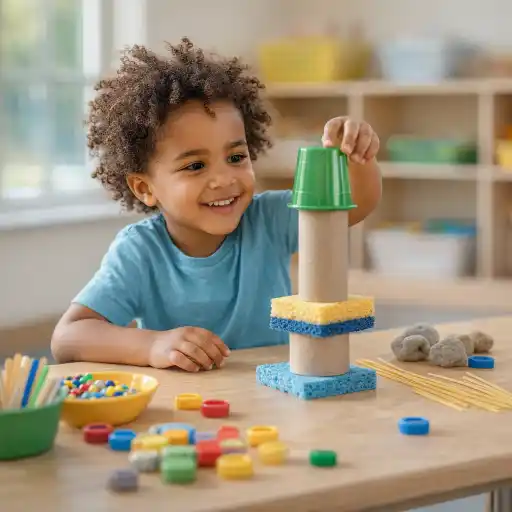
How do I set up a safe, low-prep STEM invitation that encourages scientific thinking?
Design invitations that are short to prepare, scaffolded for independence, and set up for easy cleanup. Follow a predictable structure: a one-question prompt, the materials, and a simple documentation step.
- 🧰 Prepare: choose 3–6 materials, place them on a tray, and add one open prompt (e.g., "What will float?" or "How can we make a tower stronger?").
- 👀 Position: put invitations where adults can observe and step in without interrupting; state requirements vary - check your state licensing agency.
- 🧪 Process: let children explore first, encourage one prediction, test, then invite description or drawing.
- 📸 Document: take a photo and jot one child quote (quick and repeatable). This makes learning visible and supports planning the next step.
Designate trays, smocks, and wipes so you don’t avoid messy but high-value investigations. Using clear cups and droppers supports color-mixing and measurement conversations; a water tub with mixed objects is perfect for sink/float and sorting tasks.
What teacher moves deepen learning without taking over the play?
Your role is to expand thinking—ask questions that stretch ideas, not to solve the problem for the child. Use short, targeted moves:
- Observe first—let the child try.
- Ask one open question: "What do you notice?" or "Why do you think that happened?"
- Encourage iteration: "Can you try it a different way to see what changes?"
- Help children record evidence: a quick drawing, a tally, or a captioned photo.
Pair these moves with simple assessment: count trials, note vocabulary (predict, more, less, sink, float), and collect two photos per child across repeated invitations to show progress. For staff training on building science routines and cognitive supports, consider courses like Basic Science in Early Childhood Buy Now $25.00 and Enhancing STEM Education for Infants and Toddlers Buy Now $16.00 to expand classroom strategies.
How do I adapt materials and invitations for diverse learners and include families?
Adaptations ensure all children participate meaningfully. For infants and toddlers, focus on sensory versions (large, safe objects, sensory tubs). For Montessori-inspired strategies to support infants' and toddlers' emergent scientific thinking, see Supporting Our Littlest Montessori Scientists. For children with fine-motor challenges, include larger manipulatives and two-handed tools. Provide visual supports and photo prompts for children who benefit from predictable sequences. When working with Dual Language Learners, label materials in home languages, accept explanations in the child’s preferred language, and capture child quotes in both languages when possible. For children with disabilities, break tasks into small steps and offer choice ("Would you like to stack or sort?").
Invite families by sending a photo and a one-sentence prompt to try at home (e.g., "Ask: Which items float at home?"). Encourage families to donate safe recyclables and share cultural materials—this supports relevance and inclusion. For deeper course options about inclusive practice and design, look at Math Foundations in Early Childhood Buy Now $16.00 (for math supports) and inclusion courses that help adapt lessons for all learners.
How can I avoid common mistakes and sustain a materials-based STEM approach?
Common pitfalls are easy to fix and often do more to block learning than lack of materials.
- ⚠️ Over-directing: adults solving problems reduces inquiry. Fix: ask a single question and wait.
- ❗Too many materials: overwhelm shortens engagement. Fix: limit to 3–6 choices per invitation.
- 🧼 Avoiding mess: skipping messy investigations loses rich learning. Fix: plan trays, smocks, and a brief cleanup routine.
- 📷 Poor documentation: learning disappears without evidence. Fix: photo + one quote method.
Sustaining the approach: rotate materials weekly, keep a teacher planning card with the invitation question and learning goal, and schedule short collaborative reflections during staff meetings. Consider staff training bundles or targeted single workshops to refresh skills—courses on ChildCareEd provide quick PD options and practical templates to support long-term implementation.
FAQ
- Q: Do I need special kits to teach STEM? A: No. Everyday recycled and household items are highly effective. The key is time, open prompts, and adult moves that promote inquiry.
- Q: How long should invitations run? A: 10–20 minutes for focused invitations; longer for multi-day investigations that track change over time.
- Q: How do I include infants and toddlers? A: Scale materials to size, emphasize sensory experience, and ensure safe, supervised exploration—courses like Enhancing STEM Education for Infants and Toddlers Buy Now $16.00 offer specific strategies.
- Q: What should I tell families? A: Send one photo + one question to try at home and invite material donations that reflect family cultures.
- Q: Are these activities safe for licensing? A: In general yes when you follow safety checks, but state requirements vary - check your state licensing agency.
Conclusion
Everyday materials are one of the most democratic, powerful tools you have for building early #Science, #Math, and creative thinking. With a small set of organized materials, one clear prompt, the right adult moves, and a simple documentation routine, you can create a classroom where children test ideas, build reasoning, and grow language every day. If you want immediate, classroom-ready strategies, explore Beautiful Junk Buy Now $16.00, deepen your science practice with Building Early Science Foundations Buy Now $16.00, and pick up targeted modules like Basic Science in Early Childhood Buy Now $25.00, Enhancing STEM Education for Infants and Toddlers Buy Now $16.00, or Math Foundations in Early Childhood Buy Now $16.00 to support your team. Small, repeated invitations with everyday things build big learning—trust the play, document the thinking, and make room for inquiry every day.
- Beautiful Junk: Using Recycled Materials in the Classroom
- CDA Home Visitor Subject Area 3 Part 3 Birth to 5
- Professional Presence in Early Childhood
- From Play to Planning: Building Culturally Competent, Child-Centered Curriculum
- Using Toys to Support Learning
- Art from the Heart for Preschoolers: Open Ended Art Projects that Build Self-Esteem
- 45-Hour Infant and Toddler Curriculum
- Creating Environments that Nurture Growth and Community
- Texas Director Credential
- Supporting Families and Caregivers in Language and Literacy
- "Junk" Art
- 👶 ¿Cuáles son las proporciones y grupos requeridos en Dakota del Norte? 🏫
- Easy Ways to Add STEM to Your Preschool Classroom
- What are easy STEM activities I can do with preschoolers?
- Celebrando la amistad en el cuidado infantil durante el Día de los Mejores Amigos
- How can we encourage scientific thinking through hands-on exploration?
- How can I use simple STEM activities to spark curiosity in preschoolers?
- How can blocks, water play, cooking, and outdoor exploration introduce STEM to young children?
- How Can I Use Everyday Materials for Meaningful STEM Exploration in My Preschool Classroom?
- How can I turn everyday materials into meaningful learning experiences?
- How can I introduce STEM concepts in early childhood?
- STEM for Preschoolers: Fun Activities That Encourage Curiosity
- Can You Build a Leaf Bridge? Fall STEM Challenges for Pre-K
- How Can STEM Activities Turn Everyday Preschool Play Into Powerful Learning?
- How Can Recycled Materials Create Engaging Learning Centers?
- How Can Child Care Providers Create Low-Cost STEM Activities With Items They Already Have?
- How Can Loose Parts Play Turn Everyday Objects Into Powerful Learning Opportunities?
- ¿Todos los niños deben participar en el tiempo de círculo?
- How Can Child Care Programs Protect Preschool Playtime When the Schedule Gets Crowded?
