Winter nature learning does not require fresh snow, a large outdoor area, or a costly new kit—a few thoughtful materials can turn a classroom corner into a place for meaningful discovery. Explore Basic Science in Early Childhood Buy Now $25.00 for practical guidance on helping children investigate, question, and experiment. Then use the simple setup ideas below to make winter’s textures, patterns, and changes visible in your classroom.
Why create a winter nature discovery center?
A seasonal discovery center brings children into repeated contact with ideas that might otherwise pass by unnoticed: bare branches, evergreen needles, changing daylight, frost, and the movement of water between solid and liquid forms. Children do not need elaborate demonstrations to begin thinking scientifically. They need time to look closely, handle suitable materials, share observations, and return to questions over several days.
That repeated, hands-on experience can support development across domains. As children compare two pinecones, describe a rough twig, arrange objects by size, or draw a pattern they notice, they practice #observation, vocabulary, early math, fine-motor coordination, and collaboration. Open-ended exploration also gives educators a natural opportunity to listen for children’s theories and extend them with a timely question.
The center is not a display that children must admire from a distance. It is an accessible learning space that invites children to explore in ways suited to their ages, interests, and abilities. A tray on a shelf or a small table can be enough; the value comes from responsive adult interaction, safe materials, and time for children’s ideas to develop. As described in ChildCareEd’s nature-based learning guidance, a program can make nature part of learning even without extensive outdoor space.
How can you set up the center with materials you already have?
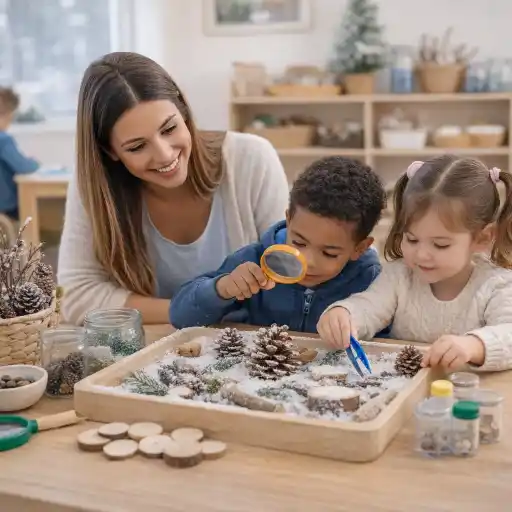
Begin with a low, supervised surface that does not block pathways or compete with a busy activity area. A shallow tray, reused box lid, basket, or section of a sturdy table can define the center. Use a neutral cloth or a piece of blue or white paper as a background, then arrange a few items with enough room for children to move them.
- Choose a small collection of sturdy, inspected natural objects, such as large pinecones, bark pieces, smooth stones, twigs, or evergreen clippings.
- Add everyday tools: magnifiers, plastic sorting bowls, recycled cardboard tubes, paper, crayons, and child-safe tongs.
- Use clear jars or sealed discovery bottles for objects that should be observed but not handled directly.
- Keep extra items in a labeled container and rotate only a few at a time to prevent visual clutter.
- Include a picture book, simple nature photographs, or children’s drawings to connect the objects with stories and prior learning.
Materials need not match a particular winter palette or style. Children’s local environment is a useful starting point: a branch from a familiar tree, a photograph of the playground in winter, or a container of clean ice can make the season relevant. A winter nature table can inspire a seasonal arrangement, while the goal here remains active, child-accessible investigation.
What invitations encourage children to explore winter?
Offer a simple invitation rather than a sequence of instructions. One open-ended question can sustain a surprising amount of inquiry when educators give children time to respond, notice their actions, and add vocabulary without taking over.
- 🌨️ “What do you notice about these two branches?” Invite children to compare color, shape, texture, and patterns.
- “Which objects feel smooth, rough, light, or heavy?” Encourage children to describe rather than guess a right answer.
- “What do you think will happen to this ice in our classroom?” Children can draw or dictate a prediction, then revisit it later.
- “Can you arrange these objects from shortest to longest?” Add a strip of paper or blocks as a nonstandard measuring tool.
- “What sounds might we hear outside in winter?” Connect listening, memory, and language through a short supervised observation near a window or outdoors.
Follow children’s attention. If they become absorbed in the way ice changes, provide a clear container and observe it over time; if they focus on animal tracks in a photograph, add picture cards or a related story. For young children, discovery is not a race to name facts. The educator’s role is to extend #curiosity through attentive conversation and meaningful opportunities to revisit a question. ChildCareEd’s article on winter seasonal science offers additional examples of winter investigations that can be adapted to a classroom setting.
How can activities be inclusive and developmentally appropriate?
One discovery center can welcome children with different ages, communication styles, sensory preferences, and physical abilities when it offers multiple ways to participate. An infant may watch light move through a sealed bottle while an adult narrates; a toddler may place large objects into a bowl; a preschooler may sketch, compare, or sort objects. These are all meaningful forms of engagement.
- Offer observation as a valid choice; children do not have to touch every material.
- Provide seated access, stable containers, easy-grip tools, and objects that are large enough for the children using the center.
- Pair spoken prompts with photos, gestures, picture choices, and home-language words where possible.
- Offer a quieter alternative for children who are sensitive to textures, smells, or group activity.
- Invite children to communicate through pointing, movement, drawing, sign, or dictation as well as speech.
Adjust the level of adult support to the group. Some children benefit from a single clear choice; others may be ready to create their own sorting system or explain a prediction. Respect family knowledge and local traditions when selecting seasonal images, stories, and objects, so the center reflects the children’s community rather than a one-size-fits-all idea of winter.
Small changes to the environment can help all children take part without making exploration feel like a test. As a practical extension, Building Early Science Foundations  Buy Now $16.00 explores ways to support young children’s inquiry through developmentally appropriate, play-based experiences.
How do you keep the center safe and manageable?
Natural materials are not automatically safe simply because they come from outdoors. Inspect each item and remove anything sharp, moldy, contaminated, unstable, or of uncertain origin. Avoid unknown berries, mushrooms, and plants. Consider allergies, mouthing behaviors, the ages of children, and any individual health or sensory needs. Keep small objects away from children who may place them in their mouths.
Active supervision continues throughout exploration. Position educators so materials and children remain in view, keep pathways clear, and establish a few consistent expectations, such as “materials stay on the tray” and “we wash hands after exploring.” Clean reusable items and surfaces according to program procedures, and store materials dry and protected between uses. If you use ice or water, plan for spills, safe temperatures, close supervision, and prompt cleanup.
- Do a quick daily check for damaged items, moisture, loose parts, and changes in children’s needs.
- Use sealed bottles when loose natural pieces are not appropriate for a child or group.
- Keep the center modest: fewer well-chosen materials are easier to supervise, clean, and refresh.
- State requirements vary - check your state licensing agency, especially for rules related to natural materials, small parts, sanitation, and supervision.
A reliable routine makes the center easier for staff to maintain and helps children know how to participate. The purpose of safety planning is not to remove every interesting challenge; it is to manage hazards while preserving thoughtful, developmentally appropriate discovery.
How can you connect discovery to curriculum and document learning?
Choose one or two learning intentions for the center, such as descriptive language, comparison, counting, prediction, or drawing from observation. Then let children’s actions and questions guide what happens next. If children group pinecones by size, you might introduce words such as larger, smaller, and similar. If they watch ice melt, you could invite them to revisit a drawing or describe what changed.
Documentation can be brief and useful. Record a child’s question, photograph a construction or arrangement, or write one sentence about a strategy the child tried. These observations can help educators plan a next step and give families a concrete glimpse of learning. Keep the record focused on what the child noticed, said, or did rather than assigning a label to the child’s ability.
- Notice: What do children return to, compare, or talk about?
- Respond: What material, word, book, or question could extend that interest?
- Revisit: Can children return to the experience, compare an earlier observation, or share what they learned?
Refresh the center as the season changes, but avoid replacing everything at once; familiar materials help children recognize change. For more ideas on bringing natural materials into varied programs, see ChildCareEd’s seasonal nature-based activities. Providers who want additional professional learning may also explore Creating the Natural Outdoor Classroom Buy Now $16.00, which focuses on planning nature-rich learning environments.
Conclusion: How can you begin a winter discovery center?
Start with one supervised tray, a handful of safe materials, and a question that invites children to notice. Everyday classroom supplies—paper, crayons, bowls, magnifiers, and recycled containers—can support comparison, language, early science, and creative expression when educators make time for children to explore and return to their ideas.
Keep the setup accessible, inclusive, and simple to maintain. Inspect materials, adapt participation for individual children, and document a brief observation to guide what you offer next. A winter nature discovery center does not need to be elaborate to be meaningful: its strength lies in children’s questions and an educator’s thoughtful response.
Related professional learning:
- Basic Science in Early Childhood Buy Now $25.00 — strategies for supporting science inquiry and reasoning.
- Building Early Science Foundations Buy Now $16.00 — play-based approaches to early exploration and discovery.
- Creating the Natural Outdoor Classroom Buy Now $16.00 — ideas for connecting children with nature-rich environments.
- Spaces that Support Discovery Buy Now $24.00 — designing learning spaces that encourage exploration.
- CDA: Curriculum Alignment & Materials Buy Now $16.00 — selecting materials for children’s needs and learning centers.
- CDA Certification en Español: Recursos y Consejos para Educadores Bilingües
- 💛🧩 ¿Cómo puedo hacer que mi enseñanza sea inclusiva para los niños con autismo?
- 👶 ¿Cuáles son las proporciones y grupos requeridos en Dakota del Norte? 🏫
- 🚌❤️ Ideas de excursiones en Illinois
- ¿Cuáles son las mejores actividades del Día de la Tierra para niños en casa o en el aula?
- 10 Ejemplos de Cómo la Cultura Influye en el Desarrollo Infantil
- Proporciones de Cuidado Infantil y Tamaños de Grupo por Edad en Maryland (Guía Rápida para Centros y Hogares)
- Proporciones de Cuidado Infantil y Tamaños de Grupo por Edad en Nueva Jersey (Guía Rápida para Centros y Hogares)
- Proporciones de Cuidado Infantil y Tamaños de Grupo por Edad en Virginia (Guía Rápida para Centros y Hogares)
- Cómo Ser Maestra de Preescolar en Maryland
- Las Mejores Ideas de Excursiones para Guarderías en Texas
- Celebrando la amistad en el cuidado infantil durante el Día de los Mejores Amigos
- Canciones, juegos y preguntas de círculo para niños
- How can I plant a classroom garden with preschoolers?
- What’s Happening Outside? Fall Science Adventures for Preschoolers
- ¿Todos los niños deben participar en el tiempo de círculo?
- What Should a Seasonal Learning Center Help Children Do Beyond Admiring the Decorations?
- How Can You Create a Cozy, Learning-Rich Winter Classroom on a Budget?
- How Can You Create a Winter Nature Discovery Center with Everyday Classroom Materials?
- How Can You Make Winter Classroom Activities Accessible for Children With Sensory and Mobility Differences?
