A child’s failed block tower, tangled zipper, or unexpected science result can become a powerful lesson when adults make room for another try. The ChildCareEd course Role of Play in Learning  Buy Now $16.00 helps providers connect play with children’s development and learning, offering a useful next step for strengthening classroom practice. Explore the course as you consider how thoughtful guidance can turn everyday challenges into opportunities for children to think, experiment, and grow.
Why does learning through trial and error matter?
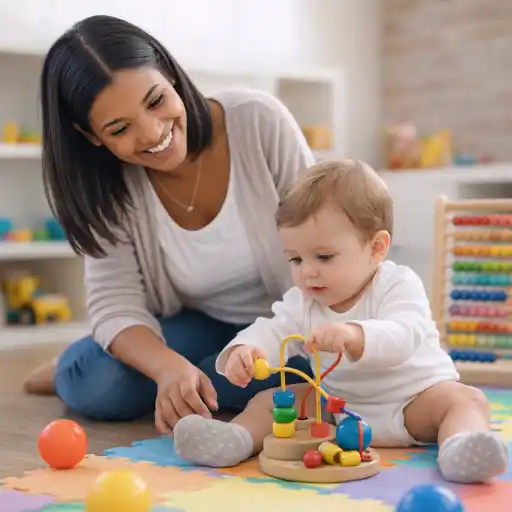
Trial and error is a natural way for children to discover relationships between their actions and what happens next. An infant kicks and watches a mobile move; a toddler turns a puzzle piece; preschoolers test which blocks will stabilize a bridge. Each attempt offers information, even when the result is not what the child expected. The Institute for Learning and Brain Sciences describes how children learn cause and effect through their own exploratory actions, rather than simply copying an adult’s demonstration.
These experiences support more than a correct answer. Children practice flexible thinking, attention, self-regulation, persistence, and communicating what they notice. NAEYC describes persistence with challenging activities as mastery motivation—a valuable disposition that educators can encourage with meaningful tasks, choices, gentle guidance, and feedback on children’s strategies.
For providers and directors, the goal is not to celebrate mistakes for their own sake or to leave children struggling alone. It is to create a supportive setting where a setback is manageable information: something happened, the child can notice it, and another approach may be possible. Warm relationships and predictable responses make it safer to take an intellectual risk. Over time, children can build #confidence, #curiosity, and the understanding that learning often involves revising an idea.
How can educators make everyday challenges productive?
Look for learning opportunities already present in play and routines rather than relying only on formal lessons. A collapsed tower, a spill, or a puzzle piece that will not fit can prompt a child to observe, form an idea, test it, and decide what to try next. The NAEYC guidance on mastery motivation and problem solving recommends a range of appropriately challenging activities, meaningful choices, and gentle guidance.
- Offer open-ended materials—blocks, fabric, cardboard, ramps, art supplies, and safe loose parts—that can be used in different ways.
- Set a purpose without prescribing the solution: “How could we make a path the car can travel along?”
- Protect enough uninterrupted time for children to test and revise ideas.
- Invite children to predict what might happen, then compare their prediction with what they observe.
- Use ordinary tasks, such as putting on a coat or organizing materials, as low-pressure opportunities to practice persistence.
Play-based challenges should be meaningful and developmentally appropriate. A child may need a simpler starting point, a visual cue, adapted materials, or a partner before a task feels accessible. Developmentally appropriate practice combines child choice with intentional planning, and it recognizes that children may investigate and communicate in different ways. Effective trial and error is not a race to complete a task; it is a sequence of trying, noticing, and adjusting.
How can adults guide without taking over?
Begin by observing. Is the child still engaged and trying strategies? Are they looking for help, feeling overwhelmed, or facing a barrier to participation? A brief pause—while maintaining supervision—can give the child space to think. The infant-and-toddler guidance from the ECE Resource Hub similarly encourages educators to support independence, acknowledge effort, and use open-ended questions instead of immediately supplying answers.
When a prompt would help, keep it brief and responsive. A descriptive comment can make the problem visible without judging: “The bridge moved when the car went across.” Then wait. Children may answer with words, gestures, movement, a home language, or another communication method.
- Observe: Notice the child’s goal, strategy, and emotional state.
- Name what happened: “That piece is not fitting there yet.”
- Prompt: Ask one open question, such as “What could you try next?”
- Scaffold if needed: Offer a small hint, a relevant tool, two choices, or a brief model.
- Return the task: Step back as the child resumes, while staying available and supervising.
Specific feedback makes the thinking visible: “You turned the piece and tried another opening.” Avoid taking over too soon or repeatedly asking questions that lead to an answer you have already selected. If frustration is rising, connect with the child, acknowledge the feeling, and help them regulate before inviting another attempt. Sometimes the most useful next step is a pause or a smaller challenge—not more prompting.
What activities help children practice testing and revising ideas?
Short, playful invitations can make trial and error a regular part of the day. Choose materials that allow more than one answer and invite children to observe what happens. The Edutopia article Failure as a Tool for Learning in Preschool offers examples such as simple experiments, art exploration, collaborative repair, and playful challenges that help normalize trying again.
- Build and test: Invite children to make a tower that stands or a bridge that a toy can cross. Ask what they notice when a design changes.
- Explore cause and effect: Provide safe objects and water, ramps, or other age-appropriate materials. Encourage children to predict, test, and describe results.
- Transform an accident: Offer washable art materials and ask whether an unexpected mark could become part of a new picture.
- Try a different way: Use puppets to act out a familiar problem, such as a toy that will not fit in a container, and invite children to suggest and test solutions.
- 🌟 Reflect together: Ask, “What did you try?” and “What might you change next time?” Children can answer by speaking, drawing, pointing, or showing their work.
Keep participation flexible. Some children may first watch, work alongside a peer, or explore with adapted tools. Use children’s interests, languages, abilities, and family knowledge to make the invitation relevant and accessible. The NAEYC guidance on developmentally appropriate practice emphasizes child agency, play, and responsive teaching that builds on each child’s assets. Keep materials safe and age-appropriate, and maintain active supervision during exploration.
How can educators respond to frustration and avoid common pitfalls?
Not every child experiences a difficult task as exciting. A child may feel embarrassed, angry, or worried about getting it wrong. Validate the emotion without suggesting that the child cannot cope: “You worked hard on that, and it feels disappointing that it fell.” Then offer presence and a manageable choice: “Would you like a little more time, a hint, or a short break?”
Adults can model a calm response to their own everyday errors: “I put the lid on the wrong container. I’ll check the label and try again.” This shows that mistakes can be noticed and addressed without shame. Praise the process specifically, not a fixed trait or a perfect outcome: “You tried a wider base after the first one tipped.”
Common pitfalls—and helpful alternatives—include:
- Fixing the problem immediately: Pause and observe first; offer the least support that helps the child continue.
- Calling every setback a success: Acknowledge disappointment honestly, then help the child identify what they learned or might try.
- Using vague or trait-based praise: Describe the child’s strategy, persistence, collaboration, or reflection.
- Making a challenge too difficult: Adjust materials, break the task into steps, or introduce a more accessible starting point.
- Expecting children to manage distress alone: Co-regulate and provide reassurance before coaching the next step.
Safety comes first: intervene promptly when a material or action creates a hazard. State requirements vary - check your state licensing agency for applicable supervision, safety, or training expectations. Consistency among staff also helps; directors can support teams in agreeing on a few shared phrases and reflecting on how children respond.
How can teams notice and strengthen children’s progress?
Brief, objective observations help educators see learning that may be missed if they record only whether a task was completed. Note what the child tried, what changed, what support was offered, and how the child responded. For example: “Jordan tested two block bases, asked a peer to hold the ramp, and tried a wider support.” This captures problem-solving and collaboration without labeling the child or judging the result.
Use observations to plan the next experience. If a child is ready for more challenge, add a new material or a gentle constraint. If the child repeatedly cannot begin, reconsider the setup, communication supports, task difficulty, or available time. Share strengths-based examples with families and ask which strategies or interests are familiar at home. These conversations can help connect classroom learning with everyday experiences such as cooking, building, or getting dressed.
Directors can make reflection practical through brief team huddles. Invite educators to share one example of children testing an idea and discuss whether to add, adapt, or remove a scaffold. The approaches-to-learning guidance from Head Start highlights curiosity, initiative, creativity, and self-regulation as related parts of how children engage in learning. For a deeper professional learning experience, explore these English-language ChildCareEd courses:
- Basic Science in Early Childhood Buy Now $25.00—explore inquiry and experimentation in early learning.
- Building Early Science Foundations Buy Now $16.00—consider play-based ways to support early exploration and discovery.
- Early Mathematics Through Play Buy Now $24.00—connect play with reasoning and problem-solving.
Conclusion: What are effective ways to help children learn from trial and error?
Effective support for trial and error combines safe, open-ended challenges with patient observation and responsive guidance. Give children time to act on their ideas, use prompts rather than immediate answers, and offer just enough help to keep a challenge manageable. When setbacks bring frustration, acknowledge the feeling and help children return to exploration when they are ready.
Notice and document the strategies children use—not only whether they reach a particular result. Adapt activities to support different abilities, communication styles, interests, and developmental levels, and share learning with families and colleagues. The central question is not how to prevent every mistake, but how to help children use what happens as information for their next attempt. With consistent, warm support, everyday challenges can nurture #problem-solving, #persistence, and a lasting sense of agency.
- CDA Home Visitor Subject Area 3 Part 3 Birth to 5
- Birth to Five CDA Credential with Portfolio Review
- Pediatric RSV First Aid & CPR/AED
- CDA Bridge Bundle: Family Child Care without Portfolio Review
- CDA Bridge Bundle: Infant/Toddler without Portfolio Review
- CDA Bridge Bundle: Preschool without Portfolio Review
- Emergent Learning & Development
- Creating Environments that Nurture Growth and Community
- Texas Director Credential
- Bienvenido! Welcoming All Families
- Beyond ABCs: Why ‘Loose Parts’ Play Is the Secret Sauce in Early Childhood Education
- CDA Certification en Español: Recursos y Consejos para Educadores Bilingües
- ❄️ ¿Qué actividades al aire libre funcionan bien para los niños de Illinois en cada estación? 🌷🍂
- Consejos de Supervisión Activa para Salones de Preescolar y el Juego al Aire Libre
- Retraso del Habla en la Guardería: Cómo Pueden Ayudar los Proveedores
- Celebrando la amistad en el cuidado infantil durante el Día de los Mejores Amigos
- How can I give constructive feedback to childcare employees?
- Lead Teacher vs. Assistant Teacher: What’s the Difference in a Child Care Classroom?
- How Can Child Care Providers Build Young Children’s Problem-Solving Skills?
- How Can You Create a “Yes Space” Where Infants and Toddlers Explore Safely?
- How Can You Correct a Mistake in a Family Update Without Damaging Trust?
- When Should Educators Demonstrate and When Should Children Experiment?
- Why Can a Child Match a Shape but Struggle to Rebuild It with Pieces?
- How Can Preschool Teachers Build Confidence in Children Who Are Afraid to Make Mistakes?
- How Can Toddlers Safely Adjust a Load Through Trial and Error?
- How Can Technology Support Children With Different Learning Needs?
- What Are Effective Ways to Help Children Learn From Trial and Error?
