A child may pass the same plant every day and still miss how much it has changed—unless we help them slow down and look closely. A simple, repeatable observation routine turns that plant into a living science investigation; Building Early Science Foundations  Buy Now $16.00 offers practical guidance for supporting young children’s curiosity, exploration, and inquiry. For more ideas to extend learning in nature, explore Creating the Natural Outdoor Classroom Buy Now $16.00; both courses can help you build purposeful outdoor experiences into everyday practice.
Small shifts—one new leaf, a taller stem, a flower opening—are easy to overlook amid a busy day. Yet revisiting one plant over time helps children see that careful attention can reveal change, and that questions can be explored with evidence. The Plant Watch Field Journal can give each visit a place to land: a drawing, a dictated observation, a date, or a simple measurement.
Why is returning to one plant such a meaningful learning experience?
Repeated visits make time visible. A single observation offers a snapshot; a series of observations lets children compare what they see now with what they remember seeing before. That comparison supports early scientific habits: attending closely, describing evidence, noticing patterns, and revising an idea when new information appears. As the University of Arizona Cooperative Extension explains in its guide to gardening with children in early care and education, gardening can provide hands-on opportunities to explore plant life cycles, make predictions, and track changes.
The experience is also relational. Children care for something living, share discoveries with peers, and practice patience when growth takes longer than expected. A plant study naturally brings together science, language, math, art, and social-emotional learning: children might count leaves, describe a stem, draw a flower, or take turns being the group’s observer.
Keep the goal modest. The point is not to make every visit a formal lesson or to guarantee a particular outcome. It is to create a dependable invitation to notice, wonder, and return. In that rhythm, the outdoor space becomes a place where children’s ideas matter and small changes become worth celebrating.
How can educators choose and introduce a plant for ongoing observation?
Choose one accessible plant that can be visited safely and regularly. It might be a sturdy garden plant, a container near the play area, or a seedling in a visible outdoor spot. Consider the local climate, available light, maintenance capacity, children’s access needs, and the plant’s suitability for the setting. Prioritize a known, identified plant and keep children from tasting or handling it unless the program has confirmed that doing so is safe and permitted.
Introduce the plant without delivering every fact at once. Invite children to look first, then ask what they notice. A few open-ended prompts can start a sustained investigation:
- “What do you see today that you didn’t notice before?”
- “What looks the same as last time?”
- “What do you wonder might happen next?”
- “How could we remember what we saw?”
Let the children help name the plant, choose a regular observation day, or decide where the journal will be kept. A consistent starting point—such as a weekly small-group visit—makes participation predictable without making it feel compulsory. Children who prefer not to touch soil can still observe, draw, point, describe, or help document what the group sees. The goal is access to the inquiry, not identical participation.
Gardening guidance from Penn State Extension’s Gardening with young children: Dig in! emphasizes helping children predict, measure, care for plants, and revisit their experiences. Those moves work especially well when educators treat the first visit as the beginning of a story, rather than a one-time activity.
What can children record in the Plant Watch Field Journal?
A useful journal supports expression at different developmental and language levels. Preschoolers do not need to write conventional sentences to document an observation. They can make marks or drawings, select a picture, point while an adult records their words, or contribute a photo with a brief caption. The journal is a record of thinking—not a test of drawing skill, spelling, or plant vocabulary.
Keep each entry simple enough to repeat. For example, children and educators might record:
- Date or visit number: When did the group observe?
- What I notice: A drawing, dictated phrase, or selected description.
- What changed: One comparison with the previous visit.
- Our question or prediction: What are children curious about now?
- Care notes: What the plant received or what weather conditions were noticed.
Use neutral, specific language. “The stem is taller than the mark from last week” gives children evidence to discuss; “The plant is happy” can be a child’s interpretation worth recording, followed by a question about what they observed. Nature-journal ideas from Great Stems’ guide to making a nature journal also show how drawings, descriptions, lists, and scientific data can all belong in a record of nature experiences.
Keep journals where children and staff can revisit them. Looking back at an earlier page helps children connect observations across visits and makes their thinking visible to families and colleagues. If a child’s drawing changes from a dot to a stem with leaves, treat that as meaningful representation of attention and learning—not as a picture to correct.
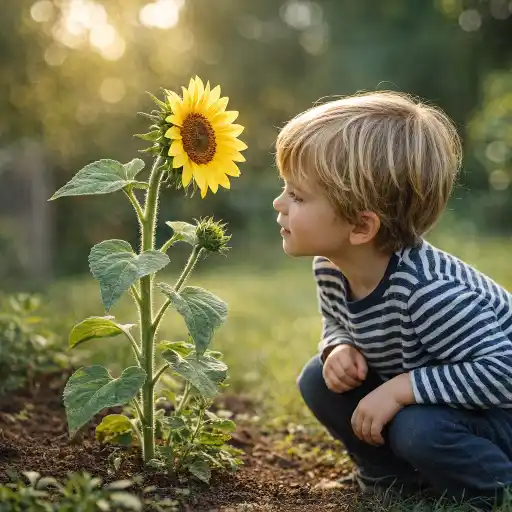
How can a repeated visit build observation, language, and early math?
Use a steady, brief routine: arrive, pause, look closely, share observations, record one or two details, and compare with the previous entry. A magnifier, child-safe ruler, or picture card may help, but the adult’s careful attention and open questions matter more than specialized equipment. Give children a quiet moment before prompting; a pause can reveal details that a quick question would interrupt.
As children observe, model precise, accessible words: bud, leaf, edge, smooth, spotted, taller, fewer, curled, or dry. Add vocabulary in context rather than quizzing. If a child says, “It got bigger,” you might respond, “You noticed it is taller. What helped you decide?” Accept home-language descriptions and invite peers to contribute words or gestures. This builds shared meaning while respecting the ways children communicate.
Early math can emerge naturally through comparison and representation:
- Count visible leaves or flower petals together.
- Compare plant height using the same non-invasive measuring method.
- Sort observations into “same” and “different.”
- Make a simple picture graph of what children noticed—new leaves, buds, or color changes.
Children’s questions can guide the next visit. If they wonder whether the plant changed after rain, revisit after wet weather and compare the journal entries. Avoid presenting a guess as a proven cause: instead, help children identify what they observed and what they might look for next. Project Learning Tree’s leaf activities for young learners demonstrate how close observation can connect science and math with art and language.
How can programs make the activity inclusive, safe, and sustainable?
Make the routine flexible enough for the children and staffing realities in your program. Offer several ways to participate: looking from a path, using a seated observation spot, drawing indoors from a photo, dictating an entry, or taking a turn as the group’s question keeper. Provide large-print images, visual prompts, adaptive writing tools, and accessible routes where possible. A child who watches quietly is still participating in observation.
Safety begins with knowing what is growing in children’s reach and planning supervision. Identify plants, check the area for hazards before visits, keep tools stored securely, and follow program procedures for allergies, handwashing, and outdoor access. Avoid assuming a plant is safe because it is familiar. State requirements vary - check your state licensing agency. The University of Arizona Cooperative Extension guide notes the value of considering plant and insect allergies, supervision, and avoiding toxic plants and chemicals in children’s garden spaces.
To keep the project manageable, choose a schedule staff can sustain—perhaps one short visit each week—and assign an adult to maintain the plant between visits. If the plant is damaged, wilts, or stops growing, do not treat that as a failed project. Children can document what happened, compare conditions, and discuss what the group might try next, while educators keep expectations realistic and compassionate.
Common pitfalls are usually fixable:
- 🌱 Rushing to explain: First record children’s ideas; then offer a small piece of information or a question.
- Expecting dramatic growth: Focus attention on small, observable differences and allow for periods with little visible change.
- Making the journal too adult-led: Preserve children’s words, choices, marks, and questions.
- Skipping continuity: Keep the plant and journal easy to find, and establish a realistic return schedule.
How can educators extend the inquiry and share children’s discoveries?
Let the journal shape next steps. When children notice a new leaf, educators can invite them to draw it more closely, compare it with an earlier drawing, or look at a child-friendly book about leaves. If they wonder about sunlight or rain, document that question and plan a simple observation—without changing multiple conditions at once or making claims the evidence cannot support. A child’s curiosity provides direction; educators provide time, materials, and thoughtful scaffolding.
Share the process with families, not only a final product. A short note might include a photo of the plant, a child’s exact observation, and a question the group is carrying forward. Invite families to share plant names or growing traditions from their cultures, or to notice a familiar plant together on the way home. Keep family contributions optional and respect different levels of access to outdoor spaces and gardening experience.
The journal can also support reflective practice among staff. Review entries periodically: Are children noticing more detail? Which prompts opened up discussion? Is the observation spot accessible? What did staff learn about children’s interests? These questions help directors connect everyday outdoor encounters to curriculum planning without requiring a burdensome assessment process. The broader resource collection from KidsGardening’s early childhood gardening lessons offers additional ways to link plant life cycles, plant needs, soil, and pollinators to ECE activities.
Above all, protect the pleasure of returning. Some visits will bring visible change; others may bring a new question, a visitor insect, or a child’s thoughtful silence. Each is a worthwhile entry in the group’s evolving understanding of the living world.
Conclusion: How does one plant become a lasting science investigation?
One plant becomes a meaningful investigation through repeated visits, open questions, simple documentation, and room for children’s ideas. A steady routine helps children compare observations over time, notice gradual changes, practice early science and math, build language, and develop patience and care for living things.
Choose a safe, accessible plant; make the Plant Watch Field Journal flexible and child-centered; and keep visits short enough to sustain. Record what children actually notice, revisit earlier pages, and let their questions inform what comes next. The aim is not perfect data or rapid growth—it is to help children recognize that careful looking can reveal change, and that their observations are worth remembering.
Explore relevant ChildCareEd courses
- Building Early Science Foundations Buy Now $16.00 — strategies for nurturing children’s curiosity and early scientific inquiry.
- Creating the Natural Outdoor Classroom Buy Now $16.00 — ideas for creating nature-rich outdoor learning environments.
- Basic Science in Early Childhood Buy Now $25.00 — approaches to everyday investigation and scientific reasoning.
- Tomorrow’s Einsteins: Infant and Toddler Science Buy Now $16.00 — ways to support inquiry among infants and toddlers.
- Enhancing STEM Education for Infants and Toddlers Buy Now $16.00 — strategies for integrating early STEM exploration into practice.
- 45 Hour Child Growth and Development
- Mental Health in Early Childhood
- 45 Hour Infant and Toddler Methods and Materials
- Pediatric RSV First Aid & CPR/AED
- CDA Bridge Bundle: Family Child Care without Portfolio Review
- CDA Bridge Bundle: Infant/Toddler without Portfolio Review
- CDA Bridge Bundle: Preschool without Portfolio Review
- Self-Regulation & Change: Helping Children Cope
- Texas Director Credential
- CDA Certification en Español: Recursos y Consejos para Educadores Bilingües
- 💛🧩 ¿Cómo puedo hacer que mi enseñanza sea inclusiva para los niños con autismo?
- 10 Ejemplos de Cómo la Cultura Influye en el Desarrollo Infantil
- Proporciones de Cuidado Infantil y Tamaños de Grupo por Edad en Nueva Jersey (Guía Rápida para Centros y Hogares)
- Proporciones de Cuidado Infantil y Tamaños de Grupo por Edad en Virginia (Guía Rápida para Centros y Hogares)
- Lista para Abrir una Guardería en Casa en Carolina del Norte: Cómo Empezar
- Lista para Guardería en Casa en California: Cómo Iniciar una Guardería en el Hogar
- Cómo Trabajar en el Cuidado Infantil en Carolina del Norte: Requisitos y Pasos
- How can I use STEM activities in my Preschool and Pre-K classroom?
- Celebrando la amistad en el cuidado infantil durante el Día de los Mejores Amigos
- Canciones, juegos y preguntas de círculo para niños
- La mejor manera de hacer seguimiento a la capacitación de su equipo de daycare How to Organize Staff Training for Your Child Care Center Cómo organizar la capacitación del personal para su centro de cuidado infantil
- Cómo simplificar la capacitación para sus empleados de daycare
- How Can We Teach Young Children to Care for the Environment?
- How Can Child Care Providers Make Outdoor Learning Meaningful, Safe, and Inclusive?
- How Does Counting Shapes Build Early Number Sense Through Play?
- How Can You Teach Young Children the Difference Between Living and Nonliving Things?
- How Can You Add Outdoor Learning Without Rebuilding the Playground?
- Where Did the Puddle Go? How Can Children Follow One Puddle Over Time?
- How Can One Plant Help Children Notice Gradual Change Outdoors?
