Working in a Minnesota child care setting means picking activities that fit children’s age, culture, and our local outdoors. This friendly guide gives clear, practical ideas you can use today for infants, toddlers, and preschoolers. You will find quick activity examples, simple planning steps, safety notes, and links to helpful ChildCareEd resources and Minnesota guides. Use these tips in your #classroom to make playful, meaningful days for your #infants, #toddlers, and #preschoolers while including #sensory experiences.
What activities work best for infants, toddlers, and preschoolers?
2. Toddlers (1–3 years) — Offer hands-on, repeatable stations: a rice or pasta scoop tray, push-and-pull toys, and simple block play. Keep routines short and predictable. ChildCareEd’s no-cost sensory ideas are great to adapt.
3. Preschoolers (3–5 years) 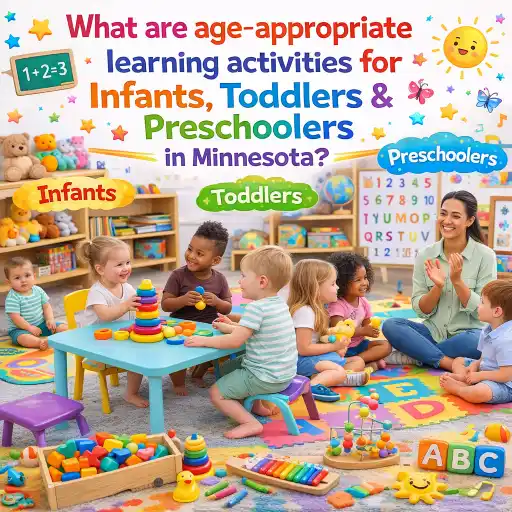 — Add open-ended projects that build language, math, and social play: process art, simple STEM challenges (ramp races or sink/float), and dramatic play centers. See 10 easy STEM ideas at ChildCareEd STEM ideas.
Quick setup tips (do these 3 steps):
- 🧺 Prepare materials in a labeled basket so you can swap quickly.
- 📏 Choose 1 learning goal for the day (language, motor, or social).
- 📷 Observe and note one child’s progress after the activity.
Why it matters: matching activities to age means children stay engaged and calm, and staff use time more effectively. For more sample lesson formats and quick templates, visit Early Childhood Lesson Plan Examples.
How do I use Developmentally Appropriate Practice (DAP) when planning?
2. Plan small, layered invites. For one activity, write:
- Goal (one sentence).
- Two entry levels (easier and harder).
- One way to document (photo or quick note).
3. Use observation-based assessment. The CDC milestone checklists help you know typical skills by age; link: CDC Developmental Milestones. Keep notes short: who, what skill, next step.
4. Include families and culture. Ask families about routines, home languages, and favorite songs. State requirements vary - check your state licensing agency. For templates and reflective planning tips, see How to Create Developmentally Appropriate Lesson Plans.
5. Adult role: observe, join in, ask open questions ("What do you notice?"), and add vocabulary. Offer two chances to try the same task so children can build mastery. A small coaching step for staff is to pick one DAP move per week to practice.
How can I make activities local to Minnesota and culturally responsive?
2. Include Indigenous perspectives. Use Ojibwe and Dakota PLT lessons and stories to add authentic local culture and language; see Ojibwe and Dakota PLT Lessons. Invite tribal storytellers if possible, and check resources that center on respect and living cultures.
3. Try seasonal, mixed-age invites (easy to adapt):
- 🍂 Fall leaf sorting: infants touch leaves, toddlers sort by color, preschoolers graph leaf types.
- ❄️ Snow play (or pretend snow inside): texture trays for infants, scoop-and-fill for toddlers, measurement experiments for preschoolers.
4. Use local food and traditions for nutrition or holiday weeks with ready activities from ChildCareEd’s Week of the Young Child Activities Buy Now $0.00. Always check families’ preferences and allergies.
How do I avoid common mistakes, document learning, and support inclusion?
Common mistakes and quick fixes:
- 😕 Too many goals at once — Fix: pick one clear goal per activity or day.
- 😬 Over-adulting play — Fix: observe first, then scaffold by asking a question.
- 😩 Large groups for tiny materials — Fix: use larger, safe pieces for group bins; reserve small parts for small groups.
Documentation: 1) Take one photo, 2) write one sentence of child words/skill, 3) note the next step. Use templates like the Infant and Toddler Weekly Lesson Plan Template on ChildCareEd or a simple STEM notebook. See math and sample lesson resources at Math Lesson Plan samples Buy Now $0.00.
Inclusion & supports:
- 🧩 Offer choices and adaptations (bigger crayons, tongs, calm corners).
- 🤝 Partner with families and specialists; consider assistive tech ideas in Assistive Technology Buy Now $0.00.
- 📚 Train staff: Minnesota ChildCareEd course options include Play, Learn, Grow
 Buy Now $16.00, and infant-focused trainings like Baby Play: Planning Infant and Toddler Activities Buy Now $16.00.
FAQ (quick):
- Q: How often should I offer sensory play? A: 2–4 short sessions per week works well.
- Q: Can I use food in sensory bins? A: Only with family permission and clear allergy checks.
- Q: How many goals per week? A: 1–2 focused goals keep plans realistic.
Conclusion
1) Pick small goals. 2) Use play as assessment. 3) Include local outdoors and culture. 4) Document one quick note. Minnesota offers rich seasonal and cultural resources—pair them with ChildCareEd lesson tools and CDC milestones to build strong, playable learning plans. State requirements vary - check your state licensing agency. Keep it simple, joyful, and practical—your care is the most powerful learning tool in the room. #classroom #infants #toddlers #preschoolers #sensory
1. Remember the three DAP checks: age-appropriate, individual-appropriate, and culturally-appropriate. Use short observations to guide choices—watch for interests for 5–10 minutes and pick one skill to support. See What Is Developmentally Appropriate Practice for clear steps. 1. Infants (0–12 months) — Keep it simple and sensory. Try 1–2 minute hand-play songs, a soft fabric touch bag, or a high-contrast board book corner. Use gentle "serve and return" talk and short tummy-time invitations. For planning ideas, see Lesson Planning for Infants and Toddlers. 1. Use the outdoors: Minnesota seasons give natural hooks. Do short nature hunts, leaf sorting, or a tree sensory table. The Minnesota DNR offers preschool outdoor lesson ideas and guides at Outdoor Lessons for K-12 students and PLT Early Childhood Activities at PLT Environmental Experiences.
- 45 Hour Child Growth and Development
- CDA Preschool Credential with Portfolio Review
- 45 Hour Preschool Methods and Materials
- Birth to Five CDA Credential with Portfolio Review
- 45 Hour Infant and Toddler Methods and Materials
- CDA Infant/Toddler Credential with Portfolio Review
- CDA Bridge Bundle: Infant/Toddler without Portfolio Review
- CDA Bridge Bundle: Infant/Toddler
- 45-Hour Infant and Toddler Curriculum
- Juneteenth History and Activities
- Boosting Language Through Play
- Recursos en Español sobre el Sueño Seguro del Bebé
- Proporciones de Cuidado Infantil y Tamaños de Grupo por Edad en Maryland (Guía Rápida para Centros y Hogares)
- What are age-appropriate learning activities for infants, toddlers & preschoolers in Michigan?
- What age-appropriate learning activities should we use for infants, toddlers & preschoolers in New York?
- How can I design age-appropriate lesson plans that really work?
- How Can Minnesota Childcare Providers Plan a Week of Activities for Mixed-Age Groups?
- How can you turn summer days into learning moments at your Minnesota program?
- Weekly Lesson Plans for Infants, Toddlers, and Preschoolers
- How can we set healthy screen-time limits in a Minnesota child care program?
- How do I choose age-appropriate toys and materials for my Minnesota program?
- What are Minnesota Child Care Ratios and Group Sizes by Age (Center + Home Quick Guide)?
- Mixed-Age Daycare Schedule: How to Plan a Day for Different Age Groups
- Hello, Fall! Cozy Activities to Help Babies Explore the Season
- No Playground Today! Rainy Day Activities for Kids All Ages.
- Proporciones para guarderías en casa bajo el Título 22: Cómo la mezcla de edades cambia su capacidad en California
- Nursery Snack Ideas by Age: What Can Babies, Toddlers, and Preschoolers Safely Eat?
- How Can Child Care Providers Set Age-Appropriate Expectations for Young Children?
- What Is Developmentally Appropriate Practice? Examples by Age
