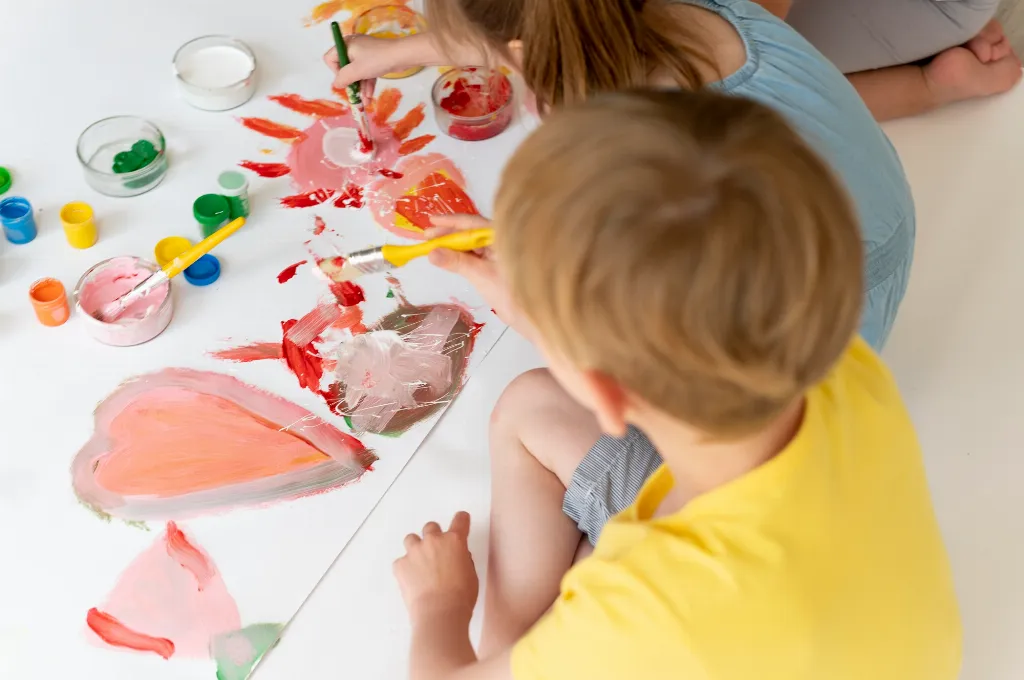
 Open-ended activities give children space to decide, try, and learn. These activities let your #preschoolers choose materials, make mistakes, and explore ideas. As a colleague working in child care, you know the big wins: deeper thinking, stronger language, and better social skills.
This article explains practical ideas you can try tomorrow, why it matters, how to keep children safe and included, and how to avoid common mistakes.
For more background on why play is powerful, see Why Open-Ended Play Is Essential for Healthy Child Development.
Why does open-ended play matter for learning?
Open-ended play grows thinking. When a child builds with blocks or mixes paint without a model, they make plans, test ideas, and solve problems. This is early STEM, backed by practical tips in Preschool STEM Activities for Hands-On Learning.
Open-ended play boosts language. Children tell stories about their play, use new words, and practice conversation. Techniques for encouraging talk in play areas (like the block center) are discussed in Telling Stories with Blocks.
Open-ended play supports social skills and #creativity. Kids negotiate roles, share ideas, and try roles like "chef" or "builder." Loose parts give lots of choices and are a low-cost way to spark creativity—see How can I use Loose Parts Play.
What simple open-ended activities can I set up tomorrow?
Try 1–2 new invitations this week. Small changes make a big difference. Here are easy ideas with quick setup steps and links to resources:
- 🎨 Open-ended art station
- Set out paper, washable paint, brushes, sponges, and loose parts.
- Invite: "Try making a sky that feels like music." For tips, see Open-Ended Art Activities.
- 🔧 Loose-parts discovery bin
- Fill a low bin with bottle caps, fabric scraps, corks, and boxes.
- Invite sorting, building, or storytelling. See Loose Parts Play for lists and safety tips.
- 🧪 STEAM tray
- Put cups, droppers, funnels, and a small water tub on a tray.
- Invite: "What happens if we mix these colors?" See hands-on ideas in Preschool STEM Activities.
- 📚 Story + props
- Read a short book and leave related props in the block or dramatic play area—this extends story to play (see the block-story link above).
Use the Imagination Basket Buy Now $0.00 for ready-made invitations and printable prompts. Keep materials reachable so children act independently and feel proud of choices. These invitations support #play and #learning.
How do I support learning, inclusion, and safety while keeping play open-ended?
Follow simple steps so all children can join and learn:
- 🧭 Plan the space
- Low shelves, labeled bins, and clear trays help children access materials independently.
- Rotate items weekly so interest stays high; fewer choices reduce overwhelm.
- 👀 Supervise and scaffold
- Observe first, then offer a single question or an extra loose part to extend play—this is called scaffolding. For teacher roles and observation tips, see Facilitating Learning in the Preschool Classroom Buy Now $35.00.
- ♿ Adapt for inclusion
- Make small changes (bigger tools, picture prompts, extra time) so children with different needs join in. See Adapting Activities for Children with Developmental Delays.
- 🛡️ Safety checklist
- Inspect loose parts for sharp edges; remove choking hazards for infants and toddlers.
- State rules: state requirements vary - check your state licensing agency.
Document learning simply: take a photo, write a short child quote, and note one next step. Use photos to show families how play builds skills and to reduce questions about "why it's messy."
How do I measure success, avoid common mistakes, and involve families?
Use simple tracking and clear communication so staff and families see the learning behind play.
- Measure with observation
- Note 1–2 goals per child (e.g., new words, taking turns).
- Record a photo + a short caption or child quote—fast and powerful.
- Common mistakes & how to avoid them
- ❌ Overfilling shelves — ✅ Rotate and offer 1–2 baskets at a time.
- ❌ Over-directing play — ✅ Ask open questions and let children lead.
- ❌ Skipping safety checks — ✅ Quick item inspections and age-appropriate bins.
- Involving families
- 📸 Send one photo a week with a short note about what the child explored.
- 📦 Invite safe donations (clean materials) and share rules for donations.
- 🗣️ Explain benefits: link to staff or parent-facing pages like Open-Ended Art to show how play builds confidence.
- FAQ (short)
- Q: How long should play blocks be? A: 10–40 minutes depending on age and focus.
- Q: Will parents want crafts? A: Offer occasional product projects for gifts and explain the learning behind daily open-ended work.
- Q: How often rotate materials? A: Every 2–6 weeks or when interest drops.
Try one small change this week: add a single loose-parts basket or an open art tray and watch what children invent. That small step supports #creativity, #play, #learning, #classroom, and #preschoolers growth. For training and more step-by-step guidance, check courses like The Best Promotion is Play Buy Now $35.00 or Art from the Heart.
Summary
1. Open-ended activities build thinking, language, and social skills. 2. Start small: one tray, one bin, one question. 3. Use observation, simple documentation, and clear family communication. 4. Make safety and inclusion routine—state requirements vary - check your state licensing agency.
You are doing important work. Small invitations to play give children big chances to learn. Share your successes with your team and try one new open-ended invitation this week.
- CDA Home Visitor Subject Area 3 Part 3 Birth to 5
- CDA Home Visitor Subject Area 2 Part 3 Birth to 5
- Building Equity: Inclusionary Practices in Preschool
- Birth to Five CDA Credential with Portfolio Review
- Open Ears: Listening in Child Care
- CDA: Special Needs: Understanding the Whole Child
- Art from the Heart for Preschoolers: Open Ended Art Projects that Build Self-Esteem
- CDA Bridge Bundle: Preschool without Portfolio Review
- Playful Spaces for Infants & Toddlers
- Every Moment Matters: Schedules and Transitions
- Learn to Use Open Ended Questions to Find Out About Your Child's Day
- CDA Certification en Español: Recursos y Consejos para Educadores Bilingües
- What new child care news should Pennsylvania providers know now?
- How can I use STEM activities in my Preschool and Pre-K classroom?
- A Simple Guide to Toddler and Preschool Lesson Plans
- Celebrando la amistad en el cuidado infantil durante el Día de los Mejores Amigos
- What Does Oklahoma’s 2026 Child Care Funding Mean for Providers and Families?
- Open-Ended Preschool Activities for Creativity, Language, and Social Skills
- Is Oklahoma’s subsidy expansion a win for working families?
- What Should You Do When a Preschooler Has a Meltdown in the Classroom?
- How Can Flag Design Help Children Explore Symbols, Patterns, and Individual Expression?
- How Can You Plan Patriotic Crafts Without Limiting Children’s Creativity?
- How Do Cut-and-Paste Activities Build Fine-Motor Control and Planning?
- How Can a Simple Watermelon Craft Build Fine-Motor and Language Skills?
- How Can Low-Prep Christmas Activities Build Preschoolers’ Visual Planning?
- What Should Preschool Educators Do When an Activity Finishes Early?
- What Should You Do When a Child Wants to Remove Their Contribution from Group Artwork?
- How Can Educators Respond When a Child Says Their Drawing Is “Nothing”?
- How Can Child Care Providers Recognize Children’s Effort Without Competitive Classroom Awards?
- What Should You Say When a Child Tells a Teacher “I Hate You”?
