A pretend stream can turn a few stepping-stone mats into a lively lesson in movement, decision-making, and spatial language. Explore practical ways to set up an inclusive, safe route—and consider Balancing Physically Active Play in Child Care Buy Now $25.00 to strengthen your planning for active, creative, and quieter experiences across the day. As you read, you’ll find ideas for helping preschoolers map a path, try it, and adapt it at their own pace.
Why does planning a pretend stream route matter?
When a child studies a path across a pretend stream, the challenge is not simply to reach the other side. The child is noticing distance, choosing where to place a foot, remembering an order, and adjusting when a stepping stone seems too far away. This links gross-motor practice with early problem-solving and spatial reasoning. Movement also gives concrete meaning to words such as between, beside, around, and across.
These skills grow through playful repetition rather than a single “right” performance. Children may pause to plan, follow a friend’s route, or invent a new way across. Such variation gives educators useful information about interests, confidence, and the supports that help each child participate. The CDC notes that physical activity supports children’s muscular fitness, attention, and memory; an active play invitation can therefore contribute to learning beyond the movement itself.
Keep the purpose broad and child-centered. The goal is not to test balance or see who crosses fastest. It is to offer a meaningful challenge in which children can practice body control, choice, communication, and persistence. A stream story adds an imaginative reason to move, while the route provides a natural setting for children to make and explain a plan.
- Build #balance and coordination through deliberate stepping.
- Connect actions with #spatial words and route sequences.
- Encourage #planning, flexible thinking, and turn-taking.
How can you prepare a clear and safe stepping-stone path?
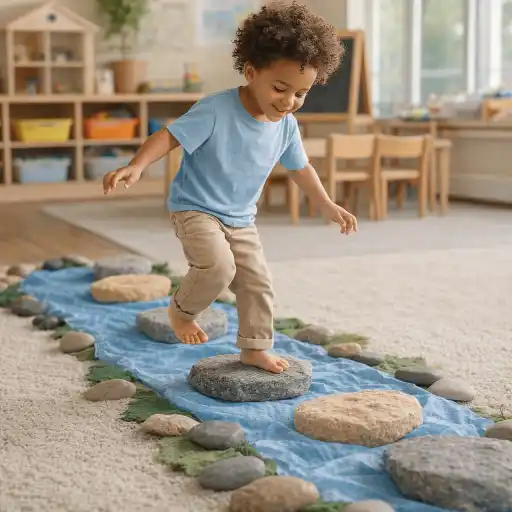
Begin with a short route of a few large, stable stepping-stone mats on a level surface. Leave enough space around the activity for children to move without crowding furniture or one another. Mats should lie flat, stay in place, and be appropriate for the children and setting. Before play, inspect the floor and materials for moisture, damage, slipping, or tripping hazards. Walk the route yourself and check sight lines from the position where you will supervise.
Use a simple story to establish the idea: “The leaves have made a stream, and the animals need a path to the other bank.” Add large autumn-colored picture markers or fabric leaves if they are safe for your group. Keep props out of the walking path unless they are intentionally part of the route. Set a clear start and finish and teach a familiar pause signal before children begin.
Active supervision means staying engaged, positioning yourself to see and hear children, and anticipating what could happen next. Organize turns in a way that limits waiting; small groups or parallel routes may work better than a long line. Follow program policies and applicable guidance. State requirements vary - check your state licensing agency.
- Start with stones close together; adjust spacing only after observing children.
- Keep the route visible and uncluttered, with a clear waiting area.
- Offer a walk-around option, a toy-animal route, or a chance to point and direct.
- 🧡 Invite children to help place safe, large markers while adults make final safety checks.
How do you help children plan and describe their steps?
Show the route slowly before inviting children to try it. Pair movement with concise language: “Step to the yellow stone, then the leaf-shaped one, and then the bank.” Point to each marker as you name it. Begin with two or three steps; a long sequence can overload working memory and reduce the playful quality of the activity.
Then give children time to make a plan. They might name the next stone, point to it, gesture, use picture cues, or move a toy animal along the route first. Ask open prompts that make room for different solutions: “Where could the fox step next?” “What do you notice about the space between these stones?” or “How might you get across without stepping on the blue one?” Wait before offering an answer; a pause can give children time to observe, think, or communicate.
Model positional vocabulary in context rather than turning the game into a vocabulary quiz. Describe what the child does: “You stepped between the two leaves,” or “You chose the stone beside the tree.” Add one new word at a time and use gestures, photos, or simple drawings to support understanding. If children speak different home languages, include familiar words when possible and invite families’ language knowledge. For related route-play ideas, see a pretend animal burrow that combines fall movement with route planning.
- Ask children to show, tell, or point to their route before moving.
- Use prompts such as “What could you try next?” rather than correcting every choice.
- Describe effort and strategy, not speed or “perfect” balance.
How can you adapt the activity so every child can take part?
Inclusive movement planning begins with multiple valid ways to join. A child might walk across the mats, step beside them, move a toy, point out a route for a partner, or watch before deciding to participate. Offer choices without implying that one option is more successful or desirable. A child who prefers not to cross can still take part in route planning, storytelling, or describing where the animal should go.
Adapt the environment and challenge in response to children’s needs and interests. Bring mats closer together, widen the pathway, reduce the number of steps, add picture arrows, or provide a steady support nearby when appropriate. Consider sensory preferences, mobility, communication styles, and the amount of processing time children need. Keep instructions short and demonstrate actions; visual cues can make the sequence easier to follow.
Offer small-group turns to reduce noise and waiting, and avoid comparing children’s movement. Notice what helps each child engage: a familiar peer, a choice of route, a quieter space, or the chance to lead. The ChildCareEd course Inclusive Lessons for Preschoolers  Buy Now $16.00 can help educators build further knowledge about adapting materials and lesson plans for varied learners.
- Provide more than one route or way to complete the pretend crossing.
- Let children choose to walk, point, guide a toy, or take an observing role.
- Use accessible communication supports, including gestures, pictures, and home-language words.
- Celebrate curiosity, persistence, and cooperation rather than completion time.
How can you extend the play without making it too complicated?
Let children’s interest guide the next step. If they enjoy the route, invite them to rearrange one or two mats and predict how the new path will feel. Add a simple destination—perhaps a woodland animal’s den—or ask children to design a second path for a different animal. A child may draw a quick map, arrange picture cards in sequence, or guide a peer through the route using positional words.
Connect movement with other learning naturally. Children can count the stones, compare which gaps look wider, notice autumn colors, or create a shared story about the animals crossing. The movement remains central, but language, early math, collaboration, and imagination can enrich the experience. Avoid adding several new rules or props at once; too many demands can make route planning harder to understand.
After a turn, invite brief reflection: “What was your plan?” “Did you change anything?” “Which stone came first?” Children can answer with words, gestures, a drawing, or another demonstration. Record a descriptive note about strategies or vocabulary you observed, rather than ranking children. For broader planning about balancing active play with other parts of the day, explore Balancing Physically Active Play in Child Care Buy Now $25.00.
- Change one feature at a time, such as the route’s shape or destination.
- Use children’s ideas to create a new path or story together.
- Keep turns short and give children time to repeat a route if they wish.
- Reflect on what helped participation and what you might adjust next time.
What common pitfalls should educators avoid?
A route can lose its purpose if it becomes a race, an obstacle course with too many parts, or a test of who can balance best. Preschoolers benefit from opportunities to plan, explore, and repeat; they do not need pressure to move quickly. Keep the route manageable, make waiting periods brief, and use descriptive encouragement rather than public comparisons.
Another common pitfall is assuming that every child should use the same movement or follow the same sequence. A flexible invitation respects individual comfort and ability while preserving the core goal: children engage with movement and route decisions. Avoid giving so many verbal directions that children cannot remember them. Demonstrate, use a few clear cues, and let children take the lead when it is safe.
Finally, do not let the story distract from supervision. Check mats and flooring before each use, maintain clear visibility, and respond promptly to signs of fatigue, discomfort, or crowding. Make adjustments when a challenge is too easy, too difficult, or unsafe. Keep the experience joyful and responsive; thoughtful simplicity often supports richer learning than an elaborate setup.
- Avoid: long lines, competitive timing, unstable mats, and crowded pathways.
- Instead: use small groups, flexible routes, clear cues, and active supervision.
- Remember: state requirements vary - check your state licensing agency.
Conclusion: What helps preschoolers plan their way across a pretend stream?
Preschoolers plan their steps most effectively when the route is clear, playful, and flexible. Prepare a short, safe path; model movement and positional language; then give children time and choices to plan, try, and revise. Stepping-stone play can support balance, spatial reasoning, communication, and cooperation when the experience follows children’s ideas rather than requiring a single correct performance.
Make participation meaningful in more than one way, supervise actively, and adjust the challenge to fit the group. The Autumn Stepping-Stone Route Mats can provide a visual starting point for a seasonal crossing, while children supply the story, choices, and strategies. To develop a broader approach to scheduling purposeful movement, consider the relevant ChildCareEd course, Balancing Physically Active Play in Child Care Buy Now $25.00. The central question—how can children plan their way across a pretend stream?—is answered through safe preparation, thoughtful language, inclusive choices, and space for exploration.
References
- HeadStart.gov: Gross Motor
- The Inspired Treehouse: Using Stepping Stones for Balance & Other Skills
- CDC: Health Benefits of Physical Activity for Children
- NAEYC: Eliminate Barriers to Risk Taking in Outdoor Play
- HeadStart.gov: Keep Children Safe Using Active Supervision
- ChildCareEd: Gross Motor Activities That Build Balance, Coordination, and Strength
- ChildCareEd: Pretend Animal Burrow and Fall Route Planning
- ChildCareEd course: Balancing Physically Active Play in Child Care Buy Now $25.00
- ChildCareEd course: Inclusive Lessons for Preschoolers Buy Now $16.00
Explore related ChildCareEd courses
- 45 Hour Child Growth and Development
- Diversity, Equity, and Inclusion in Education: For Workforce Solutions
- What Makes Me Special: An Overview of Autism and ADHD
- Children at the Wheel: Emergent Curriculum
- Pediatric RSV First Aid & CPR/AED
- Diversity, Equity, and Inclusion in Education
- Lesson Planning for Preschoolers
- Building Bridges for Dual Language Learners
- Wellness in Action: Teaching Healthy Habits to Children
- CDA Certification en Español: Recursos y Consejos para Educadores Bilingües
- Celebra El Cumpleaños de Dr. Seuss En Tu Guardería Con Actividades Fáciles y Divertidas!
- Recursos en Español sobre el Sueño Seguro del Bebé
- ¿Cómo obtengo la certificación CDA en línea en Florida?
- 10 Ejemplos de Cómo la Cultura Influye en el Desarrollo Infantil
- Cómo Empezar una Guardería en Casa: Requisitos y Pasos
- ¿Cómo solicito la licencia para una guardería en California?
- Proporciones de Cuidado Infantil y Tamaños de Grupo por Edad en Maryland (Guía Rápida para Centros y Hogares)
- Proporciones de Cuidado Infantil y Tamaños de Grupo por Edad en Nueva Jersey (Guía Rápida para Centros y Hogares)
- Proporciones de Cuidado Infantil y Tamaños de Grupo por Edad en Virginia (Guía Rápida para Centros y Hogares)
- Actividades de Otoño Fáciles para Preescolares esta Temporada
- Ejemplos de Crianza Respetuosa vs. Crianza Permisiva
- Cómo Trabajar en el Cuidado Infantil en Carolina del Norte: Requisitos y Pasos
- Cómo Ser Maestra de Preescolar en Virginia
- Celebrando la amistad en el cuidado infantil durante el Día de los Mejores Amigos
- Canciones, juegos y preguntas de círculo para niños
- Cómo simplificar la capacitación para sus empleados de daycare
- Why Does a Child Become the Rule Keeper When an Adult Joins Play?
- How Can You Build a Pretend Animal Burrow That Combines Fall Movement With Route Planning?
- How Can Preschoolers Plan Their Steps Across a Pretend Stream?
