When indoor energy rises, a few intentional minutes of movement can help children reconnect, practice self-regulation, and return to learning ready to participate. The Creating Engaging and Meaningful Learning Experiences  Buy Now $55.00 course can help you turn activity cards and everyday routines into developmentally appropriate experiences while strengthening your planning skills and professional knowledge.
Why Does Movement Belong in Every Preschool Day?
Movement is not an interruption to learning; it is one of the ways young children learn. Running, hopping, balancing, crawling, reaching, and dancing help children develop coordination, spatial awareness, strength, and body control. Movement also creates opportunities to practice language, cooperation, attention, and emotional regulation.
The CDC recommends that children ages three to five remain physically active throughout the day. Minnesota guidance describes a combination of structured and unstructured activity for preschoolers, while recognizing that programs must consider individual needs, available space, weather, and local regulations. State requirements vary - check your state licensing agency.
Short movement experiences are especially practical for child care providers. A two-minute action before circle time may prevent a long struggle with sitting still. A movement transition can make cleanup more predictable. A card-based activity can give children choices while allowing teachers to observe interests and abilities.
- Supports #preschoolers’ gross-motor development.
- Builds attention, listening, and self-regulation.
- Creates joyful opportunities for peer interaction.
- Helps children experience competence: “I can try that!”
How Can Indoor Movement Activity Cards Make Planning Easier?
Indoor Movement Activity Cards provide a simple prompt when you need an engaging idea quickly. Instead of searching for a new activity during a busy day, place a small deck in a movement basket and select one card during transitions, indoor recess, or a planned activity block.
Use cards as invitations rather than rigid scripts. Read the prompt, model the movement, and allow children to interpret it. For example, “Move like an animal” might become a frog jump, a penguin waddle, or a slow turtle walk. Children can select the next card, demonstrate an action, or suggest a variation. These choices support independence and leadership.
A useful card routine includes:
- Preview: Check the space, materials, and developmental fit.
- Model: Demonstrate slowly and name the safety expectation.
- Move: Offer a short round, usually one to five minutes.
- Reflect: Ask, “What did your body do?” or “What helped you balance?”
Cards can also support documentation. Note which movements children repeat, which adaptations help, and which vocabulary emerges. That information can guide future planning rather than treating movement as a disconnected break.
Which Simple Activities Can You Try Tomorrow?
Effective indoor movement does not require a gym or expensive equipment. Clear a defined area, use soft materials, and choose activities that can be adjusted easily.
- 🎵 Freeze and Flow: Children move while music plays and freeze when it stops. Add prompts such as “freeze tall” or “freeze with one hand touching the floor.”
- Tape Pathways: Make straight, curved, zigzag, or spiral paths with painter’s tape. Children may walk, tiptoe, step sideways, or carry a beanbag.
- Animal Parade: Invite children to hop like rabbits, stomp like elephants, crawl like bears, or glide like butterflies. For a butterfly-themed movement extension, pair the gliding game with hands-on activities for National Learn About Butterflies Day that explore the butterfly life cycle.
- Target Toss: Toss soft beanbags into baskets. Move the target closer or farther to adjust the challenge.
- Indoor Hopscotch: Use tape, carpet squares, or cardboard shapes. Add colors, numbers, or letters for an optional learning connection.
- Mirror, Mirror: A teacher or child leads slow movements while partners copy. This builds observation, coordination, and connection.
ChildCareEd’s gross motor activity guide offers additional low-preparation ideas, including balloons, obstacle courses, movement stories, and scavenger hunts.
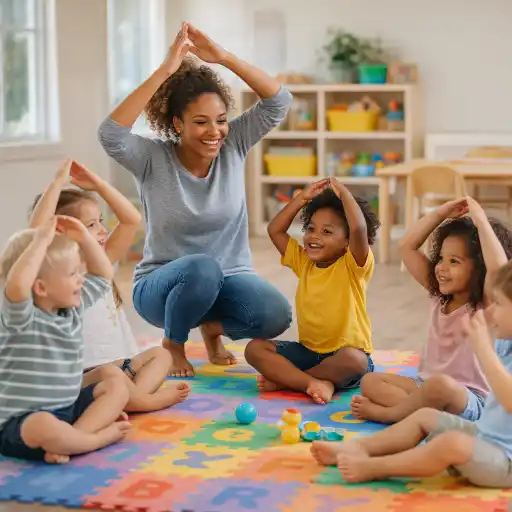
How Can You Connect Movement to Meaningful Learning?
Movement becomes more meaningful when it reflects children’s interests and connects naturally to the curriculum. The goal is not to make every game a worksheet in disguise. Rather, use movement to deepen experiences already happening in the classroom.
- Language: Practice positional words such as over, under, beside, through, near, and far.
- Math: Count jumps, compare distances, recognize shapes, or create movement patterns.
- Science: Move like weather, observe how bodies change speed, or explore balance and gravity.
- Literacy: Act out a story’s characters and sequence events through movement.
- Social-emotional learning: Practice stopping, waiting, taking turns, encouraging peers, and calming the body.
For example, after reading a story about a journey, children might follow a card sequence: climb a mountain, cross a bridge, crawl through a tunnel, and rest beside a pretend campfire. Ask open-ended questions: “How could we cross another way?” “Which movement felt slowest?” “How did your group help one another?”
Research summarized in the Early Childhood Education Journal indicates that energetic play can support self-regulation when educators model active behavior, scaffold participation, and connect movement with meaningful learning. Your presence matters: joining children communicates that movement is valued.
How Can You Keep Movement Safe and Inclusive?
Before beginning, inspect the environment. Remove loose toys, spills, and sharp or unstable objects. Mark boundaries with tape or floor spots, establish one stop signal, and position yourself where every child remains visible. Active supervision includes watching, listening, anticipating risks, and interacting with children.
Inclusion means providing more than one legitimate way to participate. A child may walk instead of hop, roll instead of throw, move while seated, use a wall for balance, or observe before joining. These options preserve agency and reduce unnecessary pressure.
- Offer choices: “Would you like to crawl or step?”
- Use larger, lighter, softer, or textured equipment when appropriate.
- Reduce waiting by using stations or small groups.
- Pair spoken directions with pictures, gestures, and demonstrations.
- Adapt sound, speed, distance, and intensity for sensory or physical needs.
Avoid eliminating active play as punishment. Children may need movement to regain regulation, and a calm-down routine can help them transition afterward. For further support with individualized participation, explore Inclusive Lessons for Preschoolers Buy Now $16.00.
How Can Directors Build Movement into the Daily Schedule?
Consistency makes movement easier for both adults and children. Directors can place activity cards in accessible baskets, include movement goals in lesson-planning templates, and encourage staff to share successful adaptations during team meetings.
A practical daily rhythm might include a five-minute tape pathway during arrival, a two-minute card before circle time, outdoor active play, and a quiet stretching card before rest. Movement can also be embedded in routines: march to handwashing, carry materials to centers, or move like a chosen animal during transitions.
Keep brief notes about children’s participation:
- Which movements does each child choose?
- Can children follow one- or two-step directions?
- Do they wait, take turns, and encourage peers?
- What equipment or cue makes participation easier?
Use observations to refine planning, not to rank children. The Balancing Physically Active Play in Child Care Buy Now $25.00 course offers practical guidance for balancing active, creative, and quieter experiences. For safety-focused professional learning, consider Active Supervision: A Strategy That Works Buy Now $35.00.
Conclusion: What Are the Simplest Ways to Add Movement?
Simple movement belongs throughout the preschool day because children’s bodies and minds develop together. Indoor Movement Activity Cards can make implementation manageable: choose one prompt, prepare a safe space, model the action, offer adaptations, and reflect briefly with children.
The most effective approach is frequent, playful, and responsive. Use tape pathways, freeze games, animal movements, target tosses, stories, and songs. Connect activities to children’s interests without over-directing them, and celebrate effort rather than performance.
- Plan short movement moments across the day.
- Use cards as flexible invitations, not fixed tests.
- Offer multiple ways for every child to participate.
- Supervise actively and follow local requirements.
- Observe children’s choices to improve future planning.
To deepen your ability to design purposeful, developmentally appropriate experiences, explore Creating Engaging and Meaningful Learning Experiences Buy Now $55.00. With a few accessible materials and a supportive mindset, movement can become one of the most joyful parts of your classroom routine.
- 45 Hour Preschool Methods and Materials
- Bienvenido! Welcoming All Families
- Engaging Indoor Activities for Inclement Weather
- Pediatric RSV First Aid & CPR/AED
- 45 Hour School Age Methods and Materials
- Potty Training Made Simple
- Sensitive Periods in Montessori: Guiding Natural Learning
- Texas Director Credential
- Wellness in Action: Teaching Healthy Habits to Children
- Preventative Health and Safety
- Gross Motor Activities for Preschoolers: Games That Build Big Skills
- Easy New Year’s Day Activities for Kids (Crafts, Games, and Movement)
- Indoor and Outdoor Gross Motor Activities for Kids
- How can child care programs boost physical activity for young children?
- Celebrando la amistad en el cuidado infantil durante el Día de los Mejores Amigos
- How can I create a daily schedule that meets Michigan's active learning expectations?
- How Can My Child Care Program Better Support Children with Special Needs?
- Get Moving: How Can Child Care Programs Build Physical Activity Into the Daily Routine?
- Preschool Classroom Schedule: A Full-Day Example from Arrival to Pick-Up
- Preschool Schedule That Works: When to Plan Centers, Circle Time, and Outdoor Play
- Kindergarten Songs for Circle Time: 15 Sing-and-Move Ideas That Sneak in Learning
- How Can Child Care Providers Create a Preschool Schedule That Supports Learning and Well-Being?
- How Can Preschool Routines Create Calmer, More Independent Classrooms?
- How Can You Add Simple Movement to the Preschool Day?
- How Can Printable Activities Save Teachers Hours of Prep Time?
- Is Your Preschool Day Too Sedentary—and How Can You Tell?
- How Long Should Circle Time Be for Preschoolers?
- What Should a Daily Preschool Schedule Include?
- Screen-Free Activities for Short Gaps in the Preschool Day: What Works?
- How Can You Teach Action Words Through Everyday Preschool Routines?
