Spatial awareness grows when children get to move, build, explore, and talk about where things are. Add practical ideas to your classroom routine—and deepen your teaching strategies with Early Mathematics Through Play Buy Now $24.00, a course that connects geometry and other early math concepts to hands-on activities. You can also explore Balancing Active Play in Child Care  Buy Now $16.00 for approaches to planning movement experiences alongside quieter parts of the day.
What does spatial awareness mean, and why does it matter?
Spatial awareness is a child’s developing understanding of where their body and other people or objects are in relation to one another. It includes noticing position, direction, distance, size, and how objects fit together. A child navigating around a chair, reaching for a cup, or placing a puzzle piece is practicing spatial skills in an everyday context.
These abilities support safe movement, coordination, communication, and problem-solving. Spatial language—words such as “under,” “between,” “beside,” “near,” and “far”—helps children describe what they notice and understand directions. Spatial thinking also supports early geometry and other math learning; research summarized by the OECD links playful experiences with shapes, puzzles, and construction toys to spatial skill development and STEM learning.
For providers, the encouraging news is that this learning does not require special equipment or a separate lesson every day. Ordinary routines and child-led play offer repeated opportunities to explore relationships in space. Children develop at different rates, so the aim is to offer varied, welcoming practice rather than expect identical performance from everyone.
How can everyday language make spatial ideas easier to learn?
Children hear and use spatial concepts throughout the day. Make those moments intentional by naming locations and describing movement as it happens. Instead of saying only, “Put the blocks away,” try, “Place the blocks inside the basket,” or “Put the long block beside the short one.” During transitions, try “Walk around the table” or “Stand behind your friend in line.”
Keep directions clear and connect words to objects children can see or touch. When a child follows a direction, invite them to explain what they did: “Where did you put the bear?” If they are not ready to answer verbally, gestures, pointing, or demonstrating are meaningful ways to participate. Repeat key words in varied situations so children learn that “under” describes more than one object or place.
- Use location words naturally during meals, cleanup, dressing, and play.
- Ask open questions: “What is next to the ramp?” or “How could we get around the blocks?”
- Pair spoken cues with gestures, pictures, or a demonstration when useful.
- Offer words in children’s home languages when possible, and welcome their own descriptions.
Spatial language can support both learning and connection: the adult is not quizzing, but noticing and thinking alongside the child.
Which play activities build spatial awareness through movement?
Movement games let children feel spatial relationships with their whole bodies. Set up a simple, supervised course with floor markers, cushions, or sturdy low equipment. Invite children to crawl through a tunnel, step over a line, walk around a cone, or move between two markers. Describe actions as children go, then give them a turn to choose the route or explain how to move.
Games such as “Simon Says,” “Red Light, Green Light,” and action songs offer another low-preparation option. Try cues such as “Reach above your head,” “Put your hands behind your back,” or “Take one step toward the doorway.” Outdoor walks can become small explorations: find a tree beside the path, notice what is far away, or follow a curved route back to the play area.
- 📍 Make a taped pathway with straight, curved, and zigzag sections for children to follow or redesign.
- Play “I Spy” with clues such as “I see something under the shelf.”
- Use soft balls or bubbles for children to track, reach, roll, or catch at their own pace.
Check the space and materials before activity, maintain active supervision, and provide choices in how children participate. Some children may prefer to point out a route, move with a partner, or try a seated gesture; these adaptations keep the learning accessible without making movement a test.
How do blocks, puzzles, maps, and art encourage spatial thinking?
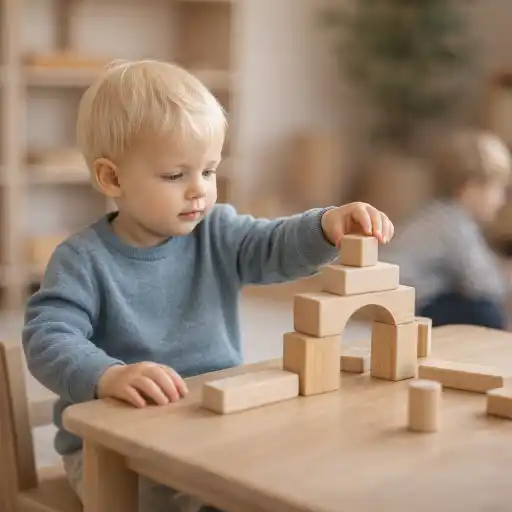
Hands-on materials invite children to rotate, compare, combine, and reposition objects. Blocks and construction toys encourage experimentation with height, balance, shape, and structure. Rather than building for a child, offer a small prompt: “What might help the bridge stay up?” or “Can you make a taller tower?” Leave time for children to test an idea, notice what happens, and revise their design.
Puzzles and shape sorters give children practice matching forms and figuring out orientation. Start with materials that are manageable and increase complexity as interest and confidence grow. Drawing a map of the classroom, playground, or a familiar route gives children a chance to represent real places with symbols. Read-alouds with journeys or maps can prompt discussion about where characters travel and how they find their way.
- Invite children to copy, adapt, or invent a block structure; there is no single required result.
- Make simple maps together and add landmarks children recognize.
- Offer varied shapes in art materials and ask children to describe how pieces fit together.
- Use puzzles as a shared problem-solving activity, not a race.
As the OECD chapter on spatial play notes, these activities provide children with opportunities to manipulate and mentally organize objects. Adult commentary can enrich play, but child choice and exploration should remain central.
How can providers adapt activities and notice children’s progress?
Start by observing what a child already does: Do they follow a familiar route, fit pieces together, respond to “under,” or adjust their body to move through a space? Record specific examples rather than labels. A useful note might be, “During cleanup, Jordan put the cars inside the bin after a verbal reminder.” These observations help you select a next step and share concrete information with families.
Adapt the challenge to children’s age, interests, language, sensory preferences, and movement needs. Reduce the number of directions, add visual cues, widen a pathway, offer lightweight materials, or let a child direct a partner. Avoid equating quick performance with understanding; children may show knowledge through movement, gestures, play choices, or words in a home language.
Common pitfalls are easy to avoid: giving too many directions at once, turning games into speed contests, or correcting every child’s attempt before they can experiment. Keep practice playful, give children time to respond, and offer encouragement that recognizes their thinking—“You turned the piece until it fit.” If concerns about a child’s movement or participation persist, follow your program’s observation and family communication procedures and consult appropriate professionals as needed. State requirements vary - check your state licensing agency.
Conclusion: What are the simplest ways to strengthen spatial awareness?
Spatial awareness grows through frequent, playful chances to move, handle objects, notice relationships, and communicate about space. Providers can make a meaningful start by using positional words in daily routines, offering movement games, keeping blocks and puzzles accessible, and inviting children to make and follow simple maps.
Keep activities safe, flexible, and responsive to each child. Model useful vocabulary, ask open-ended questions, and observe the strategies children use rather than expecting one “right” performance. The central question—what simple ways strengthen spatial awareness in young children?—has a practical answer: weave movement, language, and hands-on exploration into the day, then build on children’s curiosity one playful moment at a time.
Five useful takeaways:
- Name spatial relationships during real routines.
- Use movement and outdoor exploration to practice direction and distance.
- Offer blocks, puzzles, art materials, and map-making opportunities.
- Adapt participation and celebrate each child’s strategies.
- Observe, reflect, and plan a small next step.
Explore relevant professional learning: Early Mathematics Through Play Buy Now $24.00, Balancing Active Play in Child Care Buy Now $16.00, The Best Promotion is Play Buy Now $24.00, Math Foundations in Early Childhood Buy Now $16.00, and Inclusive Lessons for Preschoolers Buy Now $16.00.
- Moving About the Classroom: Effective Transitions for Everyday
- Early Mathematics Through Play
- CDA Home Visitor Subject Area 3 Part 3 Birth to 5
- CDA Home Visitor Subject Area 2 Part 3 Birth to 5
- Bienvenido! Welcoming All Families
- Pediatric RSV First Aid & CPR/AED
- Brain Injury Awareness in Young Children
- Potty Training Made Simple
- Play, Learn, Grow
- Moving About the Classroom: Effective Transitions for Everyday
- How to boost fine motor skills: Holiday Edition
- 🔍 ¿Qué ves cuando observas a un niño aprender?
- 🤯 ¿Por qué este niño está teniendo un comportamiento difícil de repente?
- ❄️ ¿Qué actividades al aire libre funcionan bien para los niños de Illinois en cada estación? 🌷🍂
- Cómo Abrir Una guardería Para Niños Con Necesidades Especiales?
- Actividades de Motricidad Gruesa que Desarrollan el Equilibrio, la Coordinación y la Fuerza
- 10 Ejemplos de Cómo la Cultura Influye en el Desarrollo Infantil
- Capacitación en Salud y Seguridad Preventiva en Línea para Proveedores de Cuidado Infantil
- Regulaciones de Licenciamiento de Cuidado Infantil en California para Centros y Hogares de Cuidado Infantil Familiar
- Proporciones de Cuidado Infantil y Tamaños de Grupo por Edad en Maryland (Guía Rápida para Centros y Hogares)
- Cómo Celebrar el Día Nacional del Kindergarten
- Lista para Guardería en Casa en Illinois: Cómo Iniciar una Guardería en el Hogar
- Lista para Guardería en Casa en California: Cómo Iniciar una Guardería en el Hogar
- Consejos de Supervisión Activa para Salones de Preescolar y el Juego al Aire Libre
- How Do Art Activities Support Cognitive Growth in North Dakota Preschoolers?
- Canciones, juegos y preguntas de círculo para niños
- Social Studies Activities for Toddlers: Start With Home, Helpers, and Their Little World
- How Can Child Care Programs Build Meaningful School Readiness?
- What Are the Benefits of Open-Ended Play Materials for Young Children?
- What Are Simple Ways to Strengthen Spatial Awareness in Young Children?
