A leaf rubbing can be more than a seasonal picture: it can become the first landmark in a world children invent together. With a little intentional planning, providers can extend this simple art experience into storytelling, early map skills, collaboration, and joyful pretend play. The Lesson Planning for Preschoolers course offers practical guidance for designing developmentally appropriate activities, while Children at the Wheel: Emergent Curriculum Buy Now $25.00 can help you use children’s discoveries and interests to shape what happens next.
Why extend leaf rubbings into imaginative map play?
Leaf rubbing invites children to notice texture, shape, and vein patterns. Turning those impressions into a map adds a new layer: children decide what each shape represents, where it belongs, and how a traveler might move through the imagined landscape. A large leaf might become a forest, a cluster of small leaves a village, and a winding line a river. The artwork becomes a shared setting for a story rather than a finished product with one correct interpretation.
This extension connects creative expression with language, spatial reasoning, early literacy, and social development. Children practice describing locations, sequencing events, negotiating shared ideas, and using symbols to stand for places. As Project Learning Tree’s leaf activity ideas illustrate, leaf explorations can connect art with science, math, and literature. Nature-based art also gives children a meaningful reason to compare real leaves before transforming their observations into pretend worlds.
For providers, the value is in the process: children’s choices and conversations reveal interests that can guide later planning. A rubbing that begins as a quiet table activity can grow into a collaborative #map, a story, and a dramatic-play invitation. Follow children’s ideas while keeping the experience open-ended and welcoming to different ways of participating.
How can providers prepare the materials and invitation?
Start with a manageable collection of fallen leaves in varied shapes and sizes, lightweight paper, crayons with wrappers removed, and a broad work surface. Place each leaf vein-side up beneath the paper and secure the paper at the edges so it does not slide. Children can rub the side of a crayon gently across the paper to reveal the leaf’s form; the basic technique is described in FirstPalette’s leaf rubbing steps.
After children have made several rubbings, invite them to look for possible places, paths, and features. Avoid assigning meanings for them. Try prompts such as, “Where could someone go from here?” or “What might this shape be in your story?” Offer a large sheet of paper as a shared map base and set out markers, crayons, and a few reusable loose parts such as fabric strips or blocks.
- Offer a choice of individual maps or one collaborative map.
- Use real leaves, teacher-prepared rubbings, or leaf photographs when collecting outdoors is not practical.
- Provide thicker crayons, larger paper, or a partner role to support different motor and communication needs.
- 🍂 Invite children to add a symbol key using drawings, marks, or dictated labels.
Keep the invitation brief and flexible. Some children may want to make rubbings for the whole session; others may move quickly into storytelling. Both are valid ways to engage with the materials.
How do rubbings turn into a map and a play scenario?
Once children have a collection of rubbings, work together to arrange them into a landscape. Ask where a path might begin and end, what could lie beside the river, or which places connect. Children can draw roads, bridges, ponds, gardens, or imaginary routes between leaf shapes. Their choices establish the map’s meaning. Keep it visible at child height so it can continue to inform play over several days.
Then add simple props that support children’s own stories: small figures, toy animals, blocks, fabric, or paper signs. A child might guide a bear from the “big-leaf forest” to a tiny village, while peers add a bridge or invent a destination. The map can also inspire dramatic-play roles such as explorers, helpers, travelers, or mapmakers. The key is to offer materials and language without scripting the plot.
Use open questions to enrich the experience: “How will your traveler know which way to go?” “What might they find near this tree?” or “Is there another route?” Encourage children to point, gesture, draw, speak, or act out their ideas. This approach makes room for multiple voices and supports #imagination without turning play into a teacher-led performance. The process reflects the value of child-directed participation and dramatic play described in No Time for Flash Cards’ leaf-rubbing activity.
Which learning goals can this activity support?
A leaf-rubbing map can bring several developmental domains together without interrupting the pleasure of play. When children compare leaves by size, outline, or vein pattern, they are observing and classifying. When they decide where landmarks belong or describe a route, they explore spatial relationships and positional words such as beside, behind, near, and across. Adding symbols and dictated labels brings in early literacy and representation.
- Science: Examine leaf shapes, textures, and veins; notice similarities and differences.
- Math: Sort, count, compare lengths, or use simple positional language while placing map features.
- Language and literacy: Name landmarks, dictate a shared story, create signs, or explain a route to a peer.
- Social-emotional learning: Practice listening, turn-taking, cooperation, and respectful negotiation.
- Fine-motor development: Press and control crayons, draw connecting lines, and handle paper or props.
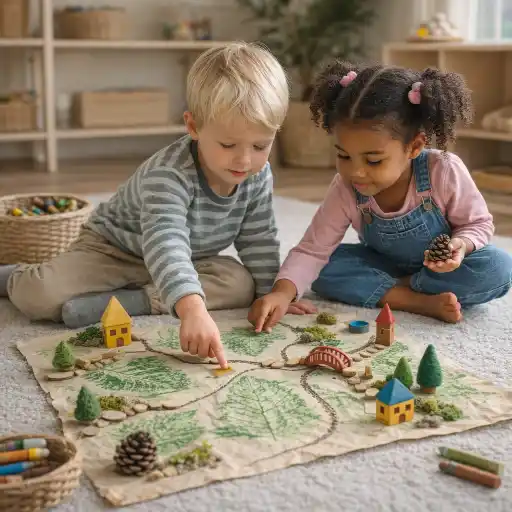
Educators can make learning visible with short, objective notes: “Lina placed three leaf shapes along the river and explained that they were stepping stones.” Photos of the evolving map, children’s words, and a quick sketch of their play help teams reflect on what to offer next. For useful planning principles, see ChildCareEd’s guide to lesson planning for preschoolers. The goal is not to assess whether a map is geographically accurate; it is to notice how children represent ideas and build meaning together.
How can providers keep the experience inclusive, safe, and flexible?
Plan the materials and space with the children in your group in mind. Check that leaves are clean and free of sharp stems, and avoid plants that are unfamiliar or potentially irritating. Supervise closely when small natural objects are available, particularly with children who may mouth materials. Provide handwashing after outdoor collecting, and follow program policies for outdoor activities. State requirements vary - check your state licensing agency.
Inclusion is supported by offering several ways to contribute. A child may select leaves, point to a location, choose a color, dictate an idea, move a figure along the map, or simply watch before joining. Use picture cues, translated or familiar words, tactile materials, and accessible work surfaces as appropriate. Some children may prefer a quiet individual rubbing station before joining group play; others may participate most comfortably with a familiar peer.
A common pitfall is deciding what each rubbing “should” represent or insisting that every child complete a map. That can narrow the imaginative possibilities and make participation feel like a task. Instead, leave space for surprises and allow children to pause, change their minds, or return later. If interest fades, offer a storybook, a new leaf shape, or a small-world figure as a gentle invitation—not a demand. Keep the map available so play can develop at children’s pace.
How can the map project grow over time?
Children’s maps can become a continuing classroom project. Revisit the artwork at a later meeting and ask what has changed in the story or what destination they would like to add. Children might create signs for landmarks, dictate a map legend, make a “travel guide,” or build parts of the landscape with blocks. A nature walk can provide new observations and leaf forms; if outdoor access is limited, photographs or teacher-collected materials can bring similar details indoors.
Documentation can help educators connect children’s interests to future plans. Save a few brief observations, photographs, and child quotes, then consider what they suggest: Are children especially interested in paths, animals, community helpers, or inventing stories? Use those interests to plan a related book discussion, block-building challenge, or dramatic-play center. The inquiry-based approach shown in Eastern Connecticut State University’s nature investigation example demonstrates how observation, questions, art, and play can inform one another over time.
Families can also contribute by sharing a favorite autumn walk, a local landmark, or a story about a familiar outdoor place. Keep participation optional and respectful of different family experiences. To build your planning practice further, the English-language Lesson Planning for Preschoolers  Buy Now $24.00, Children at the Wheel: Emergent Curriculum Buy Now $25.00, Creating the Natural Outdoor Classroom Buy Now $16.00, Art from the Heart for Preschoolers Buy Now $35.00, and Inclusive Lessons for Preschoolers Buy Now $16.00 offer related professional learning.
Conclusion: What makes leaf rubbings into meaningful imaginative play?
Leaf rubbings become maps when children are invited to interpret their marks, connect places, and use the resulting landscape in a story or shared play. Providers can support this transformation with simple materials, open-ended questions, accessible choices, attentive supervision, and time for ideas to unfold. The essential goal is not a polished product; it is an experience in which children observe nature, express their ideas, and create meaning together.
Remember the central question: how can leaf rubbings become maps for imaginative play? Let the children decide what the leaves represent, help them make their ideas visible, and leave the map ready for the next adventure. These small decisions turn autumn art into an ongoing opportunity for learning, connection, and joyful discovery.
- 45 Hour Child Growth and Development
- Children at the Wheel: Emergent Curriculum
- Pediatric RSV First Aid & CPR/AED
- 45 Hour School Age Methods and Materials
- The Best Promotion is Play
- Texas Director Credential
- Spaces that Support Discovery
- 45-Hour Infant and Toddler Curriculum
- Montessori Cultural Activities: Exploring the World Through Play and Learning
- Tiny Hands, Big Dreams: Fostering Creativity in Preschoolers
- CDA Certification en Español: Recursos y Consejos para Educadores Bilingües
- 💛🧩 ¿Cómo puedo hacer que mi enseñanza sea inclusiva para los niños con autismo?
- Cómo Abrir Una Quardería En Casa Sin Dinero?
- Requisitos Para Ser Maestra Principal En Un Daycare: Lo Que Necesitas Para Empezar
- 10 Ejemplos de Cómo la Cultura Influye en el Desarrollo Infantil
- Normas de Licenciamiento de Cuidado Infantil en Virginia para Centros Diurnos Infantiles y Hogares Diurnos Familiares
- Proporciones de Cuidado Infantil y Tamaños de Grupo por Edad en Maryland (Guía Rápida para Centros y Hogares)
- Proporciones de Cuidado Infantil y Tamaños de Grupo por Edad en Nueva Jersey (Guía Rápida para Centros y Hogares)
- Proporciones de Cuidado Infantil y Tamaños de Grupo por Edad en Virginia (Guía Rápida para Centros y Hogares)
- Actividades de Otoño Fáciles para Preescolares esta Temporada
- Lista para Guardería en Casa en Texas: Cómo Iniciar una Guardería en el Hogar
- Cómo Trabajar en el Cuidado Infantil en Carolina del Norte: Requisitos y Pasos
- Cómo Ser Maestra de Preescolar en Illinois
- Cómo Ser Maestra de Preescolar en California
- Cómo Ser Maestra de Preescolar en Maryland
- Celebrando la amistad en el cuidado infantil durante el Día de los Mejores Amigos
- Canciones, juegos y preguntas de círculo para niños
- Cómo simplificar la capacitación para sus empleados de daycare
- How Can Leaf Rubbings Become Maps for Imaginative Play?
