A move from centers to circle time can be more than a moment to manage: it can become a playful chance to practice listening, language, and spatial awareness. For practical strategies to make everyday changes smoother, explore ChildCareEd’s Moving About the Classroom: Effective Transitions for Everyday  Buy Now $24.00, a 3-hour training on choosing appropriate transition activities and turning transitions into learning opportunities. Keep reading for simple movement games you can adapt right away.
Why use movement and positional words during transitions?
Transitions ask young children to stop, shift attention, understand a direction, and begin something new. That is a substantial set of demands, especially when children are deeply engaged in play or uncertain about what comes next. A planned movement prompt gives children something concrete to do while the group shifts, rather than leaving them to wait without purpose.
Adding positional words—such as over, under, beside, behind, between, and through—makes that movement meaningful. Children can feel a spatial relationship with their bodies while hearing the language used to describe it. These words support communication and early spatial reasoning, and they are useful in everyday classroom directions: “Walk around the table,” “Stand behind the blue line,” or “Put the basket beside the shelf.”
In this way, transitions can support more than classroom flow. They can offer frequent, low-pressure practice with listening, coordination, vocabulary, and independence. As the CSEFEL guidance on helping children make transitions between activities emphasizes, advance cues, predictable routines, and individualized support can help children move between activities more smoothly. The aim is not a perfectly synchronized group; it is a safe, supportive routine that respects different paces and needs.
How can you plan a safe, predictable movement transition?
Start by deciding what children are moving toward and what the space allows. Clear the route, check for trip hazards, and make sure you can see and supervise the children as they move. Keep the activity brief and teach the signal and expectations when children are calm, so the transition does not depend on learning a new game in a busy moment.
A simple sequence makes the routine easier to follow:
- Give a clear warning: “In two minutes, we’ll put the blocks away and move to the rug.”
- Use a familiar cue, such as a song, chime, picture, or gesture.
- Offer one concise positional direction at a time: “Walk beside your partner to the rug.”
- Show where the group is going and what happens once children arrive.
- Notice specific effort: “You walked around the table and found your spot.”
Choose an activity that matches the group’s energy and the next routine. A lively animal walk might work before a seated activity if it is controlled and brief; a slow-motion path or finger movement may suit a calmer transition. Avoid turning movement into a race. Children need enough time to understand the cue and respond safely.
For example, a classroom can follow a taped pathway to the reading area, stepping over a paper “log” and stopping beside a floor marker. This offers a playful task without requiring elaborate equipment. The most effective transition activities for preschool classrooms are connected to the destination, predictable, and manageable for the children participating.
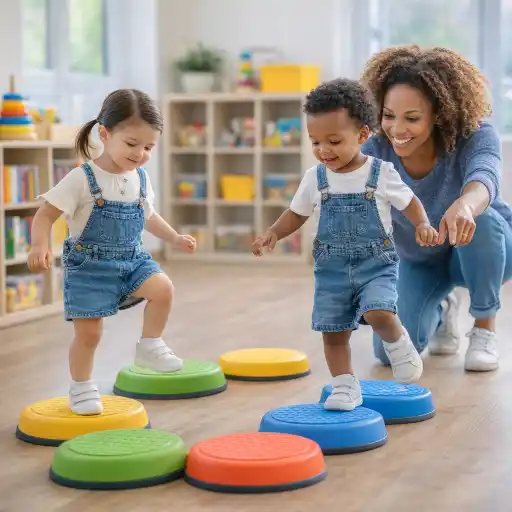
Which movement games help children practice positional words?
Positional-word games are most useful when the language is paired with visible actions. Begin with familiar words and simple directions, then vary the movement or object as children gain familiarity. Invite children to demonstrate or give directions, too; explaining a route can be as valuable as following one.
- 🎃 Friendly haunted-house path: Arrange a few safe classroom markers as a pretend route. Invite children to tiptoe around a chair, walk through a wide open “doorway,” or stand beside a picture card. Keep the theme light and optional so children who do not enjoy spooky play can choose another role.
- Move like an animal: Ask children to waddle behind the teacher, crawl under an adult-held arch only if safe and appropriate, or walk between two floor spots.
- Positional-word freeze: While children move in place, call a direction such as “hands above your head” or “one foot beside the red marker.” Offer a demonstration and allow different ways to respond.
- Find the object: Hide a familiar toy in an accessible, safe spot. Give a clue such as “Look under the table,” then ask the finder to describe where it was.
Make the directions concrete and avoid cluttering one prompt with several unfamiliar words. Repeat useful language naturally: “You went around the chair. Now you’re beside the basket.” Activities that let children use their own bodies to explore position can make abstract vocabulary easier to understand, as described in these positional-word activities for preschoolers.
How can positional language support the whole classroom?
Movement transitions provide an authentic context for children to hear and use spatial words. Instead of asking everyone to “line up,” try a specific, supportive direction: “Stand behind the floor marker,” or “Leave space beside your friend.” During cleanup, describe where materials belong: “Put the cars inside the bin,” “Set the books on the shelf,” or “Place the basket next to the blocks.” These small adjustments make directions clearer while helping children connect words with real locations.
Keep the experience conversational rather than turning every moment into a test. You might ask, “Which way should we go around the table?” or describe what a child chooses: “You walked between the two spots.” Children can answer verbally, point, gesture, move, or use words in a home language. Allowing different forms of participation helps preserve the activity’s purpose without placing unnecessary pressure on children.
These experiences also create opportunities to notice emerging skills. Observe whether a child follows a one-step direction, uses a location word, watches a peer’s movement, or benefits from a gesture or picture cue. Spatial awareness develops through ordinary movement and exploration; see simple ways to strengthen spatial awareness in young children for additional ideas. You can extend learning with blocks, classroom maps, or a quick “I Spy” clue during a short wait.
To deepen your planning of playful math and spatial experiences, consider Early Mathematics Through Play Buy Now $24.00. For professional learning about balancing active movement with quieter parts of the day, explore Balancing Physically Active Play in Child Care Buy Now $25.00.
How can you adapt games and avoid common pitfalls?
Children vary in mobility, sensory preferences, communication, confidence, and familiarity with positional vocabulary. Build flexibility into the activity from the start. A child can point to the route, direct a partner, move while seated, use a mobility aid, or watch before joining. Pair spoken directions with gestures, photos, or a demonstration when helpful. Use words children already know, then add one new term at a time.
Keep safety and dignity central. Do not ask children to climb on furniture, crawl into tight spaces, or move quickly through crowded areas. Use stable, age-appropriate markers and maintain active supervision. If a child hesitates, offer time, a simpler direction, or a choice that keeps the destination clear.
Common pitfalls are easy to address:
- Too many directions at once: Give one short instruction, then pause for children to process.
- Making it a race: Focus on safe movement and participation rather than speed.
- Using a game that raises energy at the wrong time: Match the pace and volume to the next activity.
- Expecting identical responses: Offer meaningful ways to participate, including gestures, observing, or directing a peer.
- Changing cues constantly: Practice a small number of familiar signals so children can anticipate what they mean.
Use brief, objective observations to refine the routine: What cue helped? Was the pathway clear? Did children understand the direction? State requirements vary - check your state licensing agency for applicable supervision and movement guidance.
Conclusion: How can movement make transitions playful and purposeful?
Movement and positional words can turn everyday classroom transitions into brief, engaging opportunities to practice language, listening, coordination, and spatial awareness. Start with a familiar cue, a safe and clear route, and one simple direction such as “walk beside your partner” or “step around the marker.” Keep the activity short, responsive, and connected to the next part of the day.
The central goal is not to make every transition entertaining or perfectly quiet. It is to help children understand what is happening, participate with confidence, and move safely at a developmentally appropriate pace. Observe how children respond, adapt the activity to their needs, and build on what works. With thoughtful planning, even the walk from centers to the rug can become a small moment of joyful learning.
Five practical takeaways:
- Plan transitions with a clear destination and predictable cue.
- Pair movement with everyday positional words such as over, under, beside, and between.
- Choose brief games that fit the space, supervision needs, and group energy.
- Offer multiple accessible ways for children to participate.
- Notice children’s efforts and adjust routines based on what you observe.
To strengthen your professional practice with focused guidance on effective transition planning, explore ChildCareEd’s Moving About the Classroom: Effective Transitions for Everyday Buy Now $35.00 workshop.
- 45 Hour Child Growth and Development
- Moving About the Classroom: Effective Transitions for Everyday
- Teacher-Child Interactions for Stronger CLASS® Outcomes
- From Tantrums to Triumphs: Equipping Preschoolers with Self-Regulation Skills
- Birth to Five CDA Credential with Portfolio Review
- Every Moment Matters: Schedules and Transitions
- Moving About the Classroom: Effective Transitions for Everyday
- 💛🧩 ¿Cómo puedo hacer que mi enseñanza sea inclusiva para los niños con autismo?
- ❄️ ¿Qué actividades al aire libre funcionan bien para los niños de Illinois en cada estación? 🌷🍂
- Recursos en Español sobre el Sueño Seguro del Bebé
- ¿Cuáles son las mejores actividades del Día de la Tierra para niños en casa o en el aula?
- 10 Ejemplos de Cómo la Cultura Influye en el Desarrollo Infantil
- Proporciones de Cuidado Infantil y Tamaños de Grupo por Edad en Nueva Jersey (Guía Rápida para Centros y Hogares)
- Proporciones de Cuidado Infantil y Tamaños de Grupo por Edad en Virginia (Guía Rápida para Centros y Hogares)
- Circle Time Songs, Games, and Questions for Kids
- Canciones, juegos y preguntas de círculo para niños
- Cómo simplificar la capacitación para sus empleados de daycare
- Crunch, Stomp, Scoop! Fall Activities Toddlers Can’t Resist
- No Sitting Required! Toddler Circle Time Ideas That Get Little Bodies Moving
- What No-Prep Activities Can Busy Early Childhood Teachers Use Tomorrow?
- How Can Fun Bingo Games Teach Colors, Shapes, and Animals to Preschoolers?
- How Does Cleanup Time Reveal Hidden Learning in Early Childhood Classrooms?
- How Can Early Math Activities Build Young Children’s Mathematical Thinking?
- How Can You Offer Movement Without Turning the Classroom Into Chaos?
- How Can Camping Themes Expand Preschool Vocabulary?
- What Are Simple Ways to Strengthen Spatial Awareness in Young Children?
- How Can Movement and Positional Words Make Classroom Transitions Fun?
