When a preschooler can explain that the bear is under the table or the pumpkin is beside the basket, they are doing more than naming a location: they are communicating relationships and making sense of space. Build practical strategies for extending that learning through Building Vocabulary  Buy Now $16.00, which can help you foster richer language and intentional learning experiences, and explore Early Mathematics Through Play Buy Now $24.00 for hands-on ways to connect spatial ideas with early math. Keep reading for simple, playful approaches you can weave into movement, classroom routines, and everyday conversations.
What are position words, and why do they matter?
Position words—also called positional or spatial words—describe where a person or object is in relation to something else. Familiar examples include in, on, under, beside, between, behind, above, and around. These words make messages more precise: “Put the block there” gives little information, while “Put the block beside the red truck” identifies a clear relationship.
For young children, this vocabulary links language to experience. A child hears “under,” sees a toy beneath a chair, and may crawl there to retrieve it. Repeated, meaningful encounters help children understand and eventually use the word—not merely repeat it. NAEYC describes spatial language as a foundation for understanding and describing spatial relationships, and highlights the value of combining words with books, objects, and movement.
This learning matters throughout the day. Position words support children as they explain ideas during pretend play, follow directions at cleanup, coordinate with peers, and navigate classroom spaces. They also introduce early mathematical thinking: children notice position, direction, distance, and how objects relate. These are useful foundations for later work with shapes, patterns, maps, and geometry.
- Communication: “The puppy is inside the barn.”
- Following directions: “Place your cup on the table.”
- Spatial thinking: “The small block fits between the two tall ones.”
Position words do not need to become a drill or a test. They grow naturally when caring adults notice what children are doing and name the relationship in a warm, specific way.
How do position words strengthen communication?
Spatial vocabulary gives children a practical way to share information, ask for help, and explain what they notice. “It’s there” may not help a friend find a missing toy; “It’s behind the cushion” gives a more useful clue. During collaborative play, children can use these words to direct a partner, negotiate where materials belong, and describe how they built something.
Adults can extend communication by modeling a clear phrase and then pausing for the child’s response. If a child puts a figure near a toy barn, say, “You placed the horse beside the barn. Where should the cow go?” The child may answer with a word, phrase, gesture, or action. Each response offers information about their understanding. Gentle expansions—recasting “there” as “under the table”—provide a model without interrupting the child’s idea.
Use open questions that invite children to describe rather than guess what the adult wants:
- “Where did you hide the pumpkin?”
- “What do you notice beside the basket?”
- “How can you tell your friend where to put the leaf?”
Make room for children who communicate in different ways. A child may point, move an object, use a communication device, or speak in a home language. Treat these as meaningful contributions, and model the target word alongside the child’s preferred communication. Repeated experiences across people and settings help positional language become useful, flexible communication rather than a memorized list.
How can movement make spatial ideas easier to understand?
Movement makes abstract relationships tangible. Children can place a toy on a box, crawl under a safe table, walk around a cone, or stand between two floor markers. As children act, narrate what is happening: “You went through the tunnel, then stood beside Maya.” Pairing an action with a word gives children a visible and physical reference for its meaning.
Short, playful activities are easy to include in the day:
- 🧸 Move the toy: Invite children to place a stuffed animal in, on, under, or beside a box, then describe where it is.
- Position-word pathway: With clear space and close supervision, invite children to step over a line, walk around a marker, or move between two objects.
- Action-song pause: Pause a familiar movement song and ask children to show “hands above your head” or “hands behind your back.”
- Story acting: Read a book with a journey and let children act out words such as across, through, and around.
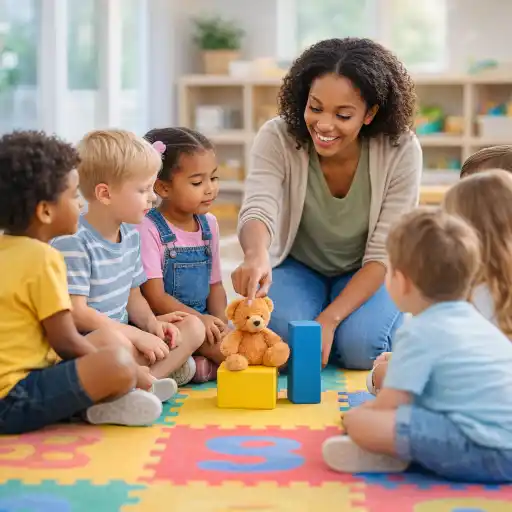
Keep movement safe, flexible, and accessible. Check the area, remove hazards, and offer an alternative such as pointing, moving a toy, or directing a partner. The goal is to explore the concept, not to require one particular movement or a fast response. A calm repetition during everyday play can be just as valuable as a planned game.
How can educators weave position words into play and routines?
Position words are especially meaningful when they solve a real communication problem or help a child carry out a purposeful action. Rather than setting aside a lengthy lesson, use short comments and invitations during play and predictable routines. At cleanup, say, “Put the cars inside the basket.” In the block area, notice, “You built a bridge over the river.” Outside, ask, “Which tree is nearest the path?”
Offer engaging materials that children can move and arrange. A small toy and a box, dolls and furniture, blocks, picture cards, or a themed scene can all prompt talk about where things are. For a seasonal example, the Pumpkin Patch: Where Is It? positional words activity Buy Now $1.49 uses a picture scene, movable pieces, and direction cards for in, on, under, and beside. An educator can model a word, invite a child to move a piece, and then ask the child to describe its location.
Try a simple sequence: model the word, invite the child to act, and then encourage the child to describe or direct. For example: “The pumpkin is under the vine. Can you put the leaf beside it? Where is the leaf now?” Let children take the lead, invent new arrangements, and use their own language. Repeating the same words in varied, interesting contexts helps children recognize that a relationship can be described across many objects and situations.
How can providers adapt activities and notice children’s learning?
Children build spatial vocabulary at different rates and may show what they know in different ways. Some will use a word independently; others may respond correctly to a direction, point to a location, or demonstrate the relationship with an object. These are all useful observations. Focus on what the child does in context rather than judging understanding by one answer or comparing children with one another.
Adjust the activity to fit children’s interests, language, sensory preferences, and movement abilities. Start with a small set of familiar terms—often in, on, and under—then add words such as beside, between, or behind as children gain experience. Support understanding with gestures, pictures, objects, repetition, and home-language words when available. Avoid assuming children understand a word simply because they can repeat it; invite them to use it across a few different situations.
- Give one direction at a time before trying a two-step direction.
- Wait for children to respond; allow words, gestures, actions, or communication supports.
- Note specific examples, such as “Placed the toy under the chair after a verbal cue.”
- Keep practice playful; avoid turning movement or vocabulary into a speed contest.
If questions about a child’s communication or development persist, follow your program’s observation and family communication procedures and consult appropriate professionals as needed. State requirements vary - check your state licensing agency.
Conclusion: How can position words support preschoolers every day?
Position words help preschoolers communicate more clearly and build an emerging understanding of spatial relationships. Children learn these ideas best through meaningful repetition: hearing a word, seeing what it describes, moving objects or their bodies, and having chances to use the word themselves. Everyday play, stories, transitions, and classroom routines offer abundant opportunities without requiring elaborate materials.
For a practical next step, choose two or three words—perhaps in, under, and beside—and model them during play and routines this week. Invite children to follow simple directions, explain where an object is, or give a peer a clue. Notice communication in all its forms and adapt activities so each child can participate. The central question—how can position words improve communication and spatial thinking?—has a grounded answer: connect clear language with hands-on experience, and let children explore, describe, and direct at their own pace.
For additional professional learning, explore Language and Literacy Foundations in Pre-K Buy Now $16.00, Balancing Active Play in Child Care Buy Now $16.00, and Inclusive Lessons for Preschoolers Buy Now $16.00. These courses offer broader strategies for supporting language, movement, and participation in early learning environments.
Takeaways: Model spatial vocabulary in real contexts; pair words with objects, gestures, stories, and movement; invite children to describe and direct; and adapt participation to children’s communication and movement needs.
- CDA Preschool Credential with Portfolio Review
- Teacher-Child Interactions for Stronger CLASS® Outcomes
- CDA Bridge Bundle: Preschool
- Emergent Learning & Development
- Staff Supervision, Observation & Feedback
- Creating Environments that Nurture Growth and Community
- Texas Director Credential
- 45-Hour Infant and Toddler Curriculum
- Every Moment Matters: Schedules and Transitions
- CDA Certification en Español: Recursos y Consejos para Educadores Bilingües
- Recursos en Español sobre el Sueño Seguro del Bebé
- Curso de Comunicación de 9 Horas de Maryland
- Proporciones de Cuidado Infantil y Tamaños de Grupo por Edad en Maryland (Guía Rápida para Centros y Hogares)
- Proporciones de Cuidado Infantil y Tamaños de Grupo por Edad en Nueva Jersey (Guía Rápida para Centros y Hogares)
- Proporciones de Cuidado Infantil y Tamaños de Grupo por Edad en Virginia (Guía Rápida para Centros y Hogares)
- Actividades de Otoño Fáciles para Preescolares esta Temporada
- Celebrando la amistad en el cuidado infantil durante el Día de los Mejores Amigos
- Canciones, juegos y preguntas de círculo para niños
- Cómo simplificar la capacitación para sus empleados de daycare
- How Does Guided Play Build School-Ready Skills in New York Preschoolers?
- How Can Early Math Activities Build Young Children’s Mathematical Thinking?
- How Can Farm-Themed Mazes Build Spatial Reasoning and Pencil Control?
- How Can Valentine’s Day Problem-Solving Activities Help Preschoolers Learn?
- How Does Building from Another Photograph Angle Change Children’s Thinking?
- Can a Floor-Sized City Fit on a Table? Exploring Scale Through Reconstruction
- Does Bending a String Change Its Length? A Preschool Measurement Investigation
- Can Halloween Activities Help Kindergarteners Learn Directions and Map Skills?
- How Can Preschoolers Learn Geometry Through Building and Play?
- How Can Position Words Improve Preschoolers’ Communication and Spatial Thinking?
