When children can describe where an apple is, they are practicing language, spatial thinking, and the confidence to give and follow directions. Turn a simple orchard scene into meaningful classroom play—and deepen your strategies with Language Development in Early Childhood  Buy Now $16.00, a course that helps providers support children’s verbal, nonverbal, and early literacy skills. As you read on, you’ll find practical ways to make positional words visible, playful, and accessible to every child.
Why are positional words worth teaching through play?
Words such as on, under, beside, between, above, and behind help children explain relationships between objects and understand directions. These concepts appear throughout the day: a child puts a cup on the table, waits behind a friend, or finds a toy under a shelf. Yet adults may assume children know these words before they have had enough chances to see, hear, and use them.
Fall pretend play gives these words a concrete purpose. A felt or paper orchard invites children to place apples, move baskets, and imagine picking fruit. Rather than completing a worksheet or testing children one by one, educators can connect vocabulary to actions that children choose and repeat. Research and practice resources emphasize hands-on, multimodal learning: children can hear a word, see the relationship, move a prop, and describe what happened.
This matters for classroom relationships, too. If a child does not follow “Put the apple beside the basket,” the difficulty may be unfamiliar vocabulary—not refusal. Modeling the word and showing the action supports understanding while keeping the interaction warm and respectful. During play, children also negotiate roles and plans, creating natural opportunities for conversation and peer learning.
How can you set up an inviting apple orchard scene?
Keep the setup simple, sturdy, and open-ended. Use paper trees, a low cardboard orchard, or a felt scene, plus large pretend apples, baskets, and perhaps a small wagon. The Apple Orchard Pretend Play: Wait With a Plan Visual Support Buy Now $1.99 can help structure turns and keep children engaged while they wait.
Before play begins, choose a small set of target words—perhaps in, on, under, next to, and between. Add picture cards or demonstrate each relationship with the materials. You can extend the scene with a farm stand, delivery station, or orchard map, but avoid crowding the area with props that compete for attention. Apple-theme dramatic play can also connect with counting, sorting, storytelling, and children’s own knowledge of farms and fall traditions.
- Place apples at varied heights and locations, ensuring the setup is reachable and safe.
- Offer baskets, boxes, or containers so children can explore “in,” “out,” and “beside.”
- Use photos or simple icons as visual cues, not as a requirement to speak.
- Invite children to help arrange the orchard and decide what roles to play.
Choose materials large enough to reduce choking risk for the age group, and maintain active supervision. Make the scene welcoming to children with different movement, sensory, and communication needs.
How do you model words without turning play into a quiz?
Begin by narrating what children are already doing: “You put the red apple in the basket,” or “That green apple is under the tree.” This gives a clear language model connected to the child’s action. Then pause. Children may respond with a word, a gesture, a look, or another action; each can show participation.
Use a few open prompts when they fit the play: “Where should this apple go?” “How can we reach the apples above the branch?” or “Which basket is between the trees?” Questions should invite thinking rather than feel like a rapid-fire test. If a child says “there,” you might expand gently: “Yes, the apple is beside the basket.” Repeating key words across different objects and turns helps children notice the relationship rather than memorize a single arrangement.
Pair words with gestures and movement. Point above a tree, move a pretend apple underneath a branch, or invite children to stand beside a partner. Read-alouds featuring journeys and locations can also introduce spatial vocabulary; educators can pause at illustrations, trace a character’s route, and invite children to act it out. The NAEYC discussion of books and movement for preschool spatial thinking describes this kind of connection between language, images, and embodied experience.
- Model a word, demonstrate it, then give children time to explore.
- Offer two possible locations if a child needs a narrower choice.
- Welcome home-language words and gestures as meaningful contributions.
What orchard games help children practice one concept at a time?
Short, repeatable games let children practice a target word in a lively context. Start with one or two concepts and change the objects or roles while keeping the language consistent. For example, the “Apple Picker” can ask a partner to place an apple under a tree, then switch roles. In a “Basket Delivery” game, children follow a simple direction such as “Put the apple inside the basket” and carry it to the farm stand.
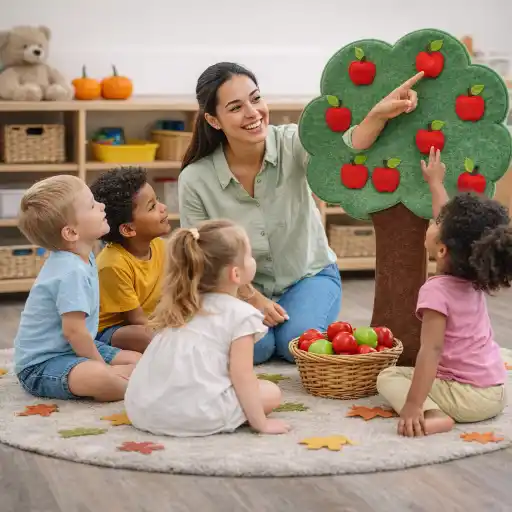
As children become interested, invite them to give directions to a peer or to create a new orchard arrangement for a friend to describe. A picture card can show a simple arrangement; children recreate it using props, or they can make their own scene for another child to interpret. This offers practice with receptive language (understanding a direction) and expressive language (describing or directing), without requiring every child to participate verbally in the same way.
- 🍎 Find the apple: Hide a large pretend apple beside, behind, or under a tree and describe its location.
- Orchard map: Place trees on a simple floor map; help a character move between landmarks.
- Harvest orders: Use picture or spoken directions such as “two apples in the basket” or “one beside the wagon.”
- Freeze and describe: Pause movement and notice who is in front of, behind, or next to a partner.
Keep movement pathways clear and adapt games for seated play, pointing, partner-directed movement, or other access needs. The goal is meaningful practice, not speed or perfect recall.
How can you adapt the activity and notice children’s learning?
Children differ in age, experience, language, sensory preferences, and how they communicate. Some may understand a word before they can say it; others may show understanding by placing an object correctly, looking toward a location, or guiding a peer. Let children participate through speech, signs, gestures, pictures, or movement. For children learning more than one language, ask families for familiar words and use those alongside English when possible.
Adjust the challenge in small steps. Begin with visible contrasts such as in/out or on/under, then introduce less familiar relations such as between or behind. Use fewer words at once, repeat a direction, add a visual cue, or place objects closer together. Avoid comparing children or assuming that a single missed direction indicates a developmental concern.
Observe without interrupting the play. Note the context, the word used, and how the child responded: “During orchard play, Sam placed the apple under the paper tree after watching the educator model it.” These specific observations help you plan a next step and share strengths with families. If concerns about communication persist across activities and settings, follow program procedures and partner respectfully with the family and appropriate professionals. State requirements vary - check your state licensing agency.
How can providers avoid common pitfalls and keep play child-led?
A well-intended activity can become less engaging if adults introduce too many target words, give several directions at once, or correct every attempt. Keep the focus narrow, model the language naturally, and let children experiment. If the apple lands somewhere unexpected, treat it as an opening: “You put it behind the basket. I wonder where it could go next.” Children’s ideas can take the play in directions the adult did not plan, and that flexibility is a strength of pretend play.
Another pitfall is expecting spoken answers as the only evidence of learning. Pointing, matching, moving an object, or responding in a home language can communicate understanding. Avoid turning the activity into a race or withholding materials until children produce a word. Instead, make the orchard accessible, offer choices, and provide enough time for each child to join in comfortably.
Directors can support consistency by encouraging staff to identify a small vocabulary goal, prepare a few visual supports, and share observations during planning. For broader professional learning on language-rich interactions, explore ChildCareEd’s Language Development in Early Childhood Buy Now $16.00. It complements this activity with a wider look at supporting communication and literacy across everyday classroom experiences.
Conclusion: Can everyone reach the apples—and the language learning?
Yes, when the orchard is designed with access, choice, and responsive teaching in mind. Fall pretend play makes positional words tangible: children move apples, baskets, and characters while hearing and using language such as under, beside, between, and behind. Providers can enrich the experience by modeling words in context, pairing them with gestures and visuals, and allowing children to direct parts of the play.
- Choose a few target words and revisit them in playful, varied ways.
- Accept communication through words, gestures, signs, home languages, and actions.
- Adapt the scene so children can participate safely and meaningfully.
- Observe specific strategies and build the next step from children’s interests.
The central question—can everyone reach the apples?—is also an invitation to ask whether every child can access the materials, the conversation, and the learning. With thoughtful setup and supportive language, the orchard becomes a shared space for exploration, connection, and growth.
Further professional learning: Explore Building Vocabulary Buy Now $16.00, Early Mathematics Through Play Buy Now $24.00, Language and Literacy Foundations in Pre-K Buy Now $16.00, and The Best Promotion is Play Buy Now $35.00 for related ideas to extend language-rich, play-based practice.
- Moving About the Classroom: Effective Transitions for Everyday
- The ABCs of Behavior: Turning Challenges into Learning Opportunities
- Teach with Respect!
- The Best Promotion is Play
- Play, Learn, Grow
- Texas Director Credential
- Building Bridges for Dual Language Learners
- Bienvenido! Welcoming All Families
- Montessori Cultural Activities: Exploring the World Through Play and Learning
- CDA Certification en Español: Recursos y Consejos para Educadores Bilingües
- 💛🧩 ¿Cómo puedo hacer que mi enseñanza sea inclusiva para los niños con autismo?
- 👶 ¿Cuáles son las proporciones y grupos requeridos en Dakota del Norte? 🏫
- Recursos en Español sobre el Sueño Seguro del Bebé
- 10 Ejemplos de Cómo la Cultura Influye en el Desarrollo Infantil
- Cómo Empezar una Guardería en Casa: Requisitos y Pasos
- Proporciones de Cuidado Infantil y Tamaños de Grupo por Edad en Maryland (Guía Rápida para Centros y Hogares)
- Proporciones de Cuidado Infantil y Tamaños de Grupo por Edad en Nueva Jersey (Guía Rápida para Centros y Hogares)
- Proporciones de Cuidado Infantil y Tamaños de Grupo por Edad en Virginia (Guía Rápida para Centros y Hogares)
- Actividades de Otoño Fáciles para Preescolares esta Temporada
- Cómo Trabajar en el Cuidado Infantil en Carolina del Norte: Requisitos y Pasos
- Cómo Ser Maestra de Preescolar en Illinois
- Celebrando la amistad en el cuidado infantil durante el Día de los Mejores Amigos
- Canciones, juegos y preguntas de círculo para niños
- Cómo simplificar la capacitación para sus empleados de daycare
- Crunch, Stomp, Scoop! Fall Activities Toddlers Can’t Resist
- Rosh Hashanah Sensory Bin Ideas: Apples, Honey, Shofars, and Sweet New Year Play
- How Can You Plan an Engaging Fall Curriculum for Preschoolers?
- How Can Simple Fall Activities Support Kindergarten Readiness Through Play?
- Can Everyone Reach the Apples? How Can Fall Pretend Play Teach Positional Words?
