What if a handful of leaves, a small pumpkin, and a few scoops could turn an ordinary autumn morning into rich learning? These low-preparation invitations help toddlers explore sound, movement, texture, language, and early science while keeping routines manageable. For deeper guidance on planning developmentally appropriate experiences, explore Playing with a Purpose: Infant/Toddler Lesson Planning  Buy Now $24.00, which can strengthen your activity planning and support professional learning hours where applicable.
Why do crunch, stomp, and scoop activities matter for toddlers?
Autumn materials are compelling because they are real, familiar, and constantly changing. A toddler can hear a leaf crackle, feel a pumpkin’s ridges, watch water move around an apple, and notice that one object is heavier than another. These experiences make abstract developmental goals concrete.
Well-designed seasonal play can support several domains at once:
- Language: Introduce words such as crunchy, smooth, wet, heavy, orange, under, and more.
- Fine-motor development: Scooping, pinching, pouring, transferring, and grasping strengthen hand coordination.
- Gross-motor development: Stomping, carrying, reaching, and balancing build body awareness.
- Social-emotional growth: Shared tools and short turns create natural opportunities for cooperation.
- Early inquiry: Children predict, test, compare, and revise their ideas through direct experience.
The goal is not to produce a perfect craft or a correct answer. It is to create an inviting context in which children can investigate at their own pace while an attentive adult notices, names, and extends their thinking. This is why #playful fall experiences can feel joyful and still be intentional curriculum.
How can I create a fall crunch station children will revisit?
Begin with a shallow tray or washable mat and a small collection of clean, dry leaves. Invite children to touch, squeeze, tear, rub, and listen. Some toddlers will immediately stomp; others may watch first or prefer to explore one leaf with a fingertip. Both responses are meaningful.
Use language that follows the child’s attention:
- “That leaf made a crackly sound.”
- “You pressed the yellow leaf.”
- “This one is soft. This one feels dry.”
- “You found two leaves that look alike.”
For a small-group variation, place leaves in two baskets and invite children to sort by a single attribute, such as color or size. Avoid requiring every child to sort correctly; the instructional value lies in comparing and talking. You can also offer crayons and paper for leaf rubbings, using larger leaves and thick crayons for easier success.
Keep the station open-ended. A child may use leaves as pretend food, blankets for toy animals, or ingredients in a “fall soup.” These symbolic uses are not distractions; they demonstrate imagination and emerging representation. The nature-based sensory learning ideas from ChildCareEd similarly emphasize the visual, auditory, tactile, olfactory, and movement-rich qualities of fall.
Inspect leaves before use, remove moldy or sharp material, and supervise closely. For children who mouth objects, offer larger, safer materials or a sealed sensory bag instead.
 What makes stomping activities exciting without making the room chaotic?
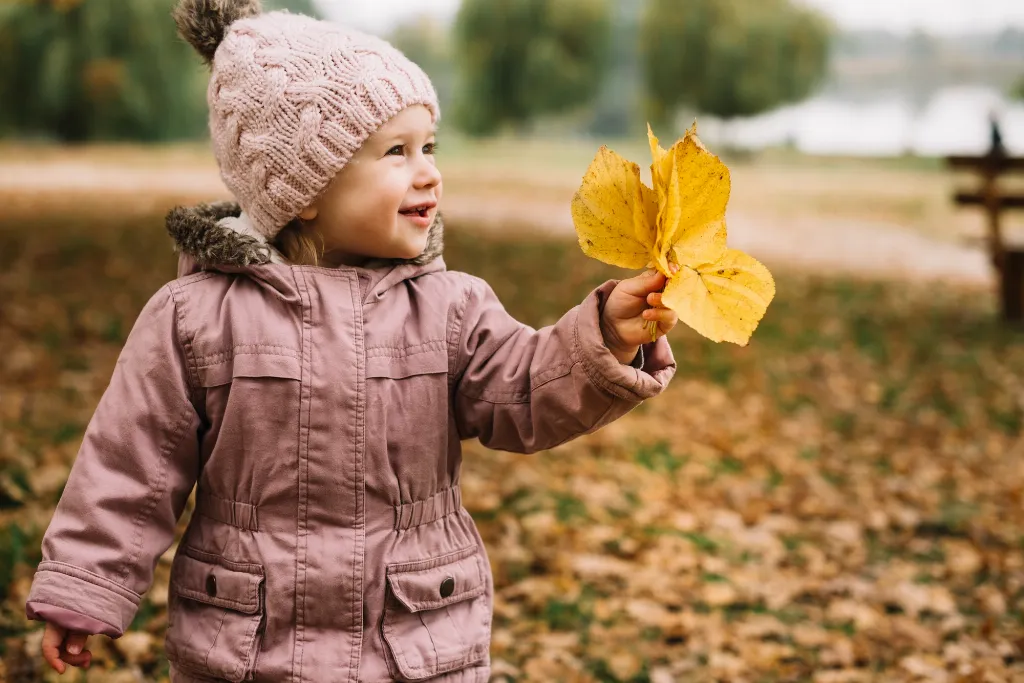
Stomping gives toddlers a satisfying way to use their whole bodies. Outdoors, designate a clear “stomp path” with a few paper leaves, fabric leaves, or clean natural leaves. Model walking, marching, tiptoeing, and stomping, then let children choose how to move. A simple chant can support rhythm: “Step, step, stomp!”
Movement can also become an early science and language experience. Ask, “What happens when your foot lands on the leaf?” or “Which sound is louder—the dry leaf or the paper leaf?” Do not turn the activity into a performance. Some children may prefer to push leaves with a broom, carry a basket, or watch from the edge.
For indoor use, place large paper leaves on a carpeted surface and add visual boundaries. Combine movement with positional words:
- Stomp on the leaf.
- Walk around the pumpkin.
- Carry the basket to the tree.
- Place the leaf under the chair.
Outdoor play offers additional room for climbing, balancing, carrying, and exploring. The CDC notes that outdoor experiences can support physical activity, attention, learning, language, and emotional development, while also requiring active attention to hazards and supervision. Review the CDC outdoor play and safety guidance when planning seasonal movement.
Remember that safe risk is different from unsafe exposure. Low, stable challenges can build confidence, but staff should scan the area, maintain sight and sound supervision, and adjust the activity for each child’s mobility and comfort. State requirements vary - check your state licensing agency.
Which scooping and pouring invitations build the most learning?
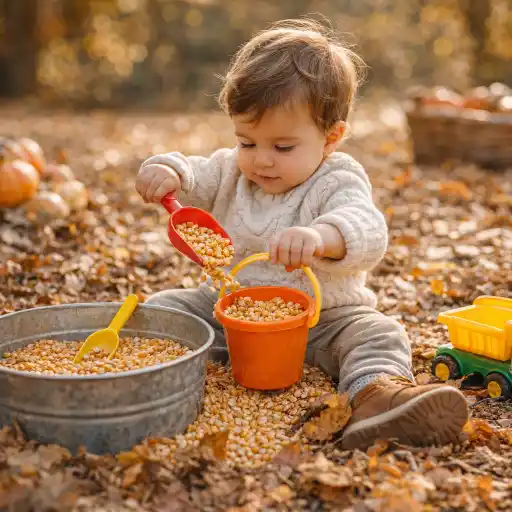
Scooping activities are popular because toddlers can immediately see the effect of their actions. Set out a shallow bin with large, developmentally appropriate materials such as fabric leaves, large foam pumpkins, or clean water-safe objects. Add sturdy cups, ladles, funnels, and large scoops. A pumpkin-washing station with warm water, sponges, and small sturdy pumpkins can combine sensory exploration with self-help practice.
As children work, narrate rather than direct every move: “You filled the cup,” “The water spilled over,” or “You used two hands.” Introduce simple mathematical concepts through natural conversation:
- Full and empty
- More and less
- Big and small
- One scoop and two scoops
- Heavy and light
An apple sink-or-float tub can add inquiry. Before testing, invite a prediction: “Do you think the apple will stay on top?” Then test one object at a time and compare what happens. Toddlers do not need a formal chart; a photograph, gesture, or repeated phrase can document their thinking.
Use water only with constant, close supervision. Keep the water shallow, position adults so every child is visible, and empty and sanitize materials according to program procedures. Avoid small fillers such as acorns, seeds, beads, or dry corn for children who mouth objects. Food items also require allergy and hygiene planning. The practical fall sensory activity guidance offers additional ideas for rotating simple stations.
How can directors and teachers adapt these activities for every toddler?
Developmentally responsive planning begins with observation. A child who avoids wet textures may happily use tongs to transfer dry leaves. A child with limited mobility may participate by sorting objects from a seated position. A child developing language may point, gesture, use home-language words, or communicate through signs. Participation does not have to look the same for every child.
Consider these adaptations:
- 🍂 Provide large-handled tools, nonslip trays, or lightweight containers.
- Use picture cards showing scoop, pour, stop, and clean up.
- Offer dry, wet, smooth, and textured choices rather than one required material.
- Invite children to observe before touching and allow them to leave and return.
- Pair words with gestures, objects, songs, and repeated routines.
- Give children meaningful jobs, such as carrying a basket or placing leaves in a bin.
Common mistakes include preparing too many materials, expecting identical products, and extending an activity after children have lost interest. A better approach is to offer one or two clear invitations, observe what children do, and make a small adjustment the next day. Documentation can remain simple: record one action, one quote or gesture, and one possible next step.
Family partnerships can extend the experience. Share a photo with a note such as, “Today Maya listened for the loudest leaf and used the word crunchy.” Invite families to notice fall sounds or colors during a walk, while reminding them that collecting natural objects should follow local safety expectations.
What is a practical fall activity plan for the week?
A predictable rotation helps staff prepare confidently and helps toddlers know what to expect. Try this five-day sequence:
- Monday—Crunch: Explore dry leaves, sounds, texture words, and leaf rubbings.
- Tuesday—Stomp: Use a leaf path for marching, stomping, tiptoeing, and positional language.
- Wednesday—Scoop: Offer a dry transfer bin with large tools and containers.
- Thursday—Wash: Set up a supervised pumpkin-washing station with sponges and shallow water.
- Friday—Investigate: Test whether selected fall objects sink or float and revisit children’s predictions.
Keep each invitation brief—often 10 to 20 minutes is enough for toddlers—and repeat it later for children who were not ready the first time. Before each session, check materials, allergies, weather, group size, and supervision assignments. Afterward, ask staff:
- What did children notice?
- Which words or gestures emerged?
- Who needed an adaptation?
- What could we change tomorrow?
For providers seeking additional preparation in outdoor design, Creating the Natural Outdoor Classroom Buy Now $16.00 explores how colors, sounds, textures, and scents can be intentionally incorporated into children’s environments. For a complementary focus on inquiry, Enhancing STEM Education for Infants and Toddlers Buy Now $16.00 connects everyday exploration with early science and mathematics.
Conclusion: How can toddlers learn through crunch, stomp, and scoop?
Toddlers learn through their bodies, relationships, and repeated encounters with meaningful materials. Fall activities become powerful when educators keep them simple, supervise actively, use rich language, and connect children’s actions to developmentally appropriate goals. Crunching leaves supports auditory and tactile exploration; stomping builds movement and confidence; scooping and pouring strengthen coordination, vocabulary, and early mathematical thinking.
Choose one invitation, prepare a safe variation, and watch closely. The most valuable moment may be a child’s unexpected question, a new gesture, or the decision to try again. When your team documents those small discoveries and plans the next step, seasonal play becomes intentional, inclusive learning that toddlers truly cannot resist.
Quick questions from child care teams
- How long should an activity last? Begin with 10 to 20 minutes and repeat based on engagement rather than a fixed timer.
- Can toddlers use real leaves and pumpkins? Yes, when materials are clean, inspected, developmentally appropriate, and actively supervised.
- What if the weather prevents outdoor play? Bring the sounds and textures inside with paper leaves, sealed sensory bags, washable trays, and movement songs.
- How can I document learning quickly? Capture one photo, one child action or quote, and one next-step idea.
- Do licensing rules apply to water, food, and natural materials? Yes. State requirements vary - check your state licensing agency and follow your program’s policies.
Five useful professional learning options
- 45 Hour Child Growth and Development
- 45 Hour Preschool Methods and Materials
- CDA Infants/Toddlers: Health and Safety
- CDA Infants/Toddlers: Abuse and Neglect Reporting Requisites
- 45 Hour Infant and Toddler Methods and Materials
- CDA Infants/Toddlers: Classroom Setup
- CDA Infants/Toddlers: Brain Development and Gene Expression
- CDA Infants/Toddlers: Stages of Development
- Montessori Cultural Activities: Exploring the World Through Play and Learning
- CDA Infants/Toddlers: Smart Nutrition & Feeding
- Pumpkin Spice and Sensory Delight: Easy Autumn Sensory Bins for Early Learners
- CDA Certification en Español: Recursos y Consejos para Educadores Bilingües
- 🚨 Reporte Obligatorio en Nevada
- Pascua En El Aula: Actividades Sencillas Para Aprender y Celebrar Con Seguridad
- Recursos en Español sobre el Sueño Seguro del Bebé
- ¿Cuáles son los pasos, requisitos y opciones en línea para la certificación de 90 horas en cuidado de Infantes/Toddlers en Maryland?
- Actividades de Motricidad Gruesa que Desarrollan el Equilibrio, la Coordinación y la Fuerza
- Actividades de Fiesta para Niños de Preescolar y Primaria
- ¿Qué preguntas aparecen en el examen CDA para preescolar?
- Proporciones de Cuidado Infantil y Tamaños de Grupo por Edad en Wisconsin (Guía Rápida para Centros y Hogares)
- Proporciones de Cuidado Infantil y Tamaños de Grupo por Edad en Virginia (Guía Rápida para Centros y Hogares)
- Cómo Celebrar el Día Nacional del Kindergarten
- Cómo Ser Maestra de Preescolar en Texas
- Las Mejores Ideas de Excursiones para Guarderías en Georgia
- Calabazas, hojas y manzanas: actividades de otoño para preescolares
- Canciones, juegos y preguntas de círculo para niños
- Too Wiggly to Sit? Fall Movement Activities Toddlers Will Love
- Crunch, Stomp, Scoop! Fall Activities Toddlers Can’t Resist
