Camping turns ordinary classroom materials into invitations for rich conversation, storytelling, and discovery. Pair a purposeful theme with Assessment of Language and Literacy Skills  Buy Now $24.00 to strengthen observation, documentation, and individualized language goals while children explore meaningful new words.
Why does a camping theme matter for preschool vocabulary?
Vocabulary grows when children hear, use, and connect words to meaningful experiences. A camping theme offers concrete objects, memorable actions, and imaginative situations: children can touch a tent, pretend to hike, describe a flashlight, or explain what belongs in a backpack. These experiences make abstract word meanings more accessible and give children repeated opportunities to communicate.
Intentional vocabulary instruction also supports later comprehension. Oral language is a foundation for reading and writing, and vocabulary development is strengthened when children encounter words in context, connect them to prior knowledge, and use them in speaking, listening, drawing, and emergent writing. A camping unit can therefore support #language, #vocabulary, #play, #literacy, and #preschoolers without turning learning into rote memorization.
For directors, the theme is especially useful because it can unite classrooms around a common set of experiences while still allowing teachers to adapt activities for age, ability, culture, and language. Summer Camping Words Buy Now $0.99 provides trace-and-color practice with words such as tent, s’more, fire, fish, and hike, making it a practical addition to a broader language-rich plan.
Which camping words should teachers introduce first?
Begin with a small, carefully selected group of high-utility words. Eight to twelve words are usually more manageable than an extensive list, especially when children will hear and use the words across several days. Select nouns, action words, describing words, and relational words so children can build complete ideas rather than simply label pictures.
- Objects: tent, map, lantern, backpack, sleeping bag, flashlight.
- Actions: hike, carry, explore, cook, roast, pack.
- Nature: forest, trail, river, rock, pinecone, star.
- Describing words: bright, dark, warm, heavy, smooth, quiet.
- Relational words: inside, outside, beside, under, near, far.
Prioritize words that children can act out, see, manipulate, or connect to personal experiences. Introduce one or two words at a time, define them in child-friendly language, model them in a sentence, and invite children to use them. For example: “A lantern gives us light. The lantern is beside the tent.” This approach reflects explicit vocabulary instruction while preserving the joy of exploration.
Include children’s home languages whenever possible. A family may use a different word for a sleeping bag, trail, or campfire, and those differences are assets rather than obstacles. Invite families to contribute translations, photographs, stories, or camping traditions so the theme reflects varied experiences.
How can educators create a vocabulary-rich camping environment?
The classroom environment can make new words visible and usable throughout the day. Create a small campsite in dramatic play with a child-sized tent, pretend food, flashlights, maps, blankets, clipboards, and labeled containers. Add picture-word cards so children can point, match, and revisit vocabulary independently.
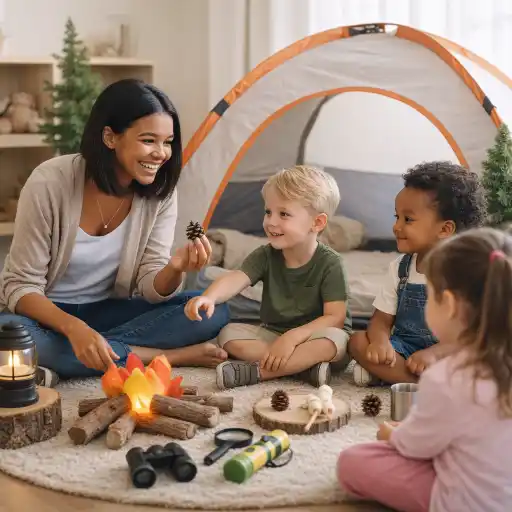
Extend the theme across learning centers:
- Library: Offer fiction and informational books about camping, forests, animals, and nighttime. Use interactive read-alouds to pause, explain unfamiliar terms, and ask children to predict or retell.
- Writing: Provide paper, markers, checklists, maps, sign-in sheets, and “camp menus.” Accept drawings, letter-like forms, copied words, and dictated sentences as meaningful literacy.
- Science: Invite children to compare rocks, leaves, or pinecones using words such as rough, smooth, heavy, light, wet, and dry.
- Construction: Encourage children to build a campsite and explain where objects belong using positional language.
- Art: Create nature collages or paint nighttime skies while discussing texture, color, shape, and pattern.
NAEYC guidance emphasizes that literacy materials belong throughout the classroom, not only in the book area. When teachers label spaces, model writing, and join children’s play with thoughtful prompts, the environment becomes an active partner in vocabulary development.
Which activities encourage children to use new camping words?
Children learn words most deeply when they use them for authentic purposes. Plan short, repeated activities that invite conversation rather than requiring children to repeat definitions.
- Mystery camping bag: Place a flashlight, map, toy fish, or fabric “sleeping bag” inside a bag. Offer clues and ask children to describe what they feel before revealing the object.
- Pack the backpack: Children choose items for a pretend hike and explain each choice: “I need a water bottle because I may get thirsty.”
- Camping story circle: Use picture cards to build a shared narrative. Encourage sequence words such as first, next, then, and finally.
- Map the trail: Create a simple classroom map. Children follow directions and describe locations using under, beside, across, and near.
- Campfire retelling: Use paper flames, animal puppets, or props to retell a familiar story and introduce expressive verbs such as whispered, searched, carried, and discovered.
- Word tracing and coloring: Use Summer Camping Words: Trace-and-Color Vocabulary Practice Buy Now $1.49 as a brief small-group activity, then connect each word to an object, gesture, sentence, or dramatic-play experience.
🌲 Make repetition playful by using a “word of the day” during arrival, snack, outdoor play, and departure. Children may hear “trail” in a story, use it while drawing, and act it out during movement. Multiple meaningful encounters are more powerful than a single worksheet.
How should teachers support multilingual learners and varied language abilities?
A camping theme should invite every child into communication, including children who are developing English, use communication devices, speak quietly, or are still building expressive language. Use photographs, real objects, gestures, signs, home-language labels, and predictable sentence frames. For example: “I see a ___,” “The ___ is under the ___,” or “I would pack ___ because ___.”
Teachers can expand, rather than correct, children’s language. If a child says, “Tent there,” respond, “Yes, the blue tent is beside the tree.” This models richer syntax while honoring the child’s contribution. Offer choices, allow wait time, and accept pointing, drawing, acting, signing, or using an assistive device as valid participation.
Invite families to share camping-related words and experiences from their communities. Not every family camps outdoors, and some children may associate outdoor travel with visiting relatives, fishing, picnics, gardens, or neighborhood exploration. Avoid presenting one version of camping as universal. Instead, ask open questions: “Where do you like to explore?” or “What do you bring when you spend time outside?”
For deeper professional learning, explore Building Bridges for Dual Language Learners Buy Now $16.00. The course addresses language-building activities, culturally responsive environments, and family collaboration—skills that help teachers make themed learning more inclusive.
How can providers assess vocabulary growth without disrupting play?
Assessment can be brief, natural, and connected to children’s ongoing activity. Rather than asking every child to define a word in isolation, observe how children use vocabulary during play, conversation, storytelling, and classroom routines. Record the context, the child’s exact words when possible, and the support provided.
A simple observation checklist might include whether a child:
- recognizes or points to a camping object when named;
- uses a new word spontaneously or after modeling;
- describes an object using one or more attributes;
- follows or gives a direction using positional language;
- uses a camping word in a sentence or story;
- connects a new word to a personal experience;
- communicates in a home language, English, or multiple modes.
Document progress across several settings. A child who says “tent” during a picture activity may later use “inside the tent” in dramatic play and “We packed the tent” during dictation. These examples show growth in vocabulary, syntax, comprehension, and purposeful communication.
Use observations to plan next steps. If a child understands “lantern” but rarely says it, provide more modeling and opportunities to request or describe the object. If a child uses many nouns but few action words, emphasize verbs during movement and storytelling. The Assessment of Language and Literacy Skills Buy Now $24.00 course can help providers strengthen objective observation, documentation, and individualized learning goals. State requirements vary - check your state licensing agency.
What common mistakes should programs avoid?
Camping themes are engaging, but the theme itself does not guarantee language growth. Intentional interaction is the essential ingredient. Avoid presenting a long vocabulary list without enough time for children to use the words. A smaller set repeated in meaningful contexts will usually produce stronger learning than hurried exposure to dozens of terms.
- Avoid worksheet-only instruction: Pair tracing with objects, movement, conversation, and play.
- Avoid quizzing every interaction: Use genuine questions and comments instead of constant “What is this?” prompts.
- Avoid correcting grammar harshly: Expand children’s statements naturally and respectfully.
- Avoid assuming shared experiences: Represent multiple family structures, cultures, languages, climates, and outdoor traditions.
- Avoid unsafe materials: Inspect natural items, supervise flashlights and loose parts, and follow program policies for outdoor or sensory activities.
- Avoid confusing recognition with mastery: A child may identify a picture but still need support using the word in conversation.
Directors can support consistency by creating a shared word list, providing common props, scheduling peer observations, and reviewing documentation during staff meetings. Teachers can select two or three target words for each child or small group, then revisit progress at the end of the week.
Conclusion: How can camping themes expand preschool vocabulary?
Camping themes expand preschool vocabulary when educators connect words to objects, actions, relationships, stories, and children’s lived experiences. A thoughtfully chosen word set, a print- and play-rich environment, repeated conversations, inclusive language supports, and brief formative observations can transform a seasonal theme into sustained language learning.
Use Summer Camping Words Buy Now $0.99 or the trace-and-color companion as one component of a larger plan—not as a replacement for interaction. Pair the resource with dramatic play, read-alouds, mapping, sensory exploration, shared writing, and family connections. When teachers observe carefully and respond intentionally, children gain more than camping labels: they develop confidence using words to describe, explain, imagine, and participate.
Related ChildCareEd courses:
- CDA Home Visitor Subject Area 2 Part 3 Birth to 5
- Reading Aloud and Storytelling
- Language and Literacy Foundations in Pre-K
- Art from the Heart for Preschoolers: Open Ended Art Projects that Build Self-Esteem
- 45-Hour Infant and Toddler Curriculum
- Assessment of Language and Literacy Skills
- Texas Director Credential
- Building Vocabulary
- Classroom Tools for Emergent Literacy
- Supporting Families and Caregivers in Language and Literacy
- CDA Certification en Español: Recursos y Consejos para Educadores Bilingües
- Curso Gratis De Cuidado Infantil Con Certificado
- Requisitos Para Ser Maestra Principal En Un Daycare: Lo Que Necesitas Para Empezar
- Celebra El Cumpleaños de Dr. Seuss En Tu Guardería Con Actividades Fáciles y Divertidas!
- Recursos en Español sobre el Sueño Seguro del Bebé
- 10 Ejemplos de Cómo la Cultura Influye en el Desarrollo Infantil
- Proporciones de Cuidado Infantil y Tamaños de Grupo por Edad en Nueva Jersey (Guía Rápida para Centros y Hogares)
- Proporciones de Cuidado Infantil y Tamaños de Grupo por Edad en Virginia (Guía Rápida para Centros y Hogares)
- Cómo Ayudar a Niños con Retraso del Habla en el Cuidado Infantil
- Retraso del Habla en la Guardería: Cómo Pueden Ayudar los Proveedores
- Cómo Trabajar en el Cuidado Infantil en Carolina del Norte: Requisitos y Pasos
- Cómo Ser Maestra de Preescolar en Illinois
- Cómo Ser Maestra de Preescolar en Wisconsin
- Cómo Ser Maestra de Preescolar en Maryland
- Calabazas, hojas y manzanas: actividades de otoño para preescolares
- Celebrando la amistad en el cuidado infantil durante el Día de los Mejores Amigos
- Canciones, juegos y preguntas de círculo para niños
- Cómo simplificar la capacitación para sus empleados de daycare
- How Can Camping Themes Expand Preschool Vocabulary?
- How Can You Teach a New Word So Children Use It Beyond the Activity?
