Guided play is a gentle way teachers help children learn while they are playing. This article explains how guided play grows the skills children need for kindergarten, especially in New York programs. You will find clear steps you can try, links to useful resources from ChildCareEd and others, and practical ideas for program leaders. Remember: state requirements vary - check your state licensing agency.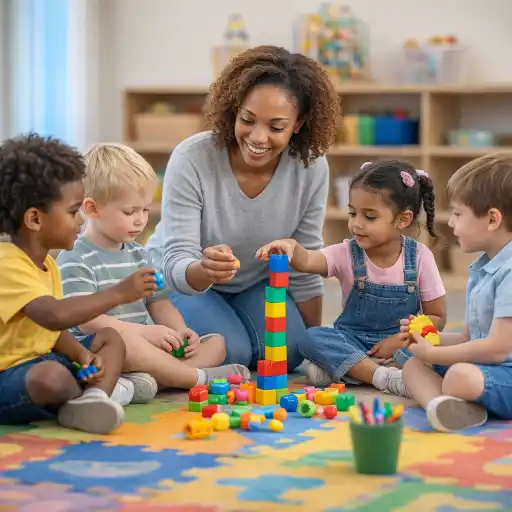
Why it matters:
1) Guided play helps children enjoy learning. Joy makes them try new words, count, and solve problems. See research summaries at ChildCareEd.
2) When guided play is done well, it supports lasting gains in language, self-control, and early math — skills that predict later school success (see RAND).
Key words we will use in this article: #guidedplay #schoolreadiness #playbased #preschoolers #NewYork
What is guided play,y and how does it look in a preschool classroom?
Guided play is play that children lead while adults add small ideas to push learning forward. It sits between free play and direct instruction. Teachers watch, listen, and step in with a question, prop, or idea that keeps the child in charge. For plain-language descriptions and steps, see ChildCareEd's guide to play-based learning and the Cambridge summary linked from ChildCareEd.
- 👀 Teachers observe first to learn what a child cares about.
- 🙂 Teachers add one small idea (a question, new word, or tool) to stretch learning.
- 🤝 Teachers step back so the child explores and tests ideas.
- 📸 Teachers record a quick note or photo to capture learning for planning and families.
Examples in New York classrooms: a block corner where a teacher shows a new shape word and then asks, "How can we make that bridge stronger?" or a dramatic play shop where the teacher adds number cards and asks, "How many cookies will you sell?" The New York Times described how city Pre-K programs use guided play in real classrooms (NYTimes), and university centers like the University at Buffalo Early Childhood Research Center show guided play in their play-based curriculum (ECRC).
Which school-ready skills does guided play build for New York preschoolers?
Guided play grows many skills at the same time. This is why it is powerful for #schoolreadiness. Research and plain-language reviews point to clear links between play and key early skills — language, thinking skills, self-control, social skills, and early math (see Play-Based Learning & Cognitive Growth and What Does Research Really Say About Play?).
- 🗣️ Language and vocabulary: Pretend play and stories let children try new words and longer sentences. Teachers add target words during play to boost talk.
- 🧠 Executive function and self-control: Games, routines, and problem-solving during play help children plan, remember steps, and wait their turn. See meta-analyses linking executive skills to math growth (Journal of Numerical Cognition).
- 🔢 Early math and spatial sense: Blocks, counting games, and playful measurement build number sense. Research and program reviews show guided play supports early numeracy (see Playful Learning).
- 🤝 Social skills: Role-play and cooperative games teach sharing, conflict-solving, and empathy. ChildCareEd gives practical friendship-building guided play ideas (How to Foster Friendship Skills).
- 🏃 Physical and sensory skills: Outdoor and sensory guided play support gross and fine motor growth and reduce stress (see How Play Helps Brain Development).
Why this matters in New York: well-planned guided play can support state Pre-K learning goals and prepare children for kindergarten. High-quality early programs produce benefits for children across backgrounds — evidence summarized by RAND and OECD supports investing in strong, play-rich early learning (RAND, OECD).
How can New York programs use guided play while meeting standards and family expectations?
Balancing play and measurable goals is doable. Child care leaders can design schedules, staff coaching, and family talks so guided play fits licensing and learning goals. For New York-specific guidance, ChildCareEd offers a short, practical guide on blending play and readiness for New York educators (Can play-based learning and academic readiness work together?).
Step-by-step checklist for programs (numbered):
- 🧭 Create a daily flow: routine, long free play block (30–60 minutes), guided play pockets, and short focused mini-lessons. This protects deep play time while allowing targeted instruction.
- 🎒 Equip centers with open-ended materials: blocks, loose parts, number cards in the block area, menus in dramatic play, and sensory bins.
- 👩🏫 Coach staff in guided moves: observe, join briefly, ask open questions, add a challenge, then step back. Use peer learning and PD — NYU research shows peer interaction strengthens teacher learning (NYU).
- 📋 Link play to goals: map simple learning targets (language, counting, self-regulation) to play areas and collect 1–2 quick observations per child each week.
- 🤝 Talk with families: share photos, short notes, and examples that show how play builds skills. Invite families to a guided play demo so they see the learning in action.
Remember to check rules: state requirements vary - check your state licensing agency for ratios, curriculum rules, and documentation expectations. For assessment tools, programs in New York often use observation-based measures like the DRDP (DRDP Preschool Measures) or developmentally appropriate local tools. Participatory approaches to readiness (involving teachers and families) can make assessment more useful and fair (Instructional Foundations for Kindergarten research).
What common mistakes should we avoid, and how can we assess progress?
Common pitfalls and quick fixes (numbered):
- ⚠️ Too much adult direction — Fix: adults should nudge with one small idea and then step back so children lead at least 70% of the play.
- ⚠️ Rushing play blocks — Fix: schedule at least one long block (30–60 minutes).
- ⚠️ Narrow, single-use toys — Fix: choose open-ended and rotated materials to spark imagination.
- ⚠️ No staff coaching — Fix: build regular peer reflection and short in-house coaching (NYU shows peer PD helps teacher confidence).
How to document learning (simple, practical steps):
- 📷 Take a photo and jot 1–2 notes: new words used, counting attempts, problem-solving steps.
- 📝 Use short checklists or observation notes aligned to goals (language, math, social). Tools like DRDP or Pearson resources can guide what to watch (DRDP, Pearson).
- 🔁 Share snapshots in staff meetings to plan next steps and to inform families.
FAQ (quick answers for directors):
- Q: How long should guided play be? A: Include at least one long block (30–60 minutes) plus short guided pockets. See ChildCareEd.
- Q: Can play teach math and literacy? A: Yes — guided play supports counting, spatial skills and vocabulary (see Playful Learning).
- Q: How do we explain play to skeptical families? A: Share photos and simple learning notes that show how play grows concrete skills. Invite families to watch a guided play session.
- Q: Where to get training? A: ChildCareEd courses and local PD; peer learning is powerful and cost-effective (ChildCareEd, NYU research). For hands-on modules and practical guidance on using play intentionally to support learning, see The Play’s the Thing!
Summary
1) Guided play is child-led play plus small, intentional supports from teachers. It builds language, thinking, social skills, and early math — all important for #schoolreadiness.
2) Make changes in three places: schedule (protect long play blocks), room setup (open-ended materials), and staff development (coaching + peer learning). ChildCareEd has practical tools and course links to support each step (ChildCareEd resources).
3) Document small moments. Use observation tools like DRDP and short notes to show growth to families and funders. And remember: state requirements vary - check your state licensing agency before big changes.
You are doing important work. Guided play gives children joyful ways to practice the skills they need for school — one guided question, one prop, and one photo at a time.
- CDA Home Visitor Subject Area 2 Part 3 Birth to 5
- CDA Preschool Credential with Portfolio Review
- 1,2,3, Eyes on Me: Classroom Safety
- Children at the Wheel: Emergent Curriculum
- Pediatric RSV First Aid & CPR/AED
- CDA Bridge Bundle: Family Child Care without Portfolio Review
- CDA Bridge Bundle: Infant/Toddler without Portfolio Review
- CDA Bridge Bundle: Preschool without Portfolio Review
- Creating Environments that Nurture Growth and Community
- Texas Director Credential
- CDA Certification en Español: Recursos y Consejos para Educadores Bilingües
- What Skills Really Matter for Kindergarten Readiness (and Why Worksheets Aren't the Answer)?
- Lista para Abrir una Guardería en Casa en Dakota del Norte: Cómo Empezar
- Actividades de Otoño Fáciles para Preescolares esta Temporada
- How can child care providers use the science of reading to boost early literacy in New York?
- Can play-based learning and academic readiness work together for New York educators?
- What age-appropriate learning activities should we use for infants, toddlers & preschoolers in New York?
- How Do Art Activities Support Cognitive Growth in North Dakota Preschoolers?
- How Can We Help Children Make Friends?
- How can providers offer free child care for 2‑year‑olds in New York?
- How Can We Teach Preschoolers Through Play?
- Celebrando la amistad en el cuidado infantil durante el Día de los Mejores Amigos
- What indoor activities help New York child care programs stay safe and happy during a heat wave?
- What Kindergarten Readiness Skills Should My Program Build?
- How do New York day care supervision and ratio rules keep children safe?
- How Does Guided Play Build School-Ready Skills in New York Preschoolers?
- How can we prepare children for the transition to kindergarten in New York?
- How can music and movement help New York preschoolers?
- Why Do Open-Ended Toys Beat Battery-Powered Ones?
- How Can Child Care Programs Build Meaningful School Readiness?
