Play is not a break from learning—it is one of the primary ways young children develop physically, cognitively, socially, and emotionally. This article gives child care providers and directors a practical, research-informed roadmap for using play to strengthen motor skills, problem-solving, creativity, communication, cooperation, and self-regulation. It includes specific classroom strategies, inclusive adaptations for different abilities and interests, guidance for balancing child-directed and teacher-supported experiences, and ideas for documenting the learning that occurs during play. To deepen staff practice, explore ChildCareEd’s self-paced online course From Play to Planning: Building Culturally Competent, Child-Centered Curriculum  Buy Now $55.00, which covers play-based learning, child development, problem-solving, scaffolding, inclusive environments, and developmentally appropriate curriculum planning. Through intentional observation and thoughtful support, programs can ensure that play strengthens children’s bodies, minds, relationships, and confidence.
Why it matters: Two short reasons.
1) Foundation for lifelong learning — Play builds movement patterns, language, executive function, and peer skills that predict later academic and social success. See the ChildCareEd synthesis on how play fuels early learning and school readiness as part of The Power of Play.
2) Holistic and efficient — A single play episode can simultaneously practice gross motor coordination, symbolic thinking, problem solving, and cooperation: high-impact learning in a natural context (see How Play Supports Brain Development).
How does play support children’s physical growth and motor skills?
Play is the primary context for building gross and fine motor competence in early childhood. Active, unstructured movement and targeted motor challenges both contribute to strength, balance, coordination, and the sensorimotor foundations required for later self-care and classroom tasks.
- Physical systems strengthened by play (brief):
- Muscles, bone density, and cardiovascular health through running, climbing, and sustained activity — documented benefits summarized by the CDC.
- Fine motor control from manipulative play such as blocks, stringing, and scooping — essential for pencil use and self-help skills (ChildCareEd: Importance of Play).
- Postural control and cross-lateral coordination from obstacle courses and gross-motor games, which support later attentional stamina (Eastern CT resources).
- Practical, enumerated classroom moves:
- 😊 Provide daily outdoor blocks of time (longer, less fragmented sessions) so children can sustain active play — outdoor play amplifies both physical and mental benefits (ChildCareEd: Outdoor Play).
- 🏃 Offer at least three types of movement choices: locomotor (running, hopping), manipulative (balls, scoops), and balance (stepping stones, beams).
- 🔧 Intentionally rotate materials to challenge fine motor skills (tongs, small blocks, threading) and plan a weekly "motor challenge" like simple obstacle courses (Eastern CT).
- Safety note: follow safe practices when using outdoor spaces and water play; the CDC offers guidelines on supervision, sun/heat precautions, and playground design (CDC: Outdoor Play and Safety).
How does play shape the developing brain and cognitive skills?
Play is cognitive practice. It creates contexts for symbolic thinking, problem solving, language expansion, and the executive function skills that support self-regulation, working memory, and flexible thinking. Neuroscience and developmental studies converge on the idea that early, varied play experiences strengthen neural circuits and lay groundwork for school learning.
- Mechanisms by which play builds cognition:
- Symbolic and pretend play: transforms objects and invites abstract representation—an early scaffold for reading comprehension and math symbols (see the classic review on pretend play and cognition in ECRP: Bergen).
- Executive function practice: turn-taking games, rule-based play, and planning (e.g., building a complex structure) rehearse inhibitory control, working memory, and mental flexibility (ChildCareEd: Playful Learning).
- Language and narrative development: role play and storytelling expand vocabulary, complex syntax, and conversational skills (ChildCareEd: Brain Development).
- Practical strategies (enumerated):
- 🧩 Scaffold complexity: start with simple pretend scripts and gradually introduce multi-step roles and problem-solving challenges.
- 🎭 Use guided pretend-play prompts: ask open prompts like “What happens next?” or “How will you solve that?” to stretch planning and reasoning.
- 📚 Pair play with literacy: place books, labels, and simple recording tools in play centers so symbolic play and print experiences overlap (ChildCareEd: Power of Play).
- Evidence highlights: longitudinal and experimental research links high-quality pretend play with perspective-taking, problem solving, and higher-order cognition; more applied studies are encouraged, but current findings support robust investment in play-based curricula (Bergen).
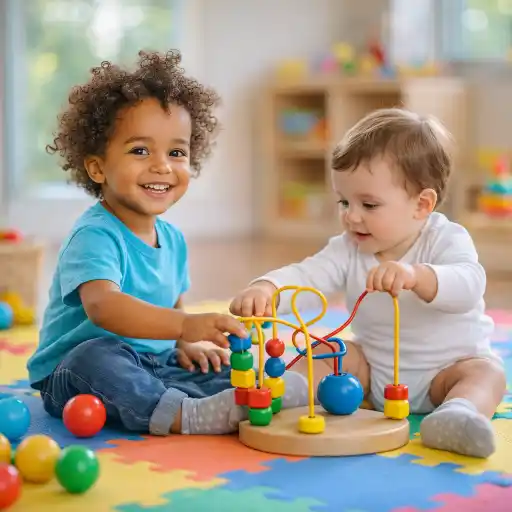
How does play promote social-emotional learning and peer competence?
Social pretend play, cooperative games, and guided peer interactions are among the strongest classroom tools for developing empathy, conflict-resolution skills, language for emotion, and relationships that sustain learning. Play is where children practice, fail, repair, and rehearse social roles in an emotionally safe context.
- Core social-emotional gains from play:
- Perspective-taking and theory of mind grow through role play and negotiated scripts (ECRP: Bergen).
- Turn-taking, sharing, and co-planning in group play build pragmatic language and peer skills (CSEFEL).
- Conflict resolution practice within play supports emotional regulation and reduces escalation in classroom settings (ECRP: Nurturing Social Experience).
- Practical steps (enumerated):
- 😊 Teach social scripts explicitly — short role-play modeling for greetings, asking to join, or resolving a toy conflict.
- 🤝 Create structured partner activities that require shared planning (e.g., two-child construction projects) to promote collaboration and joint attention.
- 🔁 Use short reflection moments: after block play or dramatic play, ask children to name feelings, strategies used, and solutions tried.
- Special considerations: children with developmental delays benefit from higher adult scaffolding and planned social prompts; see targeted guidance in Play with Purpose Buy Now
$55.00$40.00 and ECRP special education studies (Recchia).
How can caregivers design environments, routines, and adult roles to maximize play-based learning and avoid common pitfalls?
Intentional design aligns space, materials, schedule, and adult interactions so play is frequent, safe, rich, and observable as evidence of learning. Below are practical, enumerated recommendations and common mistakes with ways to avoid them. Remember: state requirements vary - check your state licensing agency as you adapt spaces or change schedules.
- Design elements (enumerated):
- 🧺 Learning zones: define centers for dramatic play, blocks, art, sensory, and quiet reading. Rotate provocations weekly to sustain interest (ChildCareEd Resources).
- 🌤️ Daily outdoors: schedule at least one long outdoor block (not just 10-minute recesses) to allow sustained motor and social play (ChildCareEd).
- 📋 Observation systems: use simple checklists or anecdotal notes tied to developmental goals (e.g., a weekly executive-function target) and share highlights with families.
- Adult roles and interactions:
- Facilitator more than director — follow children's interests, step in briefly to extend play, and model language rather than taking over.
- Guided play balance — combine child-led exploration with targeted scaffolding (ask a question, add a prop, suggest a challenge).
- Coaching families — share newsletters or brief videos that demonstrate play strategies families can replicate at home (Play, Learn, Grow course Buy Now $16.00).
- Common mistakes and how to avoid them:
- ❌ Over-scheduling adult-directed instruction — avoid fragmenting play with too many short teacher-led lessons; instead integrate learning objectives into play blocks.
- ❌ Underpreparing outdoor areas — plan materials and risk-aware challenges; follow CDC safety guidance for heat, sun, water, and playground design (CDC).
- ✅ How to avoid pitfalls: commit to at least 60–90 minutes of continuous free play spread across the day, document learning through quick observation notes, and use small, intentional adult interventions to expand complexity.
How do you observe, assess, and support individual differences — including children with special needs — during play?
Play reveals strengths and needs. Observation-based assessment lets educators capture authentic demonstrations of skills across motor, cognitive, and social domains. For children who need adaptations, play is also the most natural venue for supported practice.
- Observation and documentation (enumerated):
- 📝 Use brief, targeted tools: time-sampling, event sampling, and annotated photos/videos linked to learning objectives provide usable data for planning.
- 📊 Record frequency and quality: how often a child initiates interaction, how they solve play problems, or how they sustain a physical skill are actionable metrics.
- 📂 Link notes to individual plans: tie observations to developmental goals and share progress with families and specialists.
- Supporting individual needs:
- Provide materials with multiple entry points (e.g., larger blocks, tactile options, picture supports) so children of differing abilities can participate together (Play with Purpose Buy Now
$55.00$40.00). - Use peer-mediated supports: buddy systems and cooperative tasks can scaffold social initiation for children who need assistance (ECRP special ed study).
- Work with specialists: when behaviors or delays are persistent, collaborate with early interventionists, therapists, or mental health consultants to adapt play materials and expectations (CSEFEL).
- Provide materials with multiple entry points (e.g., larger blocks, tactile options, picture supports) so children of differing abilities can participate together (Play with Purpose
- Inclusion checklist (quick):
- ✅ Accessible materials and varied sensory options.
- ✅ Small-group or 1:1 supported play times built into the schedule.
- ✅ Shared goals with families and documented strategies that everyone can use.
State and licensing reminder: state requirements vary - check your state licensing agency for staffing ratios, outdoor time standards, and documentation rules when you adjust schedules or routines.
Conclusion — What should you do Monday morning?
Quick, actionable takeaways for child care leaders and providers:
- 🕒 Prioritize longer, uninterrupted play blocks (including outdoors) across the day.
- 📚 Intentionally scaffold pretend and gameplay to target language and executive-function skills.
- 🤝 Use short social scripts and peer-mediated activities to teach cooperation and empathy.
- 🔍 Observe play with a purpose — brief notes tied to goals make progress visible for families and funders.
- ♿ Design for inclusion — materials, roles, and routines should offer multiple entry points for all learners (ChildCareEd resources).
FAQ
- How much play time is appropriate each day? Aim for multiple long play blocks totaling at least 60–120 minutes for preschoolers, with one sustained outdoor session; younger children need frequent movement opportunities. Factor in your state licensing guidance.
- How do you demonstrate learning through play for regulators or families? Use brief observation notes, photos with captions of targeted skills, and portfolio samples linking play episodes to developmental goals (see Play, Learn, Grow Buy Now $16.00).
- Is guided play better than free play? Both are important: free play promotes creativity and peer negotiation; guided play lets you nudge complexity toward explicit learning goals. Use a mix.
- How do we keep playing safely outdoors? Follow CDC guidance on supervision, sun safety, hydration, and appropriate equipment (CDC).
- How do we support children with autism in play? Provide predictable routines, visual supports, peer buddies, and focused adult scaffolding; see ChildCareEd’s Play with Purpose Buy Now
$55.00$40.00 for strategies.
Play is not a luxury — it is the most efficient, natural, and joyful way children practice the skills they will use for life. Use the practical steps above, cite your observations, and keep families informed. For deeper training and downloadable materials, ChildCareEd offers practical courses and free resources linked throughout this article. If staff or prospective educators are considering careers in early childhood education and want a clear account of how preschool teachers use play and structured activities to foster learning, see the article Myth: Preschool's Just About Playing with the Kids.
- CDA Home Visitor Subject Area 3 Part 3 Birth to 5
- CDA Home Visitor Subject Area 2 Part 3 Birth to 5
- The Best Promotion is Play
- Balancing Physically Active Play in Child Care
- CDA Bridge Bundle: Family Child Care without Portfolio Review
- CDA Bridge Bundle: Infant/Toddler without Portfolio Review
- The Best Promotion is Play
- CDA Bridge Bundle: Preschool without Portfolio Review
- Texas Director Credential
- Balancing Active Play in Child Care
- Building Social Foundations
- The Family Day Care Chronicles: Tales of Laughter, Learning, and Unexpected Adventures
- Hungry for Play: The Power of Play-Based Learning in Early Education
- CDA Certification en Español: Recursos y Consejos para Educadores Bilingües
- 🔍 ¿Qué ves cuando observas a un niño aprender?
- 💛🧩 ¿Cómo puedo hacer que mi enseñanza sea inclusiva para los niños con autismo?
- 10 Ejemplos de Cómo la Cultura Influye en el Desarrollo Infantil
- Capacitación Previa al Servicio para Proveedores de Cuidado Infantil en Nevada
- Canciones, juegos y preguntas de círculo para niños
- How Does Play Support Children’s Physical, Cognitive, and Social Growth?
- What Is the Difference Between Early Childhood Education and Child Development?
- More Than ABCs and 123s: The Real Importance of Early Childhood Education
- How Can Child Care Providers Support Gross Motor Development in Every Child?
- Why Is Outdoor Play Essential for Healthy Child Development?
