Working in New York child care means you see small moments of upset and small chances to teach skills. This article gives simple, practical steps for directors and #teachers to teach #conflict resolution and #sharing every day. You will find short scripts, room ideas, ways to help children who struggle, and tips to partner with families. Remember: state requirements vary - check your state licensing agency.
How can teachers teach quick conflict-resolution skills children can use?
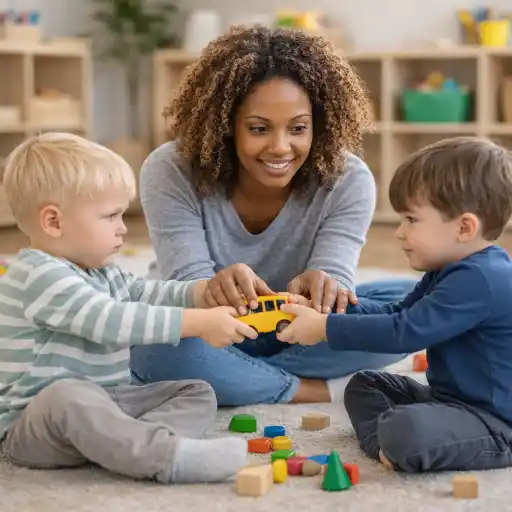
Short steps work best. Teach skills children can remember and use during play, transitions, or on the playground. Use these quick, repeatable moves and link them to classroom routines and visuals from Conflict Resolution Skills You Can Teach in Under 2 Minutes and Teaching Preschoolers How to Work Through Conflict.
- 😊 Stop, Breathe, Talk: Model a deep breath and a short script—"Stop. I feel ___. Can I have a turn?" Practice it often so children can use it when upset.
- 🕒 Offer clear choices: Teach three fast options—trade, take turns with a timer, or play together. Use a sand timer so turns feel fair (sharing & turns).
- 💬 Teach an "I message": "I feel ___ when you ___. Can we ___?" Keep the sentence short and practice with puppets.
- 🔧 Fix-it moment: Ask, "How can we make your friend feel better?" Teach quick repairs (say sorry, help rebuild, return the toy).
- 👏 Notice and praise: Be specific—"You waited for the timer—thank you for sharing the truck." Specific praise helps skills repeat. See CSEFEL guidance for prompting and praise (CSEFEL What Works Briefs).
Practice these steps in calm times (circle, guided play) and keep coaching to one short sentence in the moment. Children learn best by copying and trying again.
What room setups and routines reduce #conflict and teach #sharing?
The room and schedule do most of the work. Simple environmental designs and routines lower hurt feelings and make teaching easier. Use ideas from ChildCareEd on toddler and preschool setups (reduce toddler conflicts) and daycare conflict guides (Daycare Conflict Resolution).
- 😊 Zones & low shelves: Create clear areas (blocks, art, quiet). Low shelves let children choose without shouting.
- 🧸 Fewer toys out & duplicates: Limit how many of one item are available and add duplicates of popular toys to prevent grabbing.
- ⏳ Visual timers & turn cards: Put a picture timer or turn card at the child's level so waiting is visible and fair (teaching sharing without forcing).
- 📋 Picture schedule & short transitions: Post a simple schedule and give 1–2 minute warnings. Predictability reduces meltdowns.
- 🛋️ Peace corner: Add calm tools (breathing posters, feeling cards, sensory bottle). Teach the corner when children are calm so it is not a punishment (positive handling).
- 🔍 Watch patterns: Track when conflicts happen (time, place, toy) and change routines or add materials as needed. Caring for safety and health standards is important—see Caring for Our Children.
Small room changes and short routines give children many chances each day to practice #sharing and turn-taking.
How do I support children who struggle to join, share, or make friends?
Some children need extra help. Use simple supports, practice, and family partnership. Research and practice (see special education classroom study) show that teacher supports make a big difference. Consider adding short, structured friendship-building activities— for example, celebrating National Friendship Day with partner games and scripted invitations—to create low-stakes opportunities for children to practice joining, turn-taking, and friendly approaches.
- 🎯 Priming before play: Tell a child who to ask and what to say—"Ask Maya, 'Can I play when you’re done?'" This small step boosts success (priming & scripts).
- 🎭 Role-play & rehearsal: Practice joining, asking, and turn scripts with puppets or a staff helper. Keep scenes short and fun (role-play ideas).
- 🤝 Peer buddies: Set up a "Friendship Helper" or buddy so one peer invites a child to join and models language.
- ♿ Adapt the environment: Offer larger pieces, quieter corners, visual steps, or fewer toys to reduce overwhelm. Small changes help many children join in.
- 📣 Work with families: Share one home script and quick strengths-first notes. Family practice helps skills generalize to home and school. Also remember: state requirements vary - check your state licensing agency.
If a child continues to struggle, collect simple notes (when, where, what) and team with specialists or mental health consultants. Use CSEFEL tools for more step-by-step teaching (CSEFEL Module 2).
Why does teaching these skills matter, and how do we partner with families and staff?
Why it matters: Teaching #empathy, sharing, and problem-solving builds friendships, lowers injuries, and makes your program calmer. Children who feel connected learn better. Restorative and relationship-based approaches strengthen trust—see CDC notes on restorative practices.
- 🤝 Partner with families: Send a short note: strength + fact + plan ("Lina helped clean up today; we are practicing 'Can I have a turn?' at school. Try it at home too."). Keep messages short and positive (family partnership).
- 👥 Train your team: Pick 3 power phrases for everyone to use (example: "Stop, breathe, talk"; "My turn"; "Can I have a turn after you?"). Rehearse in staff meetings so responses stay consistent (training outcomes).
- 🔁 Use data and follow-up: Note repeating conflicts and adjust the room, schedule, or teaching plan. If safety is a concern, follow program and state reporting rules (see Caring for Our Children).
Common mistakes and how to avoid them:
- 🚫 Forcing sharing — Teach choices and offers instead of taking toys away. See gentle sharing.
- 🚫 Long lectures during a meltdown — Use one short sentence now and teach later when calm.
- 🚫 Inconsistent staff language — Pick 3 phrases and practice them together so children get the same message.
FAQ (short):
- Q: How fast will I see change? A: Small wins in weeks; stronger habits in months with daily practice.
- Q: What if conflicts keep repeating? A: Track patterns, team-plan, and bring in specialists if needed.
- Q: Are visuals helpful? A: Yes—timers, pictures, and cards help children who are learning language.
- Q: Where to get lesson tools? A: ChildCareEd has printable cards, peace corner ideas, and short courses linked above.
Summary checklist to use this week:
- 😊 Pick 3 power phrases and teach them to staff and families.
- 🧸 Set up a peace corner and add a timer and feeling cards.
- 🎭 Practice short role-play scenes twice this week during circle time.
- 🔍 Track one repeating conflict and try one small room or schedule change.
You are helping children learn skills that last. Small, steady teaching, clear routines, and warm partnerships with families turn fights into practice for real life. Thank you for the care you give New York’s #children every day.
- You're Not My Friend Anymore: Learning Conflict Resolution
- Teach with Respect ONLINE
- 45 Hour Preschool Methods and Materials
- Birth to Five CDA Credential with Portfolio Review
- Teach with Respect!
- Pediatric RSV First Aid & CPR/AED
- CDA Bridge Bundle: Family Child Care without Portfolio Review
- CDA Bridge Bundle: Infant/Toddler without Portfolio Review
- CDA Bridge Bundle: Preschool without Portfolio Review
- Texas Director Credential
- Preparing Your Child for a New School Year: Social Skills and Independence
- How Can Childcare Educators Thrive in the Big Apple?
- From Challenges to Triumphs: Strategies for Childcare Educators in New York
- CDA Certification en Español: Recursos y Consejos para Educadores Bilingües
- How to Handle Daycare Conflicts in a Positive Way
- Teaching Preschoolers How to Work Through Conflict
- Celebrando la amistad en el cuidado infantil durante el Día de los Mejores Amigos
- How can New York child care programs teach conflict resolution and sharing?
- How Can Child Care Providers Teach Children to Share and Take Turns Without Forcing Them?
- How Can Child Care Providers Turn Conflict Into Learning?
- How Can Child Care Providers Teach Children to Solve Conflicts With Each Other?
- How Can Teachers Encourage Sharing Without Forcing It?
- How Can Child Care Providers Teach Young Children to Take Turns?
- How Can Child Care Providers Teach Sharing Without Forcing It?
- How Can Child Care Providers Teach Conflict Resolution to Preschoolers?
- How Can Child Care Providers Teach Preschoolers to Wait Their Turn?
- What Are the Best Ways to Support Children Who Struggle with Sharing?
- How Can Educators Teach Respectful Disagreement in a Montessori Classroom?
