Child care leaders: this short guide helps you answer a big question for your program. We explain how #play and intentional teaching support #learning and #readiness for school. We write for #teachers and directors in #NewYork and link simple research and New York guidance so you can act confidently. State requirements vary - check your stat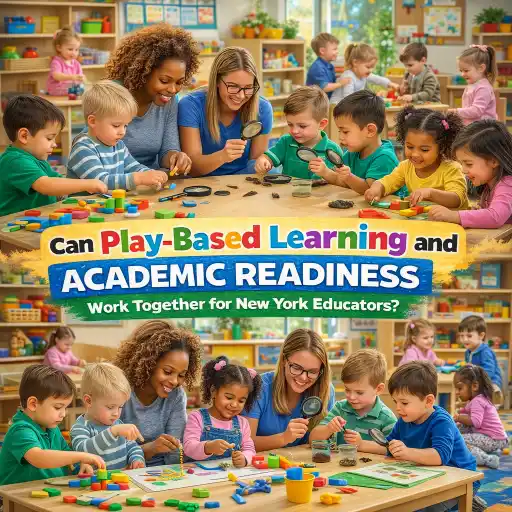 e licensing agency.
1) What is play-based learning, and why does it matter?
Why it matters:
- Play builds many skills at once: words, memory, self-control, and creativity. See Play-Based Learning and Cognitive Growth.
- High-quality play can support later school success. Large reviews (for example, OECD summaries) show benefits when programs are well run (OECD).
- Play can teach early math: board games and guided block activities improve number skills (play-based math study, board games review).
2) Does play hurt academic readiness in New York?
Practical points for your site:
- 😄 Keep long play blocks (30–60 minutes), so children can explore deeply.
- 🧠 Use guided play: ask questions that nudge learning (What will you build next?). ChildCareEd explains guided play steps in plain language (research summary).
- 🤝 Mix short teacher-led mini-lessons for phonics or number work with play centers. This balances both goals.
Why many experts agree: play builds executive function, which links to later math and classroom success (executive function meta-analysis).
3) How can New York educators balance play and measurable academic goals?
- 🙂 Plan with 4 parts: routine, free play, guided play, and short focused lessons.
- Routine: arrival, circle time, transitions.
- Free play: child-led centers for creativity.
- Guided play: teacher prompts in centers to stretch vocabulary or counting.
- Focused lessons: 5–15 minute small-group sessions for phonics or number games.
- 😃 Use simple, open-ended materials (blocks, loose parts, sensory bins). ChildCareEd has room-planning and activity ideas (Power of Play).
- 🧾 Document learning: quick notes, photos, or a checklist tying play to goals (language, math, social).
- 🚫 Avoid these common mistakes:
- Rushing play — fix: give long uninterrupted blocks.
- Adults taking over play — fix: ask one guiding question, then step back.
- Using only single-use toys — fix: rotate open materials.
- 📚 Train staff. ChildCareEd offers courses such as Play, Learn, Grow Buy Now $25.00, and Play Safe, Think Big
 Buy Now $10.00 to build skills in supervision + literacy. For additional practical workshops focused on using play intentionally in early childhood classrooms, see The Play’s the Thing!.
4) What policies, licensing, and family conversations should New York programs watch for?
Know your local rules and be ready to explain play to families:
- Understand New York standards: the State Education Department added PreK learning standards and aligned them with K-12 (NYSED memo).
- State requirements vary - check your state licensing agency for ratio, outdoor time, and curriculum rules.
- Talk with families using these steps:
- 👍 Share examples and photos showing how play grows language and math.
- 📊 Show short assessments or work samples tied to play goals.
- 🤝 Invite families to a play demonstration so they see guided play in action.
- FAQ (quick):
- Q: How long should a play be? A: Aim for at least one long play block (30–60 minutes).
- Q: Can play teach math and literacy? A: Yes—guided play, games, and board games support early numeracy and literacy (board games review).
- Q: What if a parent wants worksheets? A: Explain research and show how play teaches the same skills (see ChildCareEd summaries).
- Q: Where to get staff training? A: ChildCareEd courses and local PD. State requirements vary - check your state licensing agency.
Conclusion: What should a New York program do first?
- Start with one schedule change: add a 45-minute uninterrupted play block.
- Pick one learning goal per week (language or counting) and use guided play to support it.
- Document with a photo and 1–2 notes to share with families and supervisors.
- Invest in one staff training: try ChildCareEd's Play, Learn, Grow Buy Now $25.00 session.
Play and early academic goals belong together when adults plan with purpose. For plain-language research summaries and classroom ideas, visit ChildCareEd resources such as What Does Research Really Say About the Power of Play? and The Power of Play. Remember: check state rules before major changes — state requirements vary - check your state licensing agency.
Short answer: No. When staff plan play with goals, children meet many school-ready skills. Evidence shows that play supports literacy, math basics, and self-regulation. Some studies and news pieces note that more academic preschool can show early gains, but careful programs blend play and focused teaching rather than replace play (see NYTimes summary). Follow these practical steps you can use today. State standards in New York include PreK learning standards and Common Core alignment; see the New York guidance for PreK (NYSED PreK & CCSS memo). Play-based learning means children learn through guided and free play. It includes pretend play, block play, games, and outdoor time. Research and summaries from ChildCareEd explain that play helps language, thinking, social skills, and early math (see What Does Research Really Say About the Power of Play?) and The Power of Play.- How motor skills shape child development and creative ways educators can foster them.
- CDA Certification en Español: Recursos y Consejos para Educadores Bilingües
- CDA Certification Requirements in New York: Everything You Need to Know
- 😫🧸 ¿Qué hacer cuando un bebé no quiere dormir la siesta en el aula?
- Proporciones de Cuidado Infantil y Tamaños de Grupo por Edad en Virginia (Guía Rápida para Centros y Hogares)
- Actividades de Otoño Fáciles para Preescolares esta Temporada
- Can play-based learning and academic readiness work together for New York educators?
- Canciones, juegos y preguntas de círculo para niños
- What Kindergarten Readiness Skills Should My Program Build?
- How Does Guided Play Build School-Ready Skills in New York Preschoolers?
- Why Do Open-Ended Toys Beat Battery-Powered Ones?
- More Than ABCs and 123s: The Real Importance of Early Childhood Education
- Preschool Teacher Qualifications: What’s Required to Get Hired—and What Helps You Move Up?
- How Can Teachers Support Children Starting Kindergarten This Fall?
- Why May Emotional Self-Regulation Matter More Than Academic Skills Before Kindergarten?
- What Should Child Care Providers Prioritize When Preschool Readiness Goals Compete for Time?
