When a child knows an animal but cannot quite name it, a playful clue can help bring the word within reach. Use short, purposeful games to strengthen animal vocabulary, encourage confident communication, and connect spoken words with print; Understanding Print Knowledge in Preschool  Buy Now $16.00 offers two hours of online learning on the foundations of print and effective instruction. For a ready-to-use activity, explore ChildCareEd’s Word Search - Farm Animals resource and adapt it into a supported, conversation-rich experience.
Why do animal word-finding games matter?
- Repeated, enjoyable encounters strengthen understanding and confidence.
- Describing features builds vocabulary beyond simple labels.
- Conversation connects animal words to children’s knowledge and experiences.
- Print activities can invite attention to letters and how written words represent spoken language.
Celebrate attempts, pauses, gestures, and home-language responses as participation. The goal is to make communication feel safe and worthwhile while helping children gradually retrieve more precise words.
How can educators turn a farm-animal word search into a language game?
Try a flexible sequence with ChildCareEd’s Word Search - Farm Animals:
- Preview: show two or three farm-animal pictures and name each one.
- Clue: offer an attribute or sound—“This animal gives us wool” or “Which animal says ‘moo’?”
- Search: help the child find the printed word, pointing to the first letter or tracking across the grid together.
- Connect: match the word to its picture, toy, animal sound, or movement.
- Recall: cover the picture and invite the child to name or describe it again.
For children who are not ready to search independently, use the page as a picture-and-word matching prompt or let them point while an adult tracks the letters. Keep the print-knowledge course Buy Now $16.00 in mind as a source of deeper professional learning: print activities work best when educators deliberately connect spoken language and written text rather than expecting a worksheet to teach by itself.
Which prompts help children retrieve and use animal words?
Useful prompts during a farm-animal activity include:
- “What do you notice about its body?”
- “Where might we see this animal?”
- “What sound does it make? Can you say the name with me?”
- “Is it the animal with feathers, or the one with wool?”
- “Can you think of another animal that lives on a farm?”
How can the games include multilingual learners and varied communication styles?
Children bring different languages, experiences, and communication preferences to a farm-animal game. Invite families to share animal names in home languages, and use those words as an asset rather than treating them as a detour from learning. Pair spoken labels with photographs, gestures, objects, and simple signs. Children can demonstrate understanding by speaking, pointing, matching, acting out a movement, drawing, signing, or using an augmentative communication tool.
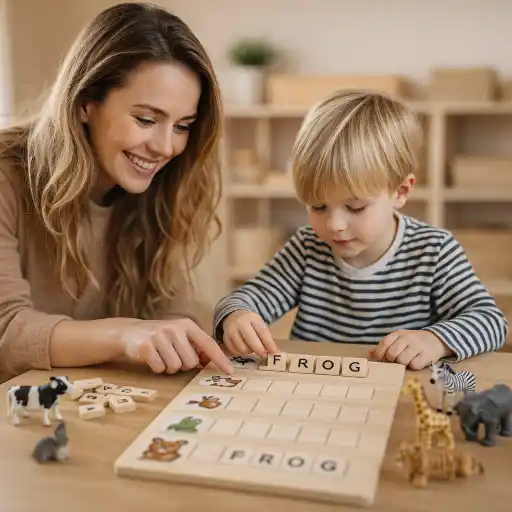
Adjust the activity’s demands while keeping its purpose—recognizing and communicating animal vocabulary—within reach:
- Offer a small choice of pictures before introducing the full word search.
- Use large, high-contrast images and cover parts of the page to reduce visual clutter.
- Provide extra processing time and allow a partner or adult to model a turn.
- Accept a gesture, sound, home-language word, or picture choice as a meaningful response.
- Let children match animal figures to pictures before attending to printed labels.
How can providers observe progress and avoid common pitfalls?
Use the game as an opportunity for informal observation, not a pass-or-fail assessment. Notice whether a child recognizes an animal picture, retrieves its name, responds to a clue, uses a descriptive word, or connects a spoken label to print. Record brief, objective notes—such as “matched cow and sheep pictures independently” or “named the pig after hearing its sound.” Over time, these observations can help you choose which words to repeat and what support to offer next.
Common pitfalls are easy to address:
- Making speed the goal: allow children time to scan, think, and respond.
- Correcting every attempt: acknowledge the message, then model the target word.
- Introducing too many animal names at once: begin with a small, familiar set.
- Relying on the puzzle alone: add talk, pictures, objects, movement, and read-alouds.
- Assuming every child must speak: provide several valid ways to communicate.
Conclusion: What helps animal vocabulary stick?
Word-finding games strengthen animal vocabulary when children hear and use target words repeatedly, receive patient clues, and connect language to meaningful pictures, sounds, movements, and play. A farm-animal word search can be a helpful starting point when educators adapt the task to children’s developmental readiness and communication styles.
Keep the experience brief, offer wait time, model rather than pressure, and note small signs of progress. Pair the printable with books and dramatic play so words are encountered in varied contexts. For a deeper foundation in how print works and how to teach it intentionally, explore Understanding Print Knowledge in Preschool Buy Now $16.00. A playful search can open the door; responsive conversation helps children carry new words into the rest of their day.
- Understanding Print Knowledge in Preschool
- Easy Steps to Resume and Interview Success
- Language and Literacy Foundations in Pre-K
- Setting the Stage: Story Time
- CDA Bridge Bundle: Family Child Care without Portfolio Review
- CDA Bridge Bundle: Infant/Toddler without Portfolio Review
- CDA Bridge Bundle: Preschool without Portfolio Review
- Play with Purpose: Supporting Children with Autism
- Texas Director Credential
- Building Vocabulary
- Actividades de Motricidad Gruesa que Desarrollan el Equilibrio, la Coordinación y la Fuerza
- 10 Ejemplos de Cómo la Cultura Influye en el Desarrollo Infantil
- Which Oklahoma Farms and Ranches Offer Preschool Field Trips That Teach About Animals and Community?
- How Can We Teach Self-Regulation Skills to Preschoolers?
- Can Screen-Free Board and Movement Games Help Young Children Learn and Stay Calm?
- What’s Happening Outside? Fall Science Adventures for Preschoolers
- Can You Build a Leaf Bridge? Fall STEM Challenges for Pre-K
- How Can Fun Bingo Games Teach Colors, Shapes, and Animals to Preschoolers?
- After School Activities for Elementary Kids Who Finish Homework Early
- What Toddler Activities Encourage Language and Communication?
- How Can Sound Bingo Sharpen Listening Skills in Preschoolers?
- Why Is Wild vs. Farm Animal Sorting a Favorite Preschool Activity?
- How Can Child Care Providers Build Phonological Awareness in Preschool?
- How Can Bingo Games Make Learning Feel Like Play?
- How Can Child Care Providers Teach Beginning Sounds with Tracing, Pictures, and Repetition?
- How Can Child Care Providers Move Children from Letter Recognition to Beginning-Sound Awareness?
- How Can Holiday Word Games Strengthen Visual Scanning and Spelling?
- How Can Word-Finding Games Strengthen Preschoolers’ Animal Vocabulary?
- How Can Reading Games Build Wildlife Vocabulary in Early Childhood?
- How Can Farm-Animal Games Build Listening and Vocabulary?
