When children search for animal words, they are doing more than solving a puzzle: they are noticing print, connecting words with prior knowledge, and building language they can use in play and conversation. Try a short wildlife word search alongside books and discussion, and explore Assessment of Language and Literacy Skills  Buy Now $24.00 to strengthen your ability to observe children’s language and literacy development and turn those observations into meaningful learning goals. The strategies below can help make a simple game a lively, inclusive part of your classroom’s literacy routine.
Why does wildlife vocabulary deserve intentional attention?
Animal themes readily spark children’s interest, but knowing a few animal names is only the beginning. As children encounter words such as habitat, nocturnal, predator, and camouflage, they gain language for describing what animals look like, where they live, and how they behave. Rich vocabulary gives children tools to express questions and connect ideas across books, science, and imaginative play.
- Connects print and spoken language to children’s interests.
- Invites children to notice details and ask questions about animals.
- Creates natural opportunities to use new words in conversation and play.
Keep the purpose clear: this is not a test of who can read the most words. The goal is to invite curiosity and build #vocabulary through supported exploration.
How can you turn a word search into a vocabulary game?
Start by choosing a small set of wildlife terms that children will encounter in a book, photograph, or classroom discussion. Before handing out the puzzle, show a few animal pictures and invite children to name what they know. Add useful descriptive words as they arise: a tiger has stripes, an eagle has feathers, and a fox may live in a den. A word list with clear print and matching illustrations gives children more than one clue to draw on.
For younger preschoolers or emerging readers, focus on matching a printed word to a picture rather than finding every letter independently. Read the word aloud, say its first sound, and invite children to locate it together. Children who are ready for more can scan the grid, trace a word with a finger, or explain how they found it. You might use a resource such as Word Search - Wild Animals as the puzzle component, then add your own animal photographs and discussion prompts.
- Introduce each target word with a picture, gesture, or short child-friendly explanation.
- Model a search strategy: find the first letter, then track across or down.
- Celebrate careful looking and collaboration, not speed.
- Ask a follow-up question: “What do you notice about this animal?”
Make the activity conversational. When children find “lion,” extend the moment: “A lion has a mane. What else can you tell me about lions?” This turns word recognition into meaningful oral language.
How can books and play help words stick?
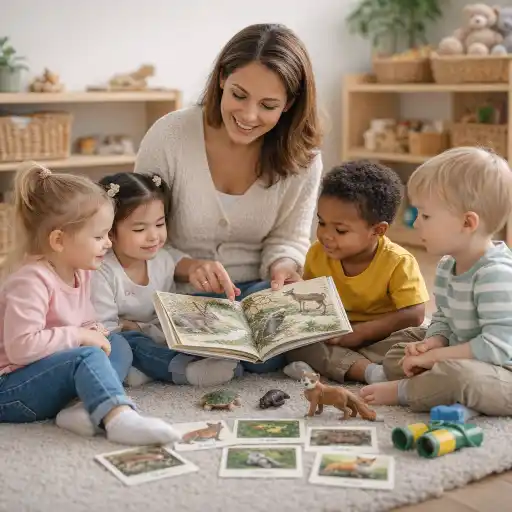
A word search works best as one part of a connected literacy experience. Read a nonfiction picture book or an engaging animal story, pausing to explain a few high-value words with images and examples. On a later reading, invite children to listen for those words, point to the matching animal, or predict what a character might do. Repeated readings create familiarity, while play gives children a reason to use new language themselves.
After reading, place toy animals, habitat pictures, and simple props in a play area. Children might build a forest, act out an animal rescue, or sort creatures by where they live or how they move. Ask open-ended questions such as “What does this animal need in its habitat?” and “How are these two animals alike?” Classification invites children to compare and explain; see how classification questions can build science vocabulary for related ideas.
- Use new words naturally in your own narration and conversation.
- Invite children to draw an animal and dictate a caption or fact.
- Offer puppets, figures, or blocks so children can reenact ideas from a book.
- Revisit the words over several days in stories, centers, and outdoor observations.
📚 Try a “word-to-world” connection: after children find an animal word, locate that animal in a book or photograph and discuss one feature or habitat detail. This supports #literacy while keeping the activity anchored in meaning.
How can you make the game inclusive and developmentally appropriate?
Children approach print and language with different abilities, experiences, and home languages. Preserve the learning goal—exploring animal words—while offering varied ways to participate. A child can point to a matching picture, use a gesture or communication device, name an animal in a home language, trace a word, or work with a partner. These are meaningful forms of engagement, not shortcuts.
Adjust the puzzle’s complexity to fit the group. Use a small number of large, clearly printed words; reduce visual clutter; and provide extra time. For children who are not yet ready to scan a grid, make a picture-and-word matching game from the same vocabulary. Children who want an additional challenge can search in more directions, sort found words by habitat, or create a new animal clue for classmates.
- Offer large-print copies, high-contrast materials, and uncluttered layouts.
- Provide picture cards, spoken labels, gestures, and home-language terms where possible.
- Use partner play or cooperative searching rather than a speed-based contest.
- Offer pointing, eye gaze, drawing, or verbal responses as appropriate.
How can educators observe and extend children’s learning?
Use the game as an opportunity for informal, purposeful observation. Notice which animal words children recognize, whether they connect words to pictures, what strategies they use, and how they describe or group animals. A completed puzzle does not tell the whole story: a child’s explanation, gesture, drawing, or collaborative strategy may provide richer evidence of understanding.
Make brief, objective notes that can guide your next activity. For example: “Sam matched ‘bear’ to the picture and said it lives in the forest,” or “Ari found ‘owl’ after listening for the opening sound.” Record what you observed rather than assigning a label or drawing a broad conclusion from one activity.
- What words did the child recognize or use?
- What clues or strategies supported the child’s participation?
- What would be a useful next step: rereading, picture matching, storytelling, or a habitat sort?
For a deeper professional learning opportunity, Assessment of Language and Literacy Skills Buy Now $24.00 explores objective observation, assessment methods, and using information to plan meaningful learning goals. State requirements vary - check your state licensing agency when considering whether a course meets a specific professional development requirement.
Conclusion: How can reading games build wildlife vocabulary?
Reading games build wildlife vocabulary when educators connect print to pictures, conversation, books, and play. A word search can invite children to notice letters and animal names, but the richest learning happens when providers help children use those words to describe, question, compare, and imagine. Choose a manageable set of terms, adapt materials so everyone can participate, and revisit vocabulary in meaningful contexts.
Observe children’s strategies and language, then use what you learn to plan the next step—perhaps another story, a habitat-building center, or a drawing with dictated animal facts. With playful repetition and responsive teaching, a simple wildlife puzzle can become a welcoming doorway into early #reading, science, and communication.
- Understanding Print Knowledge in Preschool
- CDA Home Visitor Subject Area 3 Part 3 Birth to 5
- Setting the Stage: Story Time
- 24 Hour Texas Pre-Service
- Texas Director Credential
- Classroom Tools for Emergent Literacy
- Building Vocabulary
- Classroom Tools for Emergent Literacy
- Supporting Families and Caregivers in Language and Literacy
- How to Foster Early Literacy Skills
- CDA Certification en Español: Recursos y Consejos para Educadores Bilingües
- 📖 ¿Cómo puedo hacer que la hora del cuento sea la parte más poderosa de mi día?
- 👶 ¿Cuáles son las proporciones y grupos requeridos en Dakota del Norte? 🏫
- Recursos en Español sobre el Sueño Seguro del Bebé
- Cómo Ayudar a Niños con Retraso del Habla en el Cuidado Infantil
- Retraso del Habla en la Guardería: Cómo Pueden Ayudar los Proveedores
- Cómo Trabajar en el Cuidado Infantil en Carolina del Norte: Requisitos y Pasos
- Cómo Ser Maestra de Preescolar en Illinois
- Cómo Ser Maestra de Preescolar en Maryland
- What fun literacy activities do Florida VPK classrooms need now?
- How can child care providers use the science of reading to boost early literacy in New York?
- Capacitación CDA gratuita en Illinois
- Canciones, juegos y preguntas de círculo para niños
- Cómo simplificar la capacitación para sus empleados de daycare
- What simple early literacy activities really help children learn?
- How can North Dakota child care programs lay reading foundations the right way?
- Can we build early literacy skills through play in high-quality child care?
- How Can Animal Vocabulary and Repetitive Sentences Help Preschoolers Become Confident Readers?
- How Can Reading Games Build Wildlife Vocabulary in Early Childhood?
