What if a crisp leaf, pinecone, or puddle became the starting point for scientific thinking? Fall gives child care providers an inviting, low-cost context for observation, prediction, movement, language, and discovery. To strengthen your outdoor learning environment, explore Creating the Natural Outdoor Classroom  Buy Now $16.00, a course that offers practical strategies for bringing colors, sounds, textures, and scents into purposeful experiences and may support your professional training goals.
Why does fall provide such a rich science classroom?
Fall changes the environment in ways preschoolers can see, hear, touch, and describe. Leaves shift from green to yellow, orange, or red; seeds and nuts appear; temperatures cool; daylight changes; and many animals prepare for winter. These visible changes make abstract ideas concrete. Rather than asking children to memorize seasonal facts, educators can help them investigate what is happening directly outside.
Nature-based learning also supports more than science. Outdoor experiences encourage #curiosity, sustained attention, movement, cooperation, vocabulary, and creative representation. The CDC notes that outdoor play gives children opportunities to move, test limits, practice skills, and support healthy development. NAEYC similarly describes nature as a setting rich with spontaneous questions and extended investigations. ChildCareEd’s sensory learning guidance emphasizes how fall’s colors, sounds, textures, scents, and movement invite meaningful exploration.
For directors, the value is practical: one short walk can generate documentation across science, math, language, physical development, and social-emotional learning. A child who compares two leaves is practicing classification. A child who predicts whether an acorn will float is using early scientific reasoning. A group that builds a shelter for a toy animal is collaborating and engineering.
- 🍂 Visual inquiry: compare colors, shapes, patterns, and signs of change.
- Auditory inquiry: listen for crunching leaves, birds, wind, and water.
- Tactile inquiry: notice smooth, rough, dry, damp, soft, and hard surfaces.
- Movement inquiry: explore balance, force, speed, and body awareness.
How can teachers turn children’s observations into scientific inquiry?
Effective preschool science begins with children’s noticing. A teacher does not need to provide an elaborate explanation immediately. Instead, observe what children are investigating and use a simple inquiry sequence: notice, wonder, predict, test, and represent. This structure keeps the experience playful while making scientific thinking visible.
Begin with a provocation such as a basket of leaves, a mysterious hole in a tree, or a pinecone that opens and closes. Ask, “What do you notice?” and give children time to respond through speech, gesture, drawing, or their home language. Follow with questions that invite reasoning: “What do you think happened?” “How could we find out?” and “What changed?”
For example, children may wonder why some leaves are dry while others are flexible. They can sort leaves, mist some with water, and compare them later. The goal is not a perfectly controlled experiment; it is supporting children in connecting actions with observations.
ChildCareEd’s guide on hands-on scientific thinking recommends allowing children to observe, predict, test ideas, and explain results without placing excessive emphasis on correct answers. This approach positions the child as an investigator and the educator as a thoughtful scaffold.
- Use one clear question at a time.
- Offer a small number of materials so attention stays focused.
- Accept unexpected results as opportunities for further questions.
- Repeat investigations so children can compare experiences over time.
Which fall science adventures can we try outdoors?
Fall activities work best when they are simple, repeatable, and connected to observable phenomena. A short outdoor investigation can later continue at a science table, in a journal, or during group discussion.
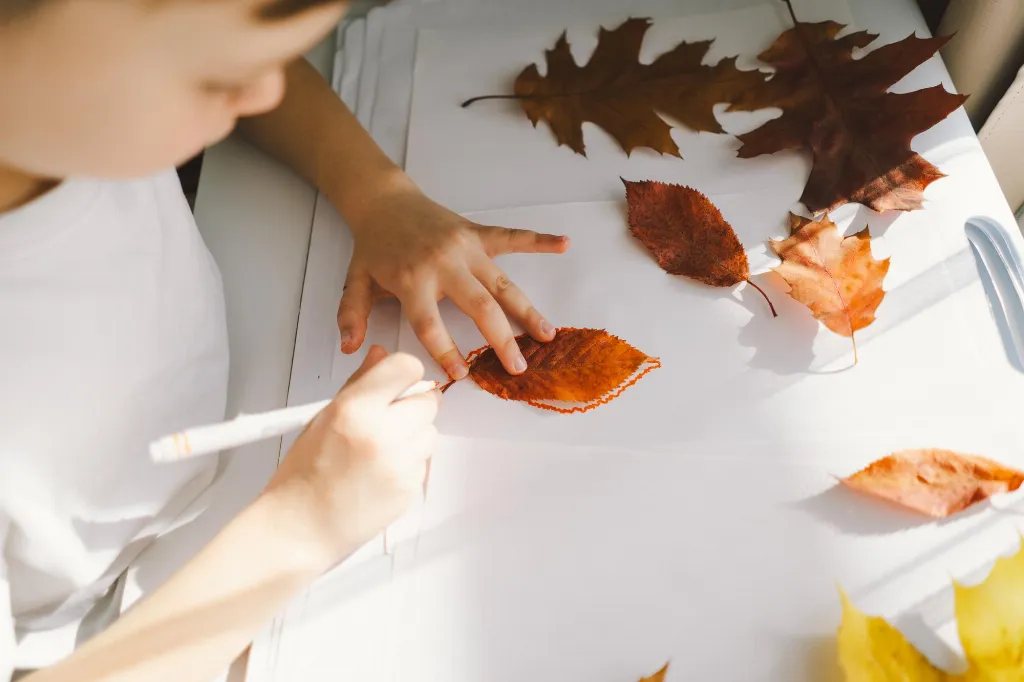
- Leaf detectives: Invite children to collect a few leaves, then compare color, size, shape, texture, and veins. Use magnifiers and create a class “leaf museum.”
- Sink-or-float fall collection: Test large, age-appropriate objects such as apples, gourds, pinecones, and leaves. Children predict first, then record outcomes with drawings or picture charts.
- Pinecone weather watch: Observe pinecones over several days and discuss whether they open or close in different conditions. Avoid presenting the activity as a weather predictor; focus on noticing changes and asking why they may occur.
- Seed sorting and counting: Compare seeds from pumpkins, apples, or nearby plants. Sort by size or shape and count in small groups.
- Leaf chromatography: With close adult supervision, use leaves, rubbing alcohol, and coffee filters to reveal hidden pigments. This is best suited to older preschoolers and should be completed by adults or in a carefully managed small group.
- Animal preparation walk: Look for nests, tracks, food remains, or changing habitats. Discuss how animals may migrate, store food, grow thicker coverings, or seek shelter.
- Nature engineering: Challenge children to build a small shelter for a toy animal using sticks, leaves, stones, and fabric. Ask what makes the structure stable and protective.
ChildCareEd’s autumn STEM projects offer additional ways to connect pumpkins, pinecones, and leaves with measurement, classification, buoyancy, chemistry, and engineering.
How can fall investigations support language, math, and movement?
Strong outdoor science is interdisciplinary by nature. Children need language to describe evidence, math to compare quantities, and movement to interact with materials. Intentional prompts help educators recognize and extend these connections.
Build vocabulary with words such as vein, stem, bark, damp, brittle, heavier, lighter, float, sink, shelter, migrate, and change. Pair each word with a real object, gesture, photograph, or home-language equivalent. Invite children to dictate observations for a teacher to write: “My leaf is dry and curled.” These statements provide meaningful evidence of both conceptual understanding and language development.
Math can emerge through sorting, counting, ordering, measuring, and patterning. Children might arrange leaves from smallest to largest, make a color graph, estimate the number of seeds, or compare how many objects floated. Keep representations developmentally appropriate: toddlers may match two colors, while older preschoolers may tally results or explain which group had more. For ideas on adapting curiosity-led discovery for younger children, explore science experiences for infants and toddlers.
Movement adds another dimension. Walking on different surfaces, carrying a basket, stepping over branches, or testing how leaves move in wind supports balance, coordination, and #gross-motor development. Outdoor play also gives children space to collaborate and negotiate roles.
ChildCareEd’s leaf-themed art and science strategies demonstrate how one material can support STEM, sensory exploration, fine-motor practice, storytelling, and collaborative learning.
How can we make outdoor fall science safe and inclusive?
Thoughtful preparation protects the joy of exploration. Before going outside, complete a quick hazard scan for sharp objects, standing water, unstable branches, poisonous plants, animal waste, and traffic risks. Use active supervision: position adults for clear sight lines, scan continuously, listen, and move as needed.
Outdoor comfort matters as much as physical safety. Check weather, heat, air quality, and local conditions. Offer water, shade, layers, rain gear, and spare clothing. Follow family permissions and program policies for sunscreen or insect repellent. The CDC recommends attention to sun, heat, hydration, insects, playground hazards, and constant supervision around water.
Adapt investigations so every child can participate. Offer seated and standing versions, large tools instead of tiny objects, visual sequence cards, tactile choices, and communication supports. A child who does not want to touch wet leaves might observe with tongs or a magnifier. A child developing English can point, draw, use a home-language word, or repeat a phrase modeled by an adult.
Be especially cautious with acorns, seeds, small stones, and other choking hazards. Avoid collecting unknown plants or mushrooms. Wash hands after outdoor exploration, and check allergy information before using food materials such as pumpkin pulp or apples. State requirements vary - check your state licensing agency.
- Plan a weather backup: move the collection indoors or use photographs and replicas.
- Limit choices: two or three focused invitations are easier to supervise.
- Protect living things: observe animals without handling or disturbing them.
- Explain boundaries: practice where children may walk, collect, and investigate.
How should educators document and extend children’s discoveries?
Documentation does not need to become a burdensome assessment project. Capture one photograph, one child quote, and one brief observation connected to a learning goal. For example: “Maya predicted the wet leaf would be heavier, then lifted both leaves and revised her idea.” This records prediction, comparison, language, and flexible thinking.
Use a simple cycle for planning:
- Observe: What are children repeatedly noticing?
- Interpret: What concepts or questions may be emerging?
- Plan: Which materials or prompt could extend the investigation?
- Revisit: What changed after children tested the idea?
- Share: How can families see and continue the learning?
Display children’s drawings beside real leaves, charts, photos, or dictated explanations. During group time, invite children to compare their findings rather than asking for one “right” answer. At home, families might look for three leaf colors, observe a bird, or compare a wet and dry object.
Common mistakes include overexplaining, collecting too many materials, rushing children through transitions, and documenting only finished crafts. To avoid these pitfalls, protect uninterrupted investigation time, use open-ended questions, and document the process. A leaf rubbing is valuable not because it looks identical to a leaf, but because children noticed texture, pressure, shape, and detail while creating it.
For providers who want deeper support with inquiry-based curriculum, Building Early Science Foundations Buy Now $16.00 can help strengthen developmentally appropriate strategies for exploration, experimentation, and discovery. Lesson Planning for Preschoolers Buy Now $24.00 is another useful option for organizing goals, materials, and follow-up observations.
Conclusion: How can fall science adventures become part of everyday practice?
Fall science does not require expensive equipment or elaborate units. It begins with a genuine question about something children can see, touch, hear, or change. A leaf hunt, pinecone observation, seed investigation, or nature-building challenge can become a rich learning experience when educators pause, listen, document, and return to children’s ideas.
The central question—what is happening outside?—has many answers. Leaves are changing, animals are adapting, weather is shifting, and children are developing theories about their world. By treating the outdoors as a living classroom, providers support science, language, math, movement, creativity, and belonging in one connected experience.
Start with one 15-minute investigation this week. Ask one open question, provide a few safe materials, record one child’s thinking, and use that observation to plan the next adventure. Small, consistent invitations can grow into a culture of #discovery that children and educators look forward to all season.
Five practical courses for continued professional learning
- Creating the Natural Outdoor Classroom Buy Now $16.00 — design nature-rich outdoor experiences.
- Building Early Science Foundations Buy Now $16.00 — support inquiry, experimentation, and discovery.
- Lesson Planning for Preschoolers Buy Now $24.00 — plan developmentally appropriate investigations.
- 1,2,3, Eyes on Me: Classroom Safety Buy Now
$32.00$24.00 — strengthen supervision and safe-environment practices indoors and outdoors.
- Building Early Science Foundations
- CDA Family Child Care Credential
- Birth to Five CDA Credential with Portfolio Review
- 24 Hour Texas Pre-Service
- Emergent Learning & Development
- 45-Hour Infant and Toddler Curriculum
- Positive Attention: Interactions & Supervision for Infants & Toddlers
- IEPs and IFSPs in Family Child Care
- ¡El Método Científico en el Aula!
- 🚌🍑 Ideas de excursiones en Georgia
- Actividades de Motricidad Gruesa que Desarrollan el Equilibrio, la Coordinación y la Fuerza
- Capacitación en Salud y Seguridad Preventiva en Línea para Proveedores de Cuidado Infantil
- Proporciones de Cuidado Infantil y Tamaños de Grupo por Edad en Maryland (Guía Rápida para Centros y Hogares)
- Proporciones de Cuidado Infantil y Tamaños de Grupo por Edad en Carolina del Norte (Guía Rápida para Centros y Hogares)
- Actividades de Otoño Fáciles para Preescolares esta Temporada
- Ejemplos de Crianza Respetuosa vs. Crianza Permisiva
- Cómo Trabajar en el Cuidado Infantil en California: Requisitos y Pasos
- How can preschool teachers safely use summer weather and cloud activities with kids in Oklahoma?
- How can we use nature-based learning through Minnesota's outdoor seasons?
- Autumn Activities for Toddlers and Preschoolers
- Calabazas, hojas y manzanas: actividades de otoño para preescolares
- Celebrando la amistad en el cuidado infantil durante el Día de los Mejores Amigos
- How can outdoor learning help young children grow and learn?
- How Can Childcare Programs Use Nature-Based Science Activities to Strengthen Learning?
- What’s Happening Outside? Fall Science Adventures for Preschoolers
- Hello, Fall! Cozy Activities to Help Babies Explore the Season
- Go on a Fall Hunt! Outdoor Learning Challenges for Preschoolers
- Field Trips for Elementary Students: 15 Adventures That Bring Learning to Life
