What if a familiar bingo board could turn “pay attention” into joyful, purposeful listening practice? Sound Bingo gives preschoolers repeated opportunities to notice, compare, remember, and respond to sounds. For a deeper foundation in oral language and early literacy, explore Language and Literacy Foundations in Pre-K  Buy Now $16.00, which can help you strengthen classroom listening, speaking, vocabulary, and communication practices while earning professional development training.
Why does listening practice matter in preschool?
Listening is more than hearing a teacher’s voice. It involves directing attention, distinguishing one sound from another, connecting sound to meaning, holding information in memory, and responding appropriately. These abilities support communication, participation in group routines, following directions, vocabulary development, and later reading.
Sound discrimination is also connected to phonological awareness. Children gradually learn that spoken language contains patterns and smaller units, including syllables, rhymes, onset-rime combinations, and individual phonemes. A child who can hear that cat and cap end differently is building an important foundation for later word analysis.
For providers, this matters because listening challenges can easily be mistaken for inattention or noncompliance. A child may be trying hard but struggling to separate a teacher’s voice from background noise, remember a multistep direction, or distinguish similar sounds. Playful practice offers support without making children feel tested.
- Strengthens auditory attention and discrimination.
- Builds sound-to-picture and sound-to-meaning connections.
- Encourages turn-taking, self-regulation, and verbal participation.
- Creates observable evidence for individualized planning.
How does Sound Bingo develop auditory discrimination?
In Sound Bingo, children listen to a sound, identify its likely source, and locate the corresponding image on a card. That sequence requires several mental actions: attending to the stimulus, comparing it with stored experiences, selecting among visual possibilities, and communicating a choice. Repeated rounds help children become more deliberate listeners.
Begin with highly contrasting sounds, such as a bell, dog bark, drum, or running water. Once children are successful, introduce sounds that are more alike or ask them to compare characteristics such as loud and soft, high and low, fast and slow, or natural and human-made. Environmental sound activities similarly invite children to notice, identify, and discuss sounds around them.
Sound Bingo can also shift from environmental sounds to speech sounds. For example, show pictures of a sun, a sock, and a moon. Say one word and invite children to cover a picture beginning with the same sound. This supports initial-phoneme awareness without requiring children to read.
Be mindful that pronunciation varies across communities and languages. The goal is not to enforce one accent; it is to help children hear meaningful contrasts in the language being taught.
How can educators prepare an inclusive Sound Bingo game?
Preparation should serve the learning goal rather than overwhelm children with materials. Choose six to twelve familiar images for a first round and use large, uncluttered cards. Pictures may represent animals, instruments, classroom objects, household sounds, or words sharing an initial sound. If you record sounds, check the volume before children participate and avoid sudden, startling audio.
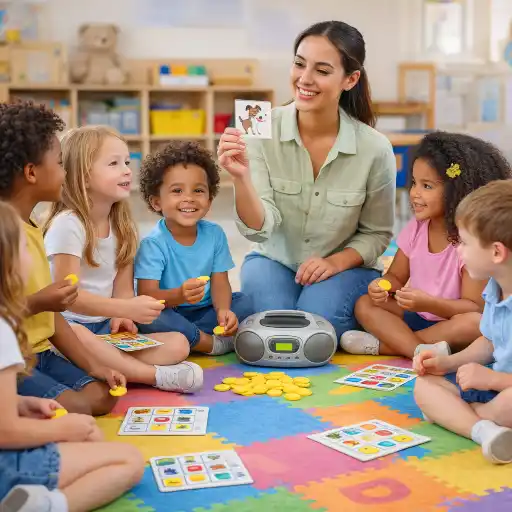
- Use counters that are large enough to reduce choking risk and easy to grasp.
- Provide one shared board for cooperative play or individual boards for more practice.
- Offer picture choices, gestures, signs, or verbal responses.
- Seat children where they can see the caller and limit competing noise.
- Include familiar experiences and culturally responsive images.
- Allow children to replay a sound or ask for repetition.
Children with auditory sensitivities may need a quieter location, warning before a sound is played, or the option to observe before participating. Children who are learning English may benefit from pictures, gestures, home-language labels, and peer modeling. A child who does not speak can point, touch, sign, or use eye gaze to indicate a choice.
Use accessible participation as a strength-based practice: preserve the listening objective while varying how children demonstrate understanding. Never require blindfolding, and do not use loud sounds as a test of attention.
What are effective ways to scaffold the game?
Scaffolding allows each child to experience an appropriate level of challenge. During the first round, show the object or picture, name it, and play its sound. Next, play the sound without showing the source and offer two or three picture choices. Later, invite children to identify the sound from a larger field or explain how they know.
- Start with matching: Play a sound and point to the matching image together.
- Move to choice-making: Offer a small selection and wait for the child’s response.
- Add language: Ask, “What did you hear?” or “Was it loud or soft?”
- Increase memory demands: Play two sounds and ask children to remember their order.
- Invite leadership: Let children select or produce sounds for peers.
Use wait time generously. Preschoolers may need several seconds to process an unfamiliar sound, search the board, and decide. If a child chooses incorrectly, respond with curiosity rather than correction: “Let’s listen again. Which picture could make that sound?” Peer collaboration can also be helpful; one child may identify the source while another locates it.
Keep whole-group rounds brief and use small groups when children need more individualized feedback. A five- to ten-minute experience can be more productive than a long game in which children lose focus.
How can Sound Bingo connect to broader classroom learning?
Sound Bingo becomes more powerful when it is part of a listening-rich curriculum rather than an isolated activity. After a sound round, invite children to investigate the source. A dog sound can lead to a conversation about animal communication, a drum sound can lead to rhythm exploration, and a rain sound can inspire descriptive writing, movement, or art.
- Take a listening walk and add newly discovered sounds to the game.
- Read a story and pause when children hear an animal, vehicle, or weather sound.
- Clap syllables in the names of pictured objects.
- Sort sounds into loud/soft, natural/human-made, or indoor/outdoor categories.
- Use instruments for children to create a classroom soundscape.
- Connect beginning-sound cards to children’s names and familiar objects.
These extensions support #vocabulary, memory, classification, movement, and social communication. They also give children multiple ways to revisit the same concept. For example, a child may hear a bell in Bingo, locate a bell during a sound hunt, describe its tone, and use the word in a story.
Sound play should remain developmentally appropriate. Preschool phonemic awareness can be oral and playful; children do not need to memorize extensive letter-sound lists to benefit. When introducing letters, clearly distinguish between hearing a sound and identifying its written symbol.
How can providers observe progress and avoid common mistakes?
Observation during play can reveal more than a right-or-wrong score. Record whether a child attends to the entire sound, distinguishes contrasting sounds, identifies a source, remembers a sequence, uses descriptive language, or requests support. Compare observations across several sessions rather than concluding after one round.
Useful notes might include: “Maya identified the bell and drum independently but needed a replay for the shaker,” or “Luis pointed to the picture beginning with /m/ after hearing the word twice.” Such notes can guide the next step and support conversations with families.
Common mistakes include playing sounds that are too loud, using too many choices, rushing responses, and turning the game into a competition. Avoid eliminating children who make mistakes; the purpose is practice, not winning. Also avoid assuming that difficulty reflects a hearing problem or a lack of effort. Persistent concerns should be documented and discussed through appropriate program and family processes.
Remember that state requirements vary - check your state licensing agency. For additional support in documenting children’s strengths and planning responsive experiences, consider Preschool Assessments & Observations Buy Now $24.00.
Conclusion: How can Sound Bingo sharpen preschoolers’ listening skills?
Sound Bingo sharpens listening by transforming auditory discrimination, attention, memory, and communication into a meaningful social game. Children listen for information, connect sounds with images or words, make decisions, and explain their thinking. With careful scaffolding, the activity can move from simple environmental sound matching to initial-sound awareness and auditory sequencing.
The most effective implementation is brief, inclusive, responsive, and connected to children’s interests. Reduce background noise, use safe and familiar materials, allow multiple response modes, and observe what each child can do. Extend the learning through stories, sound walks, music, movement, and conversations. When educators treat mistakes as information rather than failure, every round becomes another opportunity for confident #listening and joyful #learning.
Professional learning can help you connect these playful experiences to broader classroom goals. Explore Science of Reading Foundations in the Pre-K Classroom Buy Now $16.00 for additional strategies related to phonological awareness, vocabulary, comprehension, and emergent literacy.
Additional course options for child care providers
- Open Ears: Listening in Child Care Buy Now $16.00 — focuses on active and empathetic listening in child care communication.
- Language Development in Early Childhood Buy Now $16.00 — explores strategies for language growth and verbal and nonverbal communication.
- Tailoring Instruction to Children’s Needs Buy Now $24.00 — supports differentiation and scaffolding for varied abilities.
- Lesson Planning for Preschoolers
- Language Development in School Age
- Safe and Sound: Creating Healthy Environments for Every Child
- Language and Literacy Foundations in Pre-K
- Using AI Language Models for Trainers
- The ABCs of Behavior: Turning Challenges into Learning Opportunities
- Open Ears: Listening in Child Care
- Working Together: Teachers & Preschoolers
- CDA Bridge Bundle: Preschool without Portfolio Review
- Supporting Families and Caregivers in Language and Literacy
- CDA Certification en Español: Recursos y Consejos para Educadores Bilingües
- 🔍 ¿Qué ves cuando observas a un niño aprender?
- 10 Ejemplos de Cómo la Cultura Influye en el Desarrollo Infantil
- Proporciones de Cuidado Infantil y Tamaños de Grupo por Edad en Maryland (Guía Rápida para Centros y Hogares)
- Actividades de Otoño Fáciles para Preescolares esta Temporada
- Celebrando la amistad en el cuidado infantil durante el Día de los Mejores Amigos
- Canciones, juegos y preguntas de círculo para niños
- What No-Prep Activities Can Busy Early Childhood Teachers Use Tomorrow?
- How Can Fun Bingo Games Teach Colors, Shapes, and Animals to Preschoolers?
- How Can Sound Bingo Sharpen Listening Skills in Preschoolers?
- How Can Bingo Games Support Turn-Taking and Social Skills?
- Why Is Animal Bingo a Great Way to Introduce Habitats and Classification?
- Why Is Beginning-Sound Bingo a Smart Step Toward Reading?
- How Can Bingo Games Make Learning Feel Like Play?
- What Skills Can Preschoolers Build Through Bingo?
- How Can Child Care Providers Strengthen Young Children’s Listening Skills?
- How Can Child Care Providers Teach Beginning Sounds with Tracing, Pictures, and Repetition?
- How Can Farm-Animal Games Build Listening and Vocabulary?
- How Can Listening and Movement Games Build Children’s Shape Recognition?
- How Can Preschool Bingo Build Shape Reasoning Beyond Naming?
