Meaningful conversation can begin with a gesture, a sound, or a toddler’s determined point toward a favorite toy. Child care providers can turn ordinary play into rich opportunities for #language, connection, and confidence; Language Development in Early Childhood  Buy Now $16.00 offers practical strategies for supporting verbal and nonverbal communication, including sign language. To strengthen your activity planning as well, explore Baby Play: Planning Infant and Toddler Activities Buy Now $16.00, which helps providers design individualized, developmentally appropriate experiences.
Why does play matter for toddler communication?
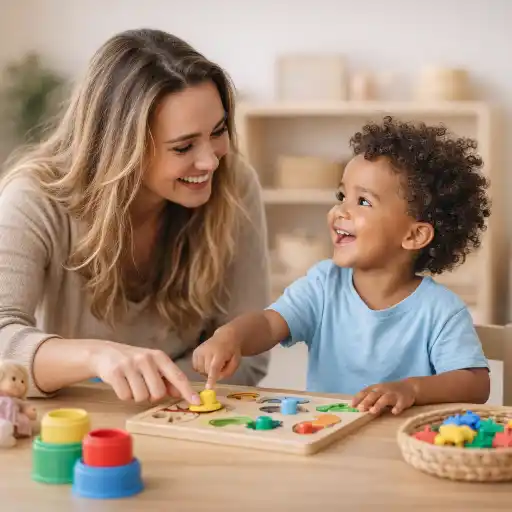
Play gives toddlers a meaningful reason to communicate. Rather than practicing isolated vocabulary words, children use communication to request a turn, describe a discovery, solve a problem, imitate an adult, or invite a peer into pretend play. These authentic purposes make language memorable and emotionally relevant.
Responsive adults are central to this process. NAEYC recommends following children’s interests, naming objects and actions, using gestures, taking conversational turns, singing, reading interactively, and allowing generous time for children to respond. Similarly, the Virtual Lab School describes caregivers as communication partners who create responsive learning opportunities throughout the day.
Language-rich activities also support more than speech. They strengthen attention, memory, symbolic thinking, social participation, and early literacy. A toddler who pretends a block is a telephone is developing symbolic understanding—the same broad capacity that allows words to represent people, objects, and events.
- Choose activities with a clear purpose for communication.
- Follow the child’s lead instead of controlling every step.
- Accept pointing, gestures, sounds, signs, home-language words, and speech as communication.
- Repeat favorite activities so children encounter important words many times.
Which everyday activities build vocabulary and turn-taking?
Some of the most effective experiences require little preparation. During water play, for example, narrate: “The cup is full. You poured the water. Now it is empty.” Add words such as wet, heavy, more, in, and out. Pause before offering another container so the toddler has an opportunity to point, vocalize, sign, or say what they want.
During block play, comment on the child’s actions rather than asking a series of test questions: “You put the long block on top. The tower is getting tall.” Expand the child’s message by adding one or two words. If the child says, “car,” respond, “A blue car is driving.” This models richer vocabulary without requiring imitation.
Try these short activities throughout the day:
- 🧺 Mystery basket: Place familiar objects in a basket. Invite children to pull out an item, explore it, and hear descriptive words such as soft, round, loud, or tiny.
- Choice talk: Offer two real choices: “Apple or banana?” Wait quietly, then honor any response.
- Routine reporter: Narrate handwashing, meals, dressing, and cleanup with predictable phrases.
- Sound-and-action play: Pair animal sounds, vehicle sounds, or environmental sounds with movements.
These activities align with the 12 Ways to Support Language Development described by NAEYC, especially labeling, modeling, singing, and conversational turn-taking.
How can books, songs, and rhymes invite toddlers to communicate?
Shared reading is most effective when toddlers are active participants rather than quiet listeners. Choose sturdy books with clear pictures, repetitive phrases, and topics connected to children’s experiences. You do not need to finish every page. Follow the toddler’s gaze, point to what they notice, and describe it: “You found the dog. The dog is sleeping.”
 Use dialogic techniques in simple ways. Pause before a repeated phrase, invite children to imitate an animal sound, or ask an open prompt such as “What is happening?” If a toddler responds by pointing, treat that action as a meaningful answer and supply language: “You pointed to the truck. The truck is going fast.” Repeated readings are valuable because familiarity frees children to anticipate, participate, and gradually use new words.
Songs and fingerplays provide a natural structure for turn-taking. Try “The Wheels on the Bus,” “Itsy Bitsy Spider,” or culturally meaningful family songs. Stop briefly before a familiar word, but never pressure a child to fill in the blank. Gestures, movement, and props make participation accessible for children who are not yet speaking or who are learning English.
- Use puppets to retell one event from a familiar story.
- Invite toddlers to choose the next song with a picture card.
- Pair rhythm with concepts such as fast/slow, up/down, and loud/quiet.
- Let children handle books, turn pages, and decide when to move on.
The National Literacy Trust’s Chat, Play, Read resources reinforce the value of songs, games, and everyday conversation for children from birth to age three.
How does pretend and sensory play expand communication?
Pretend play gives toddlers a reason to use language beyond the immediate “here and now.” A dramatic-play kitchen can generate words such as stir, hot, plate, hungry, and more. A toy doctor’s office can invite children to name body parts, describe feelings, and practice social scripts such as “Your turn” or “Help, please.” Keep the setup simple and let children determine the direction of the play.
Sensory activities are equally rich. In a playdough experience, model action words—push, roll, pinch, cut—and descriptive words—smooth, sticky, long, and small. In a nature basket, invite toddlers to touch leaves, stones, or pinecones and respond to their interests. Instead of asking “What color is this?” repeatedly, comment and wonder: “This leaf is yellow. I wonder what happens when it falls.”
Effective scaffolding involves extending—not replacing—the child’s communication:
- If the child says “baby sleep,” respond, “Yes, the baby is sleeping in the bed.”
- If the child points to a closed container, say, “You want help opening it.”
- If the child uses a home-language word, acknowledge it and offer the English word naturally when appropriate.
- If the child watches silently, describe the play and leave space for participation.
Adapt materials for children with developmental delays, sensory differences, or emerging speech. Offer visual choices, larger objects, quieter spaces, tactile symbols, gestures, or AAC supports when appropriate. Participation does not have to look like spoken words.
How can providers include bilingual toddlers and children with diverse communication needs?
Dual language learners bring valuable linguistic knowledge to the classroom. Supporting the home language does not mean reducing opportunities for English; it helps children connect new words with concepts they already understand. Ask families which words, songs, gestures, and comfort routines are familiar. Add bilingual labels, family photographs, multilingual books, and songs from children’s homes.
During play, accept communication in any language and expand meaning without demanding translation. A child who says a home-language word for “water” can receive a warm response, a gesture, and the English model: “Water—more water.” Use consistent visuals so children can participate even when they are still observing English.
Inclusive communication also means honoring nonverbal forms. A child may point, lead an adult by the hand, use eye gaze, imitate an action, sign, or activate an AAC device. Responding promptly teaches children that their communication matters. Never force a child’s hands to make a sign or require speech before meeting a need. For classroom-specific insight, explore how baby sign language can benefit children and providers.
- Provide two or three ways to answer: speak, point, sign, act, or choose a picture.
- Use wait time—silently count to five after a prompt.
- Reduce background noise and distractions for children who need additional processing time.
- Coordinate with families and specialists when an IFSP, IEP, or communication plan exists.
For deeper professional learning, Building Bridges for Dual Language Learners Buy Now $25.00 addresses language-building activities, family collaboration, and culturally responsive environments. State requirements vary - check your state licensing agency.
How should providers plan, observe, and improve language activities?
Strong planning begins with observation. Identify what each toddler already communicates, what interests them, and one reasonable next step. A child using gestures may be ready for consistent signs and single-word models; a child using one-word messages may benefit from two-word expansions. Keep goals functional and connected to real routines.
A simple activity plan can include:
- Target: one or two words, gestures, sounds, or interaction skills.
- Context: a preferred activity such as bubbles, books, blocks, or snack.
- Adult moves: comment, model, pause, offer a choice, and expand.
- Access supports: pictures, signs, objects, home-language words, or adaptive materials.
- Observation: record the child’s exact communication and the context.
Avoid common mistakes such as turning play into a quiz, correcting every pronunciation, introducing too many vocabulary words, or comparing toddlers with one another. Pressure can reduce communication attempts. Instead, celebrate approximations and respond to meaning. Document patterns objectively—for example, “During bubble play, Jordan pointed to the container and vocalized three times after the adult paused,” rather than “Jordan was not talking.”
Milestones are useful guides, not diagnoses. If you notice persistent concerns, regression, limited communication attempts, suspected hearing difficulties, or significant frustration, share specific observations with the family and follow local referral procedures. Professional screening may be appropriate. Early support is most respectful when it begins with strengths and partnership.
Summary: What toddler activities best encourage language and communication?
The best activities are playful, repeated, responsive, and connected to toddlers’ real interests. Use sensory exploration, blocks, pretend play, songs, fingerplays, interactive books, object baskets, movement games, and daily routines to create reasons for children to communicate.
Remember the practical sequence: notice what the child is doing, join the interest, describe it, pause, respond to every communication attempt, and expand gently. Include home languages, gestures, signs, visuals, and AAC so every toddler has a meaningful way to participate. When providers plan intentionally, observe objectively, and partner with families, ordinary moments become powerful opportunities for language growth and joyful connection.
For ready-to-use inspiration, explore ChildCareEd’s Early Learning with Infants and Toddlers resources and consider professional learning that helps your team turn these strategies into consistent classroom practice.
Five ChildCareEd courses to explore
- 45 Hour Child Growth and Development
- Language Development in Early Childhood
- CDA Infant/Toddler Credential
- CDA Bridge Bundle: Infant/Toddler without Portfolio Review
- 45-Hour Infant and Toddler Curriculum
- Texas Director Credential
- Building Bridges for Dual Language Learners
- Montessori Cultural Activities: Exploring the World Through Play and Learning
- Supporting Families and Caregivers in Language and Literacy
- CDA Certification en Español: Recursos y Consejos para Educadores Bilingües
- 😅❌ ¿Cómo Puedo Manejar a un Niño que Dice “¡NO!” a Todo en el Aula?
- Curso de Comunicación de 9 Horas de Maryland
- Cómo usar tu certificación de 90 horas en Maryland para completar tu CDA
- Apoyo en Español para Capacitaciones Grupales Presenciales y por Zoom en Cursos Selectos
- 45 horas para infantes y niños pequeños: cómo certificarse en línea
- ¿Cuánto tiempo se tarda en obtener una certificación CDA?
- ¿Cuáles son los pasos, requisitos y opciones en línea para la certificación de 90 horas en cuidado de Infantes/Toddlers en Maryland?
- Actividades de Motricidad Gruesa que Desarrollan el Equilibrio, la Coordinación y la Fuerza
- Apoyo en Preescolar para Retrasos del Habla: Estrategias Simples que Ayudan
- Retraso del Habla en la Guardería: Cómo Pueden Ayudar los Proveedores
- Capacitación Previa al Servicio para Proveedores de Cuidado Infantil en Maryland
- Daycare Team-Building Activities That Encourage Cooperation
- How Can Child Care Providers Support Healthy Toddler Development?
- How Can Child Care Providers Plan Infant Activities Around Developmental Milestones?
- What Toddler Activities Encourage Language and Communication?
- How Can Teachers Support Language Development in Toddlers?
