Sound-rich conversations and playful word games give preschoolers a strong foundation for later reading, spelling, and confident communication. For a deeper, practical look at phonological awareness alongside print knowledge, vocabulary, and emergent writing, explore ChildCareEd’s Science of Reading Foundations in the Pre-K Classroom Buy Now $16.00; the training can strengthen classroom practice and may help meet professional development needs, depending on local requirements.
Why does phonological awareness matter in preschool?
Phonological awareness is the ability to notice and work with the sound structure of spoken language. It does not require children to read letters; children can practice it while listening, speaking, moving, singing, and playing. This distinction matters because preschoolers develop sound awareness through oral language experiences before they are ready for formal decoding.
Research and guidance consistently connect phonological awareness with later word reading and spelling. The Massachusetts Department of Elementary and Secondary Education describes it as a foundation for blending, decoding, and connecting spoken language to print. Head Start similarly identifies it as an early language and literacy skill that develops through attention to sounds and sound patterns. These findings make everyday routines—rather than isolated worksheets—the natural starting point for instruction.
Intentional sound play also supports equitable practice. Children enter preschool with different language experiences, speech patterns, and levels of familiarity with English. When adults offer repeated, joyful opportunities to listen and respond, children can participate without being expected to read independently.
What skills should preschool educators intentionally develop?
Phonological awareness develops across increasingly complex levels. Educators do not need to wait for one skill to be mastered before introducing another; instead, they can provide varied experiences and adjust support according to each child’s responses.
- Rhyme: noticing that words such as “cat” and “hat” share an ending sound.
- Alliteration: hearing that “Mia makes muffins” repeats an initial sound.
- Sentence segmentation: recognizing separate words in a spoken sentence.
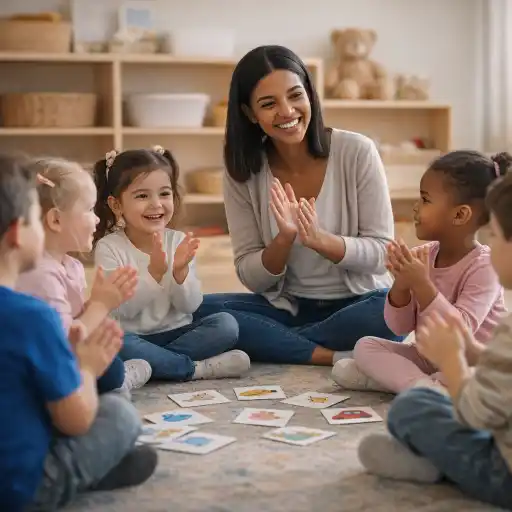
- Syllable awareness: clapping or combining the parts in “but-ter-fly.”
- Onset-rime awareness: blending an initial sound with the rest of a word, such as /m/ and /ap/ to make “map.”
- Phonemic awareness: identifying or manipulating individual sounds, such as the /h/, /o/, and /p/ in “hop.”
These skills are related but not identical to phonics. Phonological awareness focuses on spoken sounds, whereas phonics explicitly connects sounds to letters. Keeping the distinction clear helps providers choose developmentally appropriate activities and avoid asking preschoolers to manage print before they understand the oral language task.
How can playful routines build sound awareness throughout the day?
Short, frequent activities are often more effective and manageable than one lengthy lesson. The NAEYC example of embedding rhyme into snack time illustrates how ordinary routines can become meaningful literacy experiences. Providers can use children’s names, classroom materials, songs, and transitions as immediate teaching resources. For more playful ways to support early reading in daily child-care routines, see Literacy Magic: Spark Early Reading Through Everyday Fun.
- 🎵 During transitions: chant a simple rhyme while children line up, wash hands, or clean up.
- At snack: invite children to find a food or utensil that rhymes with a target word.
- In movement play: clap, hop, or tap one time for each syllable in names and familiar objects.
- In dramatic play: create alliterative role names such as “Baking Ben” or “Doctor Dana.”
- During block play: ask children to listen for words that begin with the same sound as “block.”
Use concrete objects, hand motions, picture cards, or blocks to represent parts of a word. For onset-rime blending, hold one object while saying /s/ and another while saying /un/, then bring them together to say “sun.” Movement and manipulatives make an invisible auditory concept easier to experience without turning play into a test.
How can books, songs, and home languages strengthen instruction?
Interactive read-alouds are especially valuable because they provide repeated exposure to rhythm, rhyme, alliteration, and rich vocabulary in meaningful contexts. Pause briefly to emphasize a repeated sound, invite children to complete a predictable phrase, or compare two words from the story. Avoid interrupting every page; one or two intentional moments can be sufficient.
Songs, fingerplays, poems, and nursery rhymes add rhythm and repetition. Invite families to share songs or rhymes that are meaningful in their home languages. This approach recognizes bilingualism as an asset rather than treating a child’s home language as an obstacle. Research summarized by Colorín Colorado indicates that phonological awareness developed in one language can support learning in another, although children may need explicit support with sounds that differ across languages.
Use familiar vocabulary when introducing a new sound task. If children do not know what a pictured object is called, difficulty with the activity may reflect vocabulary rather than sound awareness. Model unfamiliar English sounds patiently, accept approximations, and consult families, bilingual colleagues, or speech-language professionals when language differences require additional interpretation.
How should educators observe progress and respond to difficulty?
Assessment should inform instruction, not label children. Brief, curriculum-embedded observations can show what a child currently understands and what support may be useful next. For example, educators might ask whether two words rhyme, invite a child to clap the syllables in a name, or ask which of three words begins like “sun.” Reading Rockets provides examples of these types of informal tasks and emphasizes observing specific sound skills.
- Record the target skill, the words used, and the child’s response.
- Repeat the task in a relaxed context rather than relying on one performance.
- Provide immediate modeling: “You heard the ending in ‘cat.’ Listen: cat, hat.”
- Offer short, frequent practice with one skill at a time.
- Share simple home activities, such as rhyming during car rides or clapping names.
Persistent difficulty deserves a supportive, team-based response—not lowered expectations or repeated drilling. Document patterns, adjust the level of scaffolding, and follow program referral procedures when concerns continue. State requirements vary - check your state licensing agency. Collaboration with families, literacy specialists, and speech-language professionals can help distinguish language difference, limited experience, hearing concerns, and possible developmental needs.
What common mistakes can providers avoid?
Even well-intentioned instruction can become less effective when it is overly abstract, lengthy, or disconnected from children’s experiences. A few adjustments preserve both rigor and joy.
- Mistake: teaching sounds only through worksheets. Use oral games, movement, songs, objects, and play before or alongside print.
- Mistake: correcting pronunciation harshly. Model the target sound and recognize the child’s effort, especially when a sound is unfamiliar in the home language.
- Mistake: using unknown vocabulary. Preteach key words with real objects, photographs, gestures, or translations.
- Mistake: expecting all children to progress identically. Offer multiple entry points, small-group practice, and individualized prompts.
- Mistake: confusing phonological awareness with phonics. Begin with listening and speaking; connect sounds to letters intentionally when children are ready.
Directors can support consistency by selecting a small set of shared routines, providing staff with examples of developmentally appropriate prompts, and reviewing observation notes during planning meetings. For related professional learning, ChildCareEd’s Reading Aloud and Storytelling  Buy Now $16.00 course can help providers make books and oral language more interactive.
How can programs sustain phonological awareness instruction?
A sustainable plan is visible in the daily schedule but flexible enough to follow children’s interests. Begin with a weekly focus—such as rhyme or syllables—then revisit it in circle time, centers, outdoor play, and transitions. Use a simple planning grid to identify the target skill, familiar words, materials, and an observation opportunity.
Family partnerships extend learning beyond the classroom. Send home one activity that requires no special materials, such as “Find three words that rhyme with ‘day’” or “Clap the parts of everyone’s name.” Encourage families to use whichever language feels most natural. Shared laughter, songs, and conversation are valuable literacy experiences even when no letters are present.
For staff who want additional classroom-ready ideas, ChildCareEd’s Classroom Tools for Emergent Literacy Buy Now $25.00 course addresses interactive read-alouds, labeling, reading buddies, and other ways to create a language- and literacy-rich environment. Directors may also consider Assessment of Language and Literacy Skills Buy Now $24.00 to strengthen observation, documentation, and individualized planning.
Conclusion
How can child care providers build phonological awareness in preschool? They can make sound play brief, intentional, inclusive, and joyful. Prioritize rhyming, alliteration, sentence and syllable awareness, onset-rime blending, and emerging phonemic awareness through routines, movement, books, music, manipulatives, and conversation. Observe children’s responses, scaffold without pressure, honor home languages, and collaborate with families and specialists when concerns persist. Consistent small moments—one rhyme at snack, one syllable clap in a transition, or one sound noticed during play—can build the oral language foundation children need for future literacy.
Additional ChildCareEd courses: Language and Literacy Foundations in Pre-K Buy Now $16.00 and Building Bridges for Dual Language Learners Buy Now $16.00.
- Understanding Print Knowledge in Preschool
- Science of Reading Foundations in the Pre-K Classroom
- CDA Family Child Care Credential
- Health and Safety Orientation
- Preventative Health and Safety
- CDA Bridge Bundle: Preschool
- 24 Hour Texas Pre-Service
- Texas Director Credential
- 45-Hour Infant and Toddler Curriculum
- Responding to Emergencies
- Phonological Awareness
- Language and Literacy Preschool Curriculum
- 👶 ¿Cuáles son las proporciones y grupos requeridos en Dakota del Norte? 🏫
- Proporciones de Cuidado Infantil y Tamaños de Grupo por Edad en Maryland (Guía Rápida para Centros y Hogares)
- Proporciones de Cuidado Infantil y Tamaños de Grupo por Edad en Virginia (Guía Rápida para Centros y Hogares)
- Lista para Guardería en Casa en Texas: Cómo Iniciar una Guardería en el Hogar
- Cómo Trabajar en el Cuidado Infantil en Wisconsin: Requisitos y Pasos
- Cómo Ser Maestra de Preescolar en Maryland
- How can we prepare preschoolers for kindergarten success?
- Cómo simplificar la capacitación para sus empleados de daycare
- Can we build early literacy skills through play in high-quality child care?
- How can child care programs build strong readers before kindergarten?
- How can child care providers build early literacy skills through play?
- How can child care providers build early literacy skills through play?
- Kindergarten Songs for Circle Time: 15 Sing-and-Move Ideas That Sneak in Learning
- Why Is Beginning-Sound Bingo a Smart Step Toward Reading?
- How Can Child Care Providers Build Phonological Awareness in Preschool?
- How Can Simple Music and Movement Activities Build Early Literacy Skills?
- How Can Child Care Providers Move Children from Letter Recognition to Beginning-Sound Awareness?
- What Should Effective Beginning-Sound Practice Include?
