A well-designed calm-down space gives children a safe, respectful place to practice calming their bodies, identifying emotions, and preparing to rejoin classroom activities. This article gives child care directors and providers practical steps for choosing a quiet location, selecting simple sensory and visual tools, teaching children how to use the area, establishing safety expectations, and using supportive staff language. It also explains how to prevent the space from becoming a punishment area and how to observe whether it is helping children regulate more successfully. To strengthen staff practice, explore ChildCareEd’s self-paced online course Self-Regulation & Change: Helping Children Cope  Buy Now $16.00, which focuses on responsive care, consistent routines, transitions, and strategies for fostering self-regulation and calm classroom environments. Programs can also use the free Calm Down Posters Buy Now $0.00, which include visual reminders for breathing, mindfulness, and other calming strategies. With clear teaching, dependable staff support, and regular review, a calm-down space can help children feel respected, recover from big emotions, and return to learning more confidently. Remember that state requirements vary, so always check with your state licensing agency.
Why does a thoughtfully designed calm-down space matter?
Why this matters (brief):
- Children who can regulate return to learning faster and have fewer safety incidents; calm spaces provide a predictable, low-stimulus option (ChildCareEd: Peaceful Retreat).
- Simple, repeatable tools (breathing, sensory jars, heavy work) work best — and they are low-cost and teachable (ChildCareEd: Simple Tools).
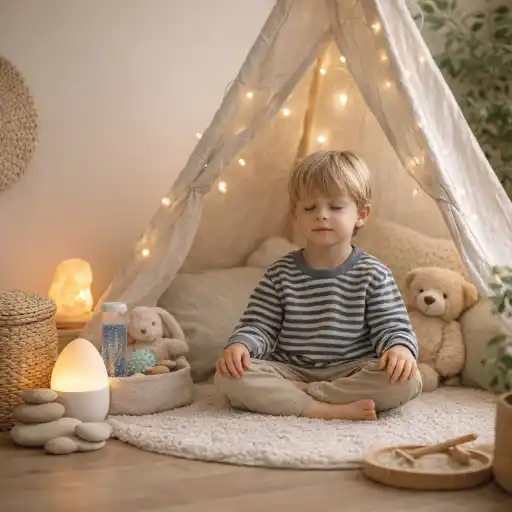
What should be in a calm-down space to truly support children?
- 🧸 Soft seating (rug, small cushion) and a clear boundary (tape or basket).
- 🔮 A visual focus: sensory bottle or glitter jar to watch slow movement.
- 😮💨 Breathing visuals and a "breathing buddy" stuffed animal for guided practice.
- ✊ One or two fidgets (squeeze ball, textured object) — limit to avoid overstimulation.
- 📘 Simple visuals: feelings chart, one short feelings book, and the "I Need a Break" poster (ChildCareEd posters Buy Now $0.00).
Practical tips:
- Rotate 1–2 items weekly to maintain interest.
- Keep materials washable and age-appropriate; avoid small parts for toddlers.
- Label choices with pictures so non-readers can choose their tool independently.
How do I teach children and staff to use the space so it becomes a tool, not a punishment?
- 🧑🤝🧑 Introduce: Show the space at circle time, name each item, and role-play one short visit.
- 😮💨 Model: Practice a breathing tool with the whole group (1–2 minutes) and invite volunteers to try the cozy spot.
- 🎲 Reinforce: Use games (Freeze Dance, Red Light/Green Light) to build stopping skills so the calm routine is familiar during upset times.
- 💬 Script: Train staff to use one short sentence during upset moments: “I’m here. Breathe with me—1,2,3.” Praise attempts, not perfection.
Teaching checklist for staff:
- Practice the same short language in staff huddles.
- Log visits briefly (time, trigger, tool used) to spot patterns.
- Share expectations with families and show photos of the space so that home and program use similar language.
How do we keep calm-down spaces safe, inclusive, and trauma-informed?
1) Safety basics: maintain supervision, sanitize materials, and ensure tools are age-appropriate. 2) Inclusivity: offer choices and respect privacy. 3) Trauma-informed practice: design the space to increase safety and choice rather than requiring disclosure (Trauma & Violence-Informed Approaches).
- 👀 Supervision: Staff stay nearby and visible; the space is voluntary.
- 🧾 Documentation: Keep simple logs and share patterns in team meetings before deciding on next steps.
- 🌈 Accessibility: Offer a range of tools (noise-reducing headphones, heavy-work options) for different sensory needs (ChildCareEd: Sensory Breaks).
Remember: trauma-informed means minimizing re-traumatization—avoid forced conversations, respect choice, and build predictable routines. State requirements vary - check your state licensing agency when changing spaces or tools.
What common mistakes should teams avoid, and when should we seek extra help?
Common pitfalls are easy to fix when the team agrees on purpose and practice.
- ❌ Mistake: Using the calm area as punishment. ✅ Fix: Teach and model visits during calm times; use the space as a choice.
- ❌ Mistake: Overcrowding the area with toys. ✅ Fix: Limit to 2–4 low-stim items and rotate.
- ❌ Mistake: Long adult lectures during meltdowns. ✅ Fix: One short sentence, one clear offer (e.g., “Breathe with me” + choice).
When to get extra help (numbered signs):
- 🛑 Frequent hurting of self or others.
- 🛑 Multiple long meltdowns daily despite consistent teaching.
- 🛑 Little or no response to tools after weeks of practice.
Next steps: collect logged data, meet with families, involve your director or a mental health consultant, and consider referrals. ChildCareEd training modules and behavior supports can guide team decisions (ChildCareEd resources).
Summary and quick FAQ
- Summary: 1) Keep the space simple and voluntary. 2) Teach tools when children are calm. 3) Use short scripts (Connect → Calm → Coach). 4) Track patterns and get help when safety or progress stalls.
- FAQ (short):
- Q: How long should visits be? A: 2–5 minutes for most resets; staff stay nearby for longer needs.
- Q: What if a child refuses? A: Offer one calm choice, stay nearby, and practice later when calm.
- Q: What tools work best? A: Breath visual, sensory bottle, one soft toy, and a small squeeze tool.
- Q: Where to find printables? A: ChildCareEd calm-down posters and calm-down kit checklists (ChildCareEd).
You are doing important, meaningful work. Small, consistent steps—a clear #cozycorner, brief practice, and team consistency—help children build lasting #calmdown habits in your #classroom and across settings for #children who need stable supports.
Design with purpose: keep the area small, visible, and low-stimulus. Use the ChildCareEd Calm-Down Kit Checklist Buy Now $0.00 and Visual Cue Cards Buy Now $0.00 as templates.1) It supports learning and safety by teaching children how to slow down so they can rejoin activities with focus. 2) It reduces repeated interruptions and protects the dignity of the child. 3) It builds #regulation skills that children use across settings. See ChildCareEd for evidence-based rationale in de-escalation and calm strategies. Teach during calm moments using a short routine: Connect → Calm → Coach. ChildCareEd recommends this order and provides scripts and practice routines (ChildCareEd calm-down corner guide).
- CDA Home Visitor Subject Area 3 Part 3 Birth to 5
- Beyond the Classroom: Connecting Families to Essential Services
- Building Equity: Inclusionary Practices in Preschool
- From Tantrums to Triumphs: Equipping Preschoolers with Self-Regulation Skills
- Teach with Respect!
- Texas Director Credential
- Spaces that Support Discovery
- CDA: Curriculum Alignment & Materials
- Environments That Inspire Independence and Exploration
- The Prepared Environment: Montessori Class Design
- Strategies for Finding Budget-Friendly Deals, Discounts, and Promotions on Back to School Supplies
- Childcare Educators in NYC: Surviving the Holiday Season in the Concrete Jungle
- CDA Certification en Español: Recursos y Consejos para Educadores Bilingües
- How can I create calm classroom spaces that help children learn?
- How Can New York Childcare Educators Support Children After Trauma?
- How can we help Georgia families feel heard, valued, and included in child care?
- What can the National Mall teach us about building a classroom where every child has a voice?
- Canciones, juegos y preguntas de círculo para niños
- How can my New York program help sensory-sensitive children cope with fireworks noise?
- How can we create calm-down spaces that truly support children?
- How do you set up a calm-down space in your classroom?
- What small changes make child care classrooms feel more welcoming?
- Can Slowing Down Actually Boost Learning in Early Childhood Settings?
- How can you design childcare spaces for flexible learning?
- Toddler Classroom Ideas: What Should Be at a Child’s Eye Level?
- Field Trips for Elementary Students: 15 Adventures That Bring Learning to Life
- How Can Providers Create a Calm-Down Corner That Actually Works?
- How Can You Create a Calm-Down Space That Truly Supports Children?
- What Is Co-Regulation and Why Does It Matter in Early Childhood?
