When a child’s feelings become bigger than their available coping skills, a thoughtfully designed calm-down corner can protect dignity while teaching regulation. Start by exploring Self-Regulation & Change: Helping Children Cope  Buy Now $16.00 to strengthen your understanding of transitions, responsive care, and practical strategies that support calmer classroom routines; providers may also benefit from Classroom Setup for Child Care Buy Now $24.00 when planning an intentional environment.
A calm-down corner is not a decorative nook or a disguised time-out chair. It is a brief, voluntary, supervised opportunity for children to notice their feelings, use a familiar strategy, and return to participation. The most effective spaces are simple, predictable, accessible, and supported by adults who teach the routine before children need it.
Why does a calm-down corner matter for children and providers?
Young children are still developing the language, attention, and physiological control needed to manage frustration, disappointment, sensory overload, and conflict. A calm-down space gives them a concrete place to practice these skills while an adult provides co-regulation. The goal is not to eliminate strong feelings; it is to help children move from overwhelming activation toward a safe next step.
Emotional literacy is central to this process. The CSEFEL What Works Brief explains that learning to identify and label feelings helps children communicate their experiences, tolerate frustration, and solve problems with support. A feelings chart, a teacher’s validating language, and repeated practice can therefore be as important as any sensory tool.
For providers, a well-taught corner can reduce repeated interruptions and make responses more consistent. It also communicates a powerful message: children are not “bad” for having emotions, and unsafe behavior still requires clear limits and teaching.
How should providers choose the location and design?
Choose a location that is quieter than the rest of the room but remains within a supervising adult’s sightline. Avoid doorways, high-traffic pathways, and areas beside loud or highly stimulating centers. A small rug, cushion, low shelf, or child-safe boundary can define the area without making it feel enclosed or isolating.
- Keep the visual field uncluttered; use calming colors and limited wall displays.
- Ensure children with mobility, communication, or sensory differences can access the space.
- Use soft, washable materials and maintain adequate lighting and ventilation.
- Design for one child at a time unless your program intentionally teaches shared use.
- Keep the area visible; privacy should never mean unsupervised isolation.
Environmental changes outside the corner matter too. Separating loud and quiet centers, using visual schedules, offering transition warnings, and reducing unnecessary noise may prevent dysregulation before it begins. A calm corner should be one part of a calm #classroom, not the only support available.
State requirements vary - check your state licensing agency before changing room arrangements, supervision practices, or materials.
Which materials help children regulate without overstimulating them?
Begin with a small collection of tools that address different needs. Too many choices can turn the area into a toy center or create decision overload when a child is already distressed. Start with two to four items, observe what children use successfully, and rotate materials thoughtfully.
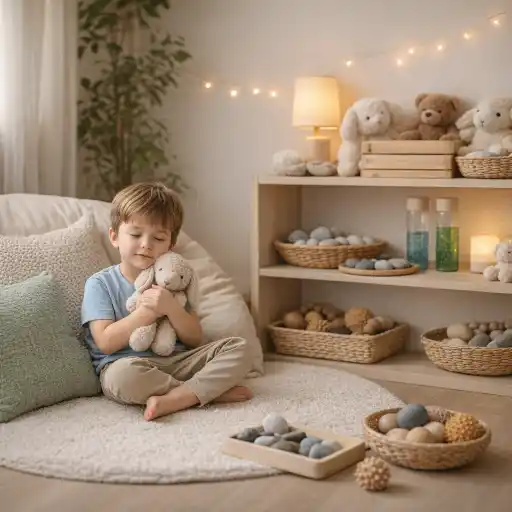
- 🧸 A soft seat, rug, pillow, or washable stuffed animal for comfort.
- A feelings chart or emotion cards with clear pictures so non-readers can point.
- A breathing visual, pinwheel, bubbles, or “breathing buddy.”
- A sensory bottle or other visual focus with no small, detachable parts.
- One safe squeeze tool or textured object, selected for the children’s ages.
- A short feelings book, social story, drawing paper, or simple mindfulness card.
Tools are not automatically calming. A flashing light, loud music, complicated fidget, or scented product may increase stimulation for some children. Introduce each item during a calm period, demonstrate its safe use, and watch individual responses. The OT Toolbox guidance on calm-down corners notes that sensory and movement needs vary; some children benefit from quiet pressure or tactile input, while others need carefully supervised movement.
Clean and inspect materials regularly. Avoid choking hazards for infants and toddlers, and follow program sanitation procedures. The best tool may be inexpensive: a picture card, a familiar book, or a teacher’s steady presence.
How do educators teach children to use the corner?
Teaching is the most important implementation step. Introduce the space during a group meeting or individual calm moment, explain that everyone may need a break, and model a brief visit. Use role-play with puppets or stories: “The puppet feels frustrated because the tower fell. What could help its body?” Allow children to practice choosing a tool without waiting for a crisis.
A consistent sequence helps staff respond quickly:
- Connect: “I’m here. You are safe. I see that you are upset.”
- Calm: Offer one familiar strategy: “Would you like balloon breaths or the squeeze ball?”
- Coach: After the child is more organized, briefly reflect: “You were frustrated, and breathing helped. What is one safe next step?”
Keep language short during escalation. Do not demand eye contact, lengthy explanations, apologies, or emotional disclosure while the child is overwhelmed. A calm-down visit is usually brief—often two to five minutes—but flexibility and supervision are essential. Children may return while still somewhat disappointed; readiness means they can participate safely, not that they look perfectly calm.
Practice skills during transitions, circle time, and play. Freeze Dance, Red Light/Green Light, breathing with stuffed animals, and emotion-charade games make stopping, waiting, noticing, and choosing more familiar. Praise effort and strategy use: “You noticed your body needed space and chose a safe tool.”
How can teams keep the space supportive, inclusive, and safe?
Every adult should describe the corner in the same way: it is voluntary or offered as a supportive choice, it is supervised, and it helps children prepare to return. A posted picture rule might say, “This space helps my body. I choose a tool. I keep materials safe. I return when I am ready.” Review the language in staff meetings and rehearse it through brief scenarios.
Partner with families by explaining the purpose, showing the tools, and inviting information about strategies that work at home. Do not assume one approach fits every child. Some children may need visual communication, noise-reducing headphones, movement, a predictable adult check-in, or individualized supports developed with specialists.
Documentation should be brief and useful. Record the time, activity or trigger, adult response, tool used, approximate duration, and outcome. Review patterns rather than judging isolated events. If several children become distressed during cleanup, the team might adjust warnings or assign transition jobs. If one child repeatedly leaves during writing, the concern may involve task difficulty, communication, sensory load, or a need for individualized planning.
Safety concerns require immediate attention. Maintain supervision, inspect tools, sanitize shared materials, and follow emergency and behavior-support policies. A calm corner must never be used for humiliation, forced isolation, or withholding basic care.
What common mistakes prevent a calm-down corner from working?
The most common mistake is using the corner as punishment. Sending a child there angrily, requiring them to stay until they appear calm, or removing the space as a consequence changes its meaning from support to exclusion. Instead, teach it proactively and offer it alongside clear limits: “You may feel angry. Hitting is not safe. I will help you make space and choose a tool.”
Other pitfalls include:
- Too many materials: Limit the selection and rotate one item at a time.
- Long lectures: Use one validating statement and one clear choice.
- Teaching only during crises: Practice daily when children are regulated.
- Using it to avoid every demand: Plan a predictable return step and investigate difficult tasks.
- Ignoring individual differences: Observe whether quiet, movement, pressure, visuals, or adult proximity is helpful.
- Inconsistent staff responses: Create a shared script and coach new staff before they need to respond.
When a child frequently hurts themselves or others, has multiple prolonged episodes, or shows little improvement after several weeks of consistent teaching, involve the family, director, mental health consultant, early-intervention provider, or other appropriate specialist. A calm corner is a classroom support, not a substitute for assessment or individualized care.
How can providers tell whether the calm-down corner is working?
Evaluate the corner by asking whether it improves participation, safety, independence, and connection—not simply whether children stop making noise. Useful indicators include shorter recovery periods, more children selecting a strategy before unsafe behavior, smoother transitions, fewer repeated triggers, and successful re-entry into play or learning.
Review observation notes every two to four weeks. Ask:
- Who uses the space, and during which routines?
- Which tools appear helpful, neutral, or activating?
- Does the child return to the activity with reasonable support?
- Are adults offering connection and choice consistently?
- Does the environment need to change before the child needs the corner?
Invite children’s perspectives through simple questions or drawings: “What helps your body?” and “What should we add or remove?” Their feedback supports autonomy and can reveal that a child needs a book, a movement option, a familiar photo, or simply a nearby adult.
Directors can support implementation by scheduling short staff refreshers, checking the space during supervision, sharing a one-page script, and recognizing examples of effective co-regulation. Professional learning such as From Tantrums to Triumphs: Equipping Preschoolers with Self-Regulation Skills Buy Now $25.00 can help providers build practical activities and understand challenging behavior while earning training that may support ongoing professional development; confirm applicability with your state or program.
Conclusion: What makes a calm-down corner actually work?
An effective calm-down corner is small, visible, voluntary, and intentionally taught. It combines a few safe tools with emotional vocabulary, co-regulation, consistent staff language, and a clear return plan. The corner works best when it is integrated into broader #regulation teaching, predictable routines, sensory-aware design, and respectful relationships.
Begin with one defined space, two or three tools, one shared script, and daily practice during calm moments. Track what children communicate through their use of the area, adapt the environment, and seek additional support when safety or persistent distress remains a concern. You are not expected to solve every big feeling with one corner; your steady, thoughtful response is already a powerful foundation for children’s #emotions and lifelong coping skills.
Frequently asked questions
How long should a child stay in the corner?
Many children need only two to five minutes for a reset. Use supervision and individualized judgment rather than a rigid timer.
What if a child refuses to use it?
Do not force participation. Stay nearby, offer one alternative, maintain safety, and practice the routine later when the child is calm.
Can toddlers use a calm-down corner?
Yes, with developmentally appropriate materials, close supervision, simple gestures or pictures, and adult co-regulation. Avoid small parts and complicated instructions.
What if a child uses it to avoid activities?
Track patterns, establish a brief return routine, and examine whether the task, transition, communication demands, or sensory environment needs adjustment.
Is a calm-down corner the same as time-out?
No. A supportive calm-down space teaches regulation and return; punitive or forced isolation changes the intervention’s purpose and can undermine dignity. Follow your program’s policies and applicable regulations.
Where can staff find additional resources?
Begin with the ChildCareEd guides How Do I Create a Calm-Down Corner in a Preschool Classroom? and How Can We Create Calm-Down Spaces That Truly Support Children?, then use team observation and family partnership to adapt the approach.
- 45 Hour Child Growth and Development
- 45 Hour Preschool Methods and Materials
- Emergency and Disaster Preparedness
- Bienvenido! Welcoming All Families
- From Tantrums to Triumphs: Equipping Preschoolers with Self-Regulation Skills
- 45 Hour School Age Methods and Materials
- Self-Regulation & Change: Helping Children Cope
- Texas Director Credential
- Spaces that Support Discovery
- Preventative Health and Safety
- How Can Positive Guidance Turn Chaos into Calm in Texas Early Childhood Classrooms?
- How Can Positive Guidance Build Respectful Classroom Routines in Texas Child Care Programs?
- How can positive guidance make indoor transitions calm in California early childhood classrooms?
- How can I create calm classroom spaces that help children learn?
- What Positive Guidance Techniques Help Preschoolers Learn and Stay Safe?
- Toddler Classroom Management: Tips for a Calm and Happy Room
- How can positive guidance help preschoolers learn and behave well?
- What Positive Behavior Guidance Techniques Work in Child Care?
- How can DC classrooms welcome every child and make inclusion real?
- Canciones, juegos y preguntas de círculo para niños
- How can preschool teachers teach mindfulness and calm-down skills so young children actually use them?
- How can daily routines teach self-regulation to young children?
- How Can Staying Calm Help Children Calm Down? Co-Regulation Strategies for Child Care Teams
- How do you set up a calm-down space in your classroom?
- Can Slowing Down Actually Boost Learning in Early Childhood Settings?
- How Can Providers Create a Calm-Down Corner That Actually Works?
- How Can Child Care Providers Help Children Calm Down Without Using Time-Out?
- How Can You Create a Calm-Down Corner That Children Actually Use?
