A thoughtfully designed calm-down space gives young children a predictable, respectful place to recognize big feelings, practice regulation strategies, and prepare to return to classroom activities. It should never be used as punishment or forced isolation. Instead, the area should remain visible to supervising adults, feel quieter than the surrounding classroom, and include only a few carefully selected tools, such as breathing visuals, emotion cards, a soft seat, a sensory bottle, or a safe fidget. This guide gives directors and child care providers practical, team-ready steps for choosing the location, selecting materials, teaching children how to use the space during calm moments, supervising it appropriately, and evaluating whether it is improving participation and emotional regulation. State requirements vary, so always check with your state licensing agency.
To strengthen your team’s approach, explore ChildCareEd’s self-paced online course Self-Regulation & Change: Helping Children Cope  Buy Now $16.00. The training helps providers use consistent routines, responsive care, and practical techniques to foster children’s self-regulation in calm, nurturing environments. Providers can also use ChildCareEd’s guide How Can We Create Calm-Down Spaces That Truly Support Children? for classroom setup ideas, visual supports, staff scripts, and strategies for teaching calm-down habits consistently.
What is a calm-down space and why does it matter?
Definition: A calm-down space (also called calm corner, cozy corner, or peace corner) is a voluntary, low-stimulus area where a child chooses brief time to calm their body and name feelings — not a punishment spot. See practical definitions and program examples at ChildCareEd (Creating a Peaceful Retreat) and its quick setup guide (How Do I Create a Calm-Down Corner).
Why it matters:
- Supports safety and learning by reducing long meltdowns and protecting peers. (#preschoolers)
- Teaches predictable #regulation routines kids can rehearse and generalize across settings.
- Signals program values: we teach coping skills, not isolation.
Evidence & guidance: Use short, repeatable steps (Connect → Calm → Coach) and simple tools — approaches echoed in practice briefs like CSEFEL and ChildCareEd resources (CSEFEL What Works Brief, How can child care teams de-escalate).
What should I put in the calm-down space?
Keep the area minimal, safe, and predictable. Limit items so the space stays low-stimulus and clear in purpose.
Suggested checklist:
- 🧸 Soft seating: small rug, cushion, or child beanbag.
- 🔮 Visual calm tool: a sensory bottle/glitter jar or hourglass (ideas list).
- 😮💨 Breathing visual & script: bubble bottle, breathing buddy, or Hoberman sphere.
- ✊ Small heavy-work or fidget option: squeeze ball, resistance band, or weighted lap pad (age-appropriate).
- 📕 A feelings chart and one short feelings book or visual cards (non-reading children must be able to point).
- 🧴 Sanitation & safety kit: wipes, small first-aid basics, and a rotation plan for washable items.
How do we teach children to use the space so they actually choose it?
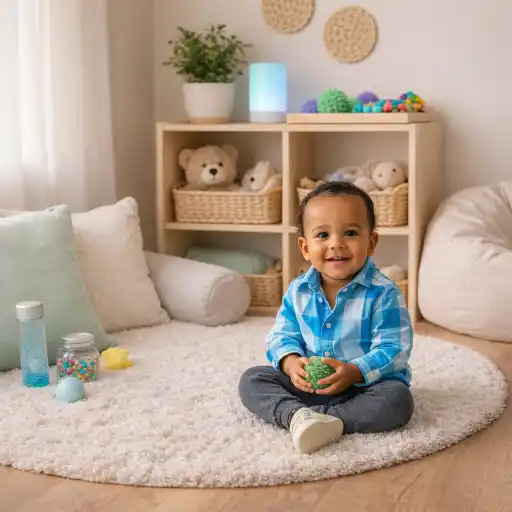
Teaching is the most important design step. Practice when calm; the space must be introduced as a tool, not a consequence.
- 🎲 Teach through short, consistent lessons: 2–5 minute demonstrations during circle time. Model tools and language (Connect → Calm → Coach).
- 🧑🤝🧑 Use a simple script during upset moments: “I’m here. Breathe with me — 1,2,3. When you’re ready, tell me what helped.” Keep coaching to one short question after calm.
- 📚 Practice routines: role play, social stories, and visuals. Use free social story templates and examples to normalize use (Free Social Stories).
- 🎯 Establish clear rules with children and families: the corner is voluntary, supervised, and time-limited (2–5 minutes typical). Post a short rule card and practice passes or tokens for older kids if overuse becomes novelty.
- 🔁 Reinforce: praise attempts to use the space and teach replacement behaviors (e.g., use a stomp spot instead of hitting).
Tip: keep visuals simple and offer 3 choices max — visual cards reduce language load when a child is escalated (Calm-Down Visuals).
How do I keep the space safe, equitable, and licensing-compliant?
Safety and equity are non-negotiable. Follow a short implementation checklist:
- 👀 Supervision: Sightline must be maintained; staff should stay nearby and check in appropriately.
- 🧴 Sanitation & age-appropriateness: Avoid choking hazards; choose washable materials and rotate items. Keep an ongoing supply and cleaning log.
- 📋 Documentation & family partnership: Post how the space works, inform families, and get consent if using specific items or planned time-in procedures.
- ⚖️ Equity: Ensure every child knows the space is available and welcome. Teach expectations in group lessons so no one is singled out.
- 🛡️ Licensing & referral: state requirements vary - check your state licensing agency. Keep incident logs, review patterns, and follow your program’s referral steps for mental health or special education consults (see CSEFEL guidance on using time-out within a comprehensive plan: CSEFEL).
Common safety pitfalls and quick fixes:
- ❌ Mistake: Using as punishment. ✅ Fix: Teach during calm times; model adult use.
- ❌ Mistake: Overcrowded with toys. ✅ Fix: Limit to 2–4 low-stim items and rotate.
- ❌ Mistake: Long teacher lectures at meltdown. ✅ Fix: Use one calm sentence + one clear choice.
How do we know the calm space is working and when to get extra help?
Track patterns, not single incidents. Use short data steps and team decision-making.
- 📈 What to log: date/time, trigger, who was present, tool used, visit length, and outcome (rejoined, required follow-up).
- 🔎 Review every 2–4 weeks: look for frequency, duration, and safety concerns. If visits are frequent, very long, or include harm to self/others, escalate.
- 👥 Team action steps: share notes with families, your director, and a mental health consultant; use behavior support planning if patterns persist (ChildCareEd’s team-step resources are helpful: De-escalation guide).
- 🛑 Referral signs: frequent physical aggression, very long meltdowns daily, or no response to practiced tools after consistent instruction — consult specialists.
Measure wins: fewer classroom disruptions, more independent use of the corner, and improved transitions are practical indicators that your #calmcorner supports #emotions and the broader #classroom climate.
Summary
1) Design: small, low-stim, and consistent. 2) Teach: short practice, visuals, and a Connect → Calm → Coach script. 3) Supervise: keep the space safe, equitable, and compliant (state requirements vary - check your state licensing agency). 4) Track: use short logs and team review to know when to consult specialists. For ready printables, training, and examples to share with staff and families, begin with ChildCareEd’s calm-corner resources (Calm-Down Corner guide) and their calm-classroom setup ideas (Building a calm classroom).
FAQ
- ❓ How long should visits be? — 2–5 minutes for a reset; staff stay nearby for longer supports.
- ❓ What if a child refuses to use it? — Offer one simple, practiced choice and model; practice later when calm.
- ❓ Can older children use it? — Yes; adapt tools (journals, headphones, coping lapbooks) and teach self-monitoring.
- ❓ What if the space is overused? — Re-teach expectations, consider pass systems, and review triggers with families.
You’re doing meaningful, relationship-driven work. Small design choices + clear teaching + team consistency create a calm space that helps children build lifelong #regulation skills.
- 45 Hour Child Growth and Development
- 45 Hour Preschool Methods and Materials
- Emergency and Disaster Preparedness
- Bienvenido! Welcoming All Families
- Play Safe, Think Big: Literacy Through Play
- Pediatric RSV First Aid & CPR/AED
- Classroom Setup for Child Care
- Texas Director Credential
- Supporting Children's Independence
- Surviving Toddler Tantrums: A Guide for Parents Who Secretly Wonder If Their Kids Have a Future in Drama
- Zen and the Art of Early Childhood Education: Self-Care for the Educators
- Creating a Positive and Calm Classroom Environment
- Positive Discipline Strategies for Child Care Providers
- Qué capacitación se requiere para ser director de cuidado infantil en Texas?
- Big feelings: helping kids calm down (age-by-age)
- How a Positive Classroom Changes Everything
- How to handle hitting in toddlers
- How can I set classroom rules preschoolers understand?
- How Environment Affects Children’s Behavior and Development
- Proporciones de Cuidado Infantil y Tamaños de Grupo por Edad en Nueva Jersey (Guía Rápida para Centros y Hogares)
- Capacitación Previa al Servicio para Proveedores de Cuidado Infantil en Dakota del Norte
- How can we create calm-down spaces that truly support children?
- Can Slowing Down Actually Boost Learning in Early Childhood Settings?
- How Does Co-Regulation Help Children Learn to Calm Down?
- How Can Child Care Providers Help Children Calm Down Without Using Time-Out?
- What Is Co-Regulation and Why Does It Matter in Early Childhood?
- How Can Giving Children Real Choices Help Them Calm Down?
