Sports do not have to focus on winning or athletic ability. When planned intentionally, sports-themed play can become a practical way for young children to practice cooperation, turn-taking, emotional regulation, communication, and shared problem-solving. This article gives child care providers and directors step-by-step, classroom-ready strategies for using short, adaptable sports activities to promote #teamwork, #sports, #cooperation, #teachers, and #inclusion across different ages and abilities. Educators can strengthen these experiences through ChildCareEd’s self-paced online course The Best Promotion is Play  Buy Now $24.00, which explores how purposeful play supports children’s physical, cognitive, language, and social development. The online course Brighter Futures: Social Emotional Development Buy Now $16.00 can also help educators encourage kindness, positive interactions, emotional growth, and cooperative behavior. Together, these approaches can help programs create sports experiences in which every child can participate, contribute to the team, and feel successful. State requirements vary, so always check with your state licensing agency.
What learning goals and outcomes should we expect from sports-based cooperation?
- Social skills: sharing, waiting, encouraging peers, and resolving minor conflicts — all foundational to classroom communities (see Team-Building Activities for Daycare).
- Self-regulation and executive function: stop-start signals, turn-taking, and referee-style rules strengthen attention and inhibitory control (supported by movement research in movement and cognition).
- Gross motor and coordination: running, kicking, carrying, and balancing activities build strength and spatial awareness (see The Gross (Motor) Truth).
- Mental health and belonging: team sport contexts can support self-esteem and peer connection — research summaries note social-emotional gains from organized team participation (learning through sport review).
Why it matters: team-style play scaffolds real-world skills—cooperation, problem solving, and persistence—that children use in class and at home. For practical, short routines that fit daily schedules, see How we can use team activities.
How can we design short, low-prep sports activities that emphasize cooperation over competition?
- 🎯 Pick one clear learning goal (e.g., "share the ball three times before a shot").
- 📦 Prep a tub with all props and a one-line script so activities start fast (ball, cones, role cards). ChildCareEd suggests low-prep tubs in team activities.
- 🕒 Keep time short: 5–15 minutes for whole group, 6–8 minutes for small groups—repeat often.
- 🔁 Use cooperative rules: shared goal (score as a team), role rotation (passer, goalie helper, cheerleader), and non-elimination rounds.
- 🔔 Use visual cues: timers, cards, or a sandglass to signal turns so children learn waiting strategies.
- 🙌 Coach with one-line scripts: "Your turn — then say, ‘nice pass.’" Model once and let them try (scripts adapted from World Cup rug ideas).
- 📣 Celebrate team wins and small steps (specific praise for waiting, passing, helping).
Practical examples: hoop pass (circle passes without dropping), partner obstacle (buddy leads blindfolded peer), team mural finish line (each child adds a team element before the group wins). For seasonal or event-based ideas, seethe March Madness guide.
How do we adapt sports activities to include diverse learners and keep everyone safe?
- 🧩 Offer layered tasks: two levels of challenge (easy / challenge) so children contribute at their level.
- 🤝 Buddy systems: pair children so strengths balance needs; rotate buddies to build relationships.
- 📋 Visual supports: role cards, picture steps, and timers aid children with language or attention differences.
- 🪑 Seated or low-mobility options: convert throwing to arm movements or passing charts for children with motor limitations.
- 🛡 Safety first: clear sight lines, soft props, and an age-appropriate space. Remember, state requirements vary - check your state licensing agency.
- ♿ Use cooperative games designed for special needs—see Cooperative Games for Children with Special Needs and adapt parachute or balloon bop games accordingly.
Keep the goal cooperative outcomes (everyone helps), not individual scores. Simple role tweaks—larger balls, slower timers, extra helpers—make sports play accessible and joyful.
How should staff plan, lead, and coach so cooperative habits stick?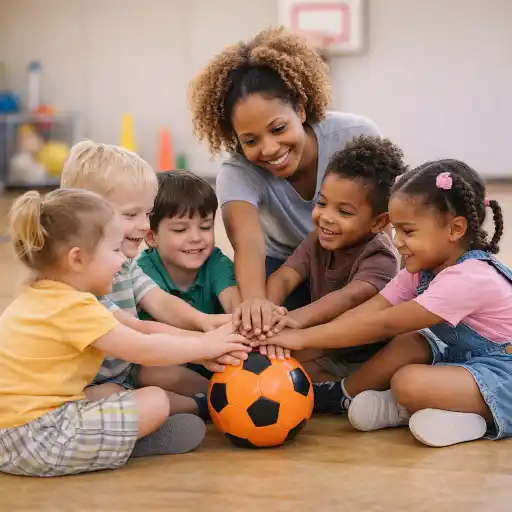
Strong adult facilitation turns a single game into repeated learning. Use these numbered coaching steps:
- 🗂️ Weekly plan: slot 3–5-minute practice moments each day focused on one micro-skill (sharing, waiting, cheering).
- 🧑🏫 Assign clear roles to staff: leader runs the activity, helper monitors specific children, floater supports transitions. Post one-sentence role cards for substitutes (recommended in Team-Building Activities for Daycare).
- 📣 Use concise scripts and model once—then step back. Praise specific actions: "You waited and passed — terrific teamwork!"
- 🔄 Reflect with staff: use a quick 1-win / 1-need / 1-change routine after sessions to refine practice.
- 📷 Document progress: brief notes, checklists, or photos (with permissions) to show growth and family communication.
Train with short refreshers and on-the-floor coaching so routines become natural. For ready-made lesson templates and small-group tips, see ChildCareEd team activity guides.
How do we measure success, avoid common mistakes, and answer quick FAQs?
Measure progress with simple, observable indicators and avoid common pitfalls:
- How to measure: use a brief checklist (turn-taking frequency, number of supportive comments, calm transitions) and weekly notes per child.
- 📈 Use evidence: track decreases in conflicts, smoother transitions, and increases in peer helpers as program indicators.
- Common mistakes & fixes:
- ❌ Too many rules → ✅ Give 1–2 clear steps and demo once.
- ❌ Over-emphasis on winning → ✅ Make team goals (shared points, cooperative wins).
- ❌ One-off training for staff → ✅ Short refreshers + coaching in-class.
FAQ
- Q: How long should a sports-based cooperation session be? A: 5–15 minutes for whole group; 6–8 minutes for small-group practice.
- Q: What if a child refuses to join? A: Offer an observer/helper role and a low-pressure re-entry plan.
- Q: How often should we run activities? A: Daily micro-practice builds habits—start with one short activity each day.
- Q: Where can I get more adaptable game ideas? A: ChildCareEd pages on team building, gross motor games, and themed guides (links above) are practical starting points.
Conclusion: Start small, stay consistent, and coach with empathy. Sport-inspired play gives many short, repeatable opportunities for children to practice cooperation, self-control, and helping behaviors. Try one cooperative sports moment tomorrow—prepare a tub, assign roles, use a one-line script, and celebrate the team. For deeper reading, see the ChildCareEd resources linked throughout and research summaries on organized sports and child well-being (see organized sport review and public health summaries like why team sport helps kids).
- Deck the Halls with Emotional Wellness: Family Traditions That Foster Connection
- CDA Certification en Español: Recursos y Consejos para Educadores Bilingües
- 🔍 ¿Qué ves cuando observas a un niño aprender?
- 👶 ¿Cuáles son las proporciones y grupos requeridos en Dakota del Norte? 🏫
- Recursos en Español sobre el Sueño Seguro del Bebé
- 10 Ejemplos de Cómo la Cultura Influye en el Desarrollo Infantil
- Proporciones de Cuidado Infantil y Tamaños de Grupo por Edad en Maryland (Guía Rápida para Centros y Hogares)
- Proporciones de Cuidado Infantil y Tamaños de Grupo por Edad en Nueva Jersey (Guía Rápida para Centros y Hogares)
- Proporciones de Cuidado Infantil y Tamaños de Grupo por Edad en Virginia (Guía Rápida para Centros y Hogares)
- Consejos de Supervisión Activa para Salones de Preescolar y el Juego al Aire Libre
- Cómo Trabajar en el Cuidado Infantil en Carolina del Norte: Requisitos y Pasos
- Cómo Ser Maestra de Preescolar en Maryland
- Celebrando la amistad en el cuidado infantil durante el Día de los Mejores Amigos
- Canciones, juegos y preguntas de círculo para niños
- Can a World Cup theme on the DC circle time rug teach teamwork, turn-taking, and big feelings?
- Superhero Activities for Preschoolers: Play, Create, and Learn
- After-School Activities for School-Age Children
- Can Superhero Day Capes and Pretend Play Teach Children to Help Others?
- Can sports-themed play teach cooperation and build team spirit in young children?
