Waiting is difficult for young children because time, impulse control, and perspective-taking are still developing. With brief practice, predictable routines, and respectful coaching, providers can turn everyday conflicts into opportunities to build #patience, communication, and cooperation. For a deeper professional-learning experience, explore From Tantrums to Triumphs: Equipping Preschoolers with Self-Regulation Skills Buy Now $25.00 to strengthen classroom strategies for helping children manage frustration and develop self-control.
Directors and teachers may also benefit from Every Moment Matters: Schedules and Transitions  Buy Now $55.00, which focuses on designing routines and transitions that make waiting more predictable and support positive behavior.
Why does learning to wait matter in preschool?
Waiting is not simply a matter of obedience. It is a developing executive-function skill that involves inhibiting an impulse, remembering a sequence, managing disappointment, and trusting that a turn will come. These capacities support children during conversations, group activities, meals, transitions, shared play, and later cooperative learning.
Research and professional guidance emphasize that turn-taking also supports language and peer relationships. Children learn to listen, respond, request materials, notice another child’s needs, and repair interactions after a conflict.
Developmental expectations should remain realistic. Preschoolers may understand that everyone gets a turn while still struggling to wait for more than a few seconds. The goal is gradual growth, not instant patience. Short, successful experiences build confidence and make the next wait more manageable.
- Waiting strengthens #selfregulation and flexible thinking.
- Turn-taking supports communication and social reciprocity.
- Shared play creates opportunities to practice #empathy.
- Predictable routines reduce uncertainty and conflict.
How can adults teach the language of waiting?
Children need practical words before they can use language during a conflict. Introduce a small set of phrases during calm moments, model them often, and practice with puppets, dolls, or classroom materials. Keep the language short enough for children to remember under stress.
- “Can I have a turn when you are finished?”
- “Your turn next.”
- “I’m done. Your turn.”
- “I can wait while I build.”
- “Help, please.”
Use a prompt-practice-praise cycle. Give one brief cue, provide an immediate opportunity to try, and describe the specific behavior you observed: “You asked for a turn and kept your hands safe while you waited.” This is more instructive than saying only “Good job.” Pair spoken language with gestures, photographs, signs, or picture cards for children with emerging language or communication differences.
Teach children what waiting looks like physically. Some may use “waiting hands,” hands folded gently or holding a small object. Others may stand on a floor marker, look at a visual timer, or choose a waiting activity. These supports should be taught as tools—not used to shame children who are still learning.
Conversational waiting deserves attention, too. During group discussions, use a talking object, pause after a child speaks, and invite peers to listen before responding. Model that waiting is an active social behavior: looking, listening, remembering, and preparing to contribute.
Which routines provide meaningful practice?
Children learn waiting through frequent, low-pressure repetition. Embed short practice into activities that already happen rather than relying on occasional lectures. Begin with waits of five to thirty seconds, then increase the duration only when children are successful.
- 😊 Buddy jobs: Pair children to pass napkins, water plants, or return materials. Rotate roles so each child experiences helping and waiting.
- Circle exchanges: Pass a beanbag or picture card. The child holding it may speak, point, sign, or answer.
- Cooperative construction: Invite each child to add one block to a shared structure before beginning another turn.
- Storytime participation: Take turns turning pages, lifting flaps, predicting events, or choosing a book.
- Movement games: Use Freeze Dance, Red Light/Green Light, or pass-and-stop music games to practice listening and inhibition.
- Shared responsibilities: Rotate line leader, materials helper, cleanup captain, and song starter roles.
Keep the group moving. Long lines create unnecessary frustration, so use small groups, duplicate materials, or stations whenever possible. During transitions, give children purposeful jobs: holding a picture cue, counting friends, carrying a book, or finding a place on the rug. Purposeful waiting is easier than passive waiting.
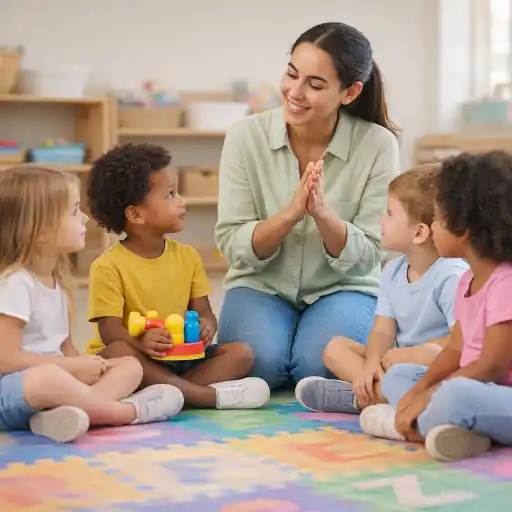
Play is especially effective because children have a meaningful reason to communicate and cooperate. ChildCareEd’s The Best Promotion is Play Buy Now $24.00 course can help providers design play experiences that support cooperation, problem-solving, and social-emotional growth.
How can visual supports make waiting more predictable?
Young children often experience time as uncertain. A visual support makes the sequence concrete: who is using the material, who is next, and what the child can do while waiting. Use a sand timer, visual countdown, first-then board, turn card, name list, or photograph queue.
Use precise language rather than vague directions. Say, “First Maya uses the red truck. When the sand is gone, Jordan is next. While you wait, you may build with these blocks.” This statement communicates the order, ending signal, and alternative activity.
- Use short turns at first, such as twenty or thirty seconds.
- Give a one-minute or two-minute warning before a change.
- Place the visual where children can see it without asking an adult.
- Let children help operate the timer or move the turn card.
- Offer an alternate role rather than requiring children to sit still.
- Observe whether the tool actually helps each child.
Timers are not universally calming. Some children become distressed by alarms or abrupt interruptions. In those cases, use a natural stopping point: “When you finish this road, Elena is next.” The purpose of a visual is to reduce uncertainty, not create another difficult transition.
Sharing also deserves careful thought. Children do not need to surrender a beloved comfort object immediately. When safety allows, offer a reasonable uninterrupted turn, a trade, parallel play, or a related role. Forcing a child to give up an object may produce compliance in the moment but does not teach negotiation or trust.
How should providers respond when waiting becomes a conflict?
When children are highly upset, lengthy explanations rarely work. Use a brief sequence: connect, calm, and coach. First move close and ensure safety: “I won’t let you grab. Hands stay safe.” Then acknowledge the problem: “You both want the red truck.” Finally, offer two or three realistic choices.
- “You can use the timer.”
- “You can trade for the blue car.”
- “You can build beside Sam while you wait.”
- “You can ask me for help.”
Validate feelings without endorsing unsafe behavior: “You really wanted the truck. Waiting is hard. I will help you.” Once the child is regulated, rehearse the replacement language. Ask the child to practice saying, “Can I have a turn after you?” and then provide a quick opportunity to use it.
Teach repair after conflicts. A repair may involve returning a material, rebuilding a knocked-down structure, checking on a friend, or using a brief phrase such as “I’m sorry. Are you okay?” Repair should be meaningful and proportionate, not a forced performance of affection.
Common mistakes include forcing sharing, giving long lectures during meltdowns, removing materials as the first response, and changing expectations from one adult to another. Instead, use one-sentence limits, shared staff scripts, and specific praise for every approximation of the desired skill. ChildCareEd’s The ABCs of Behavior: Turning Challenges into Learning Opportunities Buy Now $55.00 can help teams examine what happens before and after waiting-related behavior and plan consistent positive supports.
How can programs individualize support and measure progress?
Waiting is influenced by language, temperament, sensory processing, attention, executive functioning, culture, and prior experience. A child who grabs may not understand the sequence, may lack the words to request a turn, or may be overwhelmed by noise and proximity. Individualized support is not lowering expectations; it is providing access to the skill.
- Prime: Preview the situation and rehearse the exact phrase before free play.
- Reduce complexity: Begin with one peer, one material, and a very short wait.
- Offer communication choices: Accept pointing, signing, pictures, gestures, or an assistive communication device.
- Adapt the environment: Provide quieter spaces, more room, duplicates, or larger materials.
- Use peer support thoughtfully: Teach peers how to invite, wait, and respond.
- Track patterns: Note the setting, length of wait, adult support, child response, and successful strategy.
Use brief observations rather than labels. For example, record “During tricycle waiting, Amara pushed ahead after thirty seconds; she waited successfully when shown the photo queue and offered a book.” Review patterns with staff and families. Share strengths-first updates such as, “Today Mateo waited for the timer and then asked for a turn.” Send one home phrase so practice can continue across settings.
If concerns are persistent, dangerous, or significantly limit participation despite consistent support, collaborate with families and appropriate specialists. State requirements vary - check your state licensing agency, especially when documentation or individualized plans are involved.
Conclusion: What should your team try this week?
Teaching preschoolers to wait their turn is a gradual process built through relationships, repetition, and clear supports. Children are more likely to wait when adults make the sequence visible, teach usable language, protect safety, and recognize small attempts. The goal is not silent compliance; it is growing #cooperation, communication, flexibility, and confidence.
- Choose two shared phrases, such as “Your turn next” and “Can I have a turn when you’re finished?”
- Practice one short turn-taking game each day.
- Use a visual timer or turn card in one high-interest classroom area.
- Offer purposeful waiting jobs and parallel activities.
- Record one small success for each child and share a strengths-based note with families.
Keep expectations developmentally appropriate, adapt supports when needed, and celebrate progress that may initially last only a few seconds. With calm consistency, everyday waiting moments become valuable opportunities for children to learn how to listen, manage frustration, communicate needs, and participate in a caring community.
Additional ChildCareEd courses for professional growth
- Social Foundations and Responsive Classrooms Buy Now $24.00 — practical guidance for social-emotional development, conflict resolution, and problem-solving.
- Supporting Social Learning: Creating Classrooms that Care Buy Now $24.00 — strategies for community building, relationships, and open dialogue.
- You’re Not My Friend Anymore: Learning Conflict Resolution Buy Now $16.00 — developmentally appropriate approaches for coaching children through peer conflict.
- Turning Behavior Around for Toddlers and Preschoolers
- Teach with Respect ONLINE
- CDA Home Visitor Subject Area 3 Part 3 Birth to 5
- CDA Home Visitor Subject Area 2 Part 3 Birth to 5
- The ABCs of Behavior: Turning Challenges into Learning Opportunities
- Birth to Five CDA Credential with Portfolio Review
- Teach with Respect!
- CDA Bridge Bundle: Preschool without Portfolio Review
- Emergent Learning & Development
- Texas Director Credential
- Proporciones de Cuidado Infantil y Tamaños de Grupo por Edad en Maryland (Guía Rápida para Centros y Hogares)
- Cómo Ser Maestra de Preescolar en Virginia
- Can simple indoor movement games teach listening and cooperation to preschoolers in Oklahoma?
- How can visuals, routines, and gentle words support Georgia preschoolers with special needs?
- Celebrando la amistad en el cuidado infantil durante el Día de los Mejores Amigos
- How can child care providers teach sharing and turn-taking without forcing it?
- How Can Waiting Time Be Meaningful Instead of Frustrating?
- Self-Control Activities for Preschoolers: 10 Games That Teach Stop, Wait, and Try Again
- Child Keeps Hitting Other Kids? Look for These 7 Patterns Before Reacting
- How Can Bingo Games Support Turn-Taking and Social Skills?
- How Can Child Care Providers Help Children Develop Self-Control?
- How Can Child Care Providers Teach Feelings to Preschoolers Through Simple Activities?
- How Can Bingo Games Make Learning Feel Like Play?
- What Should Providers Put in a Classroom Waiting Basket?
- How Can Child Care Providers Teach Preschoolers to Wait Their Turn?
- How Can Child Care Providers Help Children Develop Self-Control?
- How Can Child Care Providers Teach Emotional Regulation to Toddlers and Preschoolers?
- When a Preschool Rule Expects More Self-Control Than Children Can Manage, What Should Educators Do?
- What Are the Best Ways to Support Children Who Struggle with Sharing?
- How Can Child Care Providers Support Children Who Have Difficulty Waiting Their Turn?
