When preschoolers struggle to enter play, share materials, or solve disagreements, intentional team-building can turn those difficult moments into meaningful practice. Explore these developmentally appropriate activities and consider Supporting Social Learning: Creating Classrooms that Care  Buy Now $24.00 to deepen your strategies for community building, open dialogue, and children’s problem-solving while earning useful professional development.
Why do communication and friendship deserve intentional teaching?
Friendship may look spontaneous, but the behaviors that sustain it—greeting a peer, joining play, listening, sharing, helping, and repairing harm—often require explicit modeling and repeated practice. The CSEFEL brief explains that peer interactions help preschoolers learn to collaborate and solve problems, while also noting that some children need direct instruction to participate successfully. A warm classroom relationship is therefore not an extra; it is the foundation for #belonging, participation, and learning.
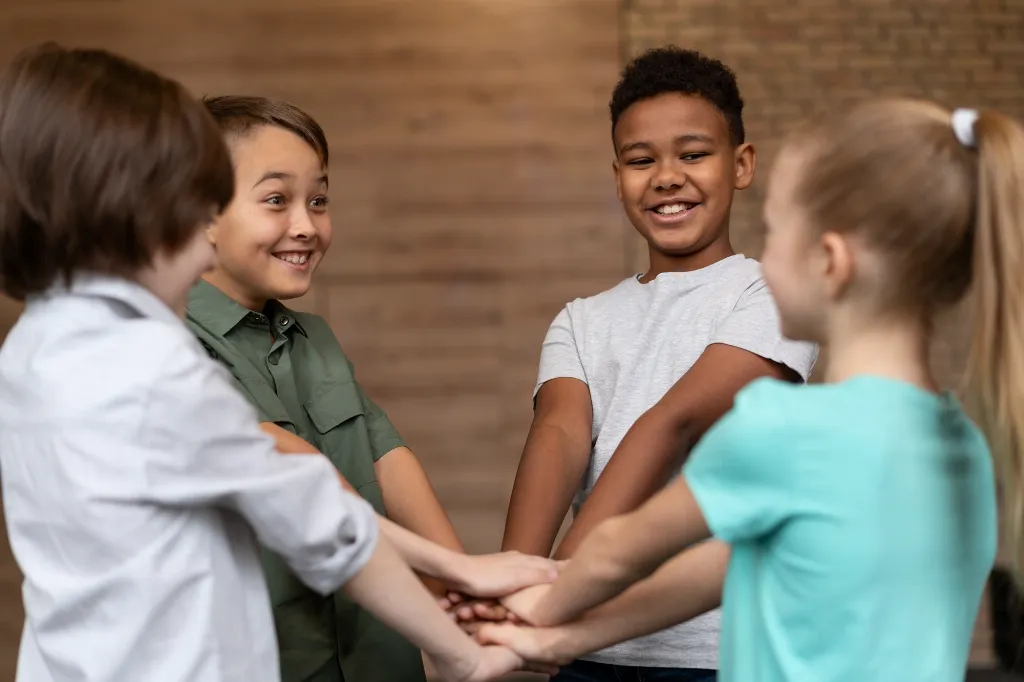
Team-building activities are particularly valuable because they give children a shared purpose without requiring advanced language or social confidence. A group collage, cooperative construction project, or circle game creates natural reasons to communicate. Children can practice short phrases such as “Can I help?”, “Your turn,” and “Let’s do it together” while adults coach from the side.
These experiences also support self-regulation. Children wait, adjust plans, tolerate disappointment, and notice another person’s perspective. Play-based learning research and the ChildCareEd resources emphasize that cooperation, communication, creativity, and problem-solving develop through meaningful play rather than isolated worksheets. The goal is not perfect performance; it is a growing willingness to connect and try again.
Which low-preparation activities build communication and cooperation?
Select activities with one shared goal, flexible roles, and a clear beginning and ending. Keep most experiences between five and fifteen minutes, especially when introducing a new routine.
- 😊 Circle Pass: Children pass a soft ball and say a peer’s name or one kind action. Model waiting, gentle hands, and attentive listening.
- Group Collage: Place one large sheet of paper and shared materials at a table. Invite children to decide where colors, shapes, or pictures belong.
- Cooperative Construction: Ask pairs or small groups to build one bridge, road, or animal home. Assign roles such as designer, materials helper, and builder, then rotate them.
- Team Story: One child begins a story and each participant adds a sentence, sound, or gesture. Use picture cards for children who need language support.
- Hoop Challenge: Children stand in a circle and pass a hula hoop around without releasing hands. Encourage them to suggest solutions rather than rushing to help.
- Partner Obstacle Course: One child describes the route while the other moves, then they switch. Use open eyes and safe, simple equipment; the purpose is communication, not speed.
Cooperative activities should avoid winners and losers whenever possible. Celebrate the shared result: “Your group kept trying,” or “You listened to Maya’s idea.” Friendship and kindness lesson resources similarly recommend group art, construction challenges, partner games, and language activities because each naturally creates opportunities for children to work toward something together.
How can guided play teach friendship scripts?
Guided play combines adult intention with children’s choices. The educator prepares the environment and identifies a target skill, but children still decide how to participate. Before centers, briefly demonstrate a social script with a puppet or colleague:
- “Can I play with you?”
- “You can be the driver, and I’ll be the passenger.”
- “Can I have a turn when you are finished?”
- “I need help.”
- “That hurt. Please stop.”
- “How can we fix it?”
After modeling, invite two children to rehearse while peers watch for the important steps. CSEFEL describes this sequence as modeling, rehearsal, practice during play, and specific positive feedback. Keep the coaching brief: “You looked at Jordan, asked, and waited.” Specific feedback helps children understand which behavior supported the interaction.
Set up dramatic-play scenarios that require reciprocity. A pretend restaurant can include a greeter, cook, customer, and server; a veterinary clinic can involve caregivers, doctors, and animal patients. Add role cards with pictures, but allow children to change roles. For dual language learners or children with communication differences, accept pointing, gestures, home-language words, AAC, or one-word responses as legitimate participation.
Watch for invitations that extend play. When a child builds alone, say, “You could ask Sam to bring the blue blocks.” When a peer approaches, prompt, “Tell her what your group is making.” The adult’s role is to open doors, not control the friendship.
How can teachers turn conflict into communication practice?
Conflict is expected when young children share space, materials, and ideas. The most effective teaching often occurs before a crisis, when children are calm enough to notice, imitate, and rehearse. During conflict, prioritize safety and regulation first; lengthy explanations rarely work when a child is highly upset.
- Connect and stop harm: “I’m here. I won’t let anyone hit.”
- Name the problem neutrally: “You both want the red truck.”
- Supply the words: “Say, ‘Can I have a turn when you’re done?’”
- Offer two or three solutions: use a timer, trade, play together, choose another item, or ask for help.
- Support repair: return materials, check on the friend, or make a new plan.
Once the children are calm, revisit the situation with puppets or a brief role-play. Avoid forcing an apology that has no meaning; instead, teach authentic repair, such as “Are you okay?” or “I can help rebuild.” ChildCareEd’s conflict-resolution course, You’re Not My Friend Anymore: Learning Conflict Resolution Buy Now $16.00, offers a focused next step for providers who want developmentally appropriate ways to teach these skills.
Document patterns rather than labeling children. Note when conflicts occur, what materials are involved, which language was attempted, and what support helped. That information can guide environmental changes, peer partnerships, family communication, and individualized teaching.
How can we include every child in team-building?
Inclusion means more than inviting every child to the same activity. It means designing genuine ways for each child to contribute, communicate, and experience membership. Begin by examining the activity’s demands: Is the group too large? Are the pieces difficult to grasp? Is the noise overwhelming? Does participation depend on spoken English?
- Offer roles such as materials helper, photographer, music leader, builder, or idea chooser.
- Use visual schedules, first-then cards, role pictures, timers, and modeled gestures.
- Provide multiple response methods: speaking, pointing, signing, drawing, moving, or using communication technology.
- Pair children thoughtfully, rotate partners, and teach peers how to invite rather than command.
- Reduce group size or begin with parallel and partner play before expecting whole-group cooperation.
- Adapt materials with larger pieces, stabilizing tape, accessible seating, or fewer steps.
Do not interpret quiet observation as failure. A child may first watch, then pass materials, then offer an idea. Each is a meaningful stage of participation. The course Building Equity: Inclusionary Practices in Preschool Buy Now $10.00 can help providers connect inclusion, equity, and practical classroom adaptations.
Honor culture and home language in friendship activities. Invite families to share words for friend, help, welcome, or feelings. Ensure displays, stories, dolls, and dramatic-play materials reflect the children and families in the program. State requirements vary - check your state licensing agency.
How can directors and teachers make these activities sustainable?
A successful activity is not merely enjoyable; it is repeatable, observable, and connected to classroom goals. Directors can protect a short weekly planning period and provide a shared activity kit with balls, puppets, picture cards, timers, hoops, and large paper. Teachers can choose one target behavior—such as joining play or asking for a turn—and use common language across rooms.
Use a simple implementation cycle:
- Plan: Identify one skill, prepare materials, and decide how children can participate.
- Model: Demonstrate the behavior in a calm, playful way.
- Practice: Offer short opportunities during circle, centers, outdoor play, and routines.
- Notice: Give specific feedback immediately.
- Reflect: Ask staff what worked, who needed support, and what to change.
Integrate team-building into ordinary routines. Two children can distribute napkins, carry a basket, return books, or check the garden together. These jobs create authentic peer interactions without requiring an additional lesson block. Staff can also hold a five-minute reflection: one success, one concern, and one adjustment for tomorrow.
For professional learning focused on staff communication and cooperation, consider TEAM: Together Everyone Achieves More Buy Now $16.00. Strong adult collaboration supports consistent language and calmer responses, which children experience as predictability and security.
Conclusion: What makes preschool team-building effective?
Preschool team-building activities strengthen communication and friendship when they offer a shared purpose, short practice opportunities, inclusive roles, and responsive adult coaching. The best activities are simple enough to repeat: pass a ball, build one structure, create one collage, tell one shared story, or solve one playful challenge.
Remember the central principles:
- Teach friendship behaviors explicitly rather than assuming children already know them.
- Model and rehearse scripts during calm moments.
- Use conflict as an opportunity to practice language, choices, and repair.
- Adapt materials, roles, and communication methods so every child can belong.
- Track small signs of growth, including longer play episodes, more peer invitations, and fewer adult prompts.
With consistency, playful repetition, and compassionate observation, everyday classroom moments become opportunities for #communication, cooperation, empathy, and lasting #friendship.
- Turning Behavior Around for Toddlers and Preschoolers
- Building Equity: Inclusionary Practices in Preschool
- TEAM: Together Everyone Achieves More
- Art from the Heart for Preschoolers: Open Ended Art Projects that Build Self-Esteem
- 45-Hour Infant and Toddler Curriculum
- CDA Infant/Toddler: Parent Relationships
- Play, Learn, Grow
- Positive Attention: Interactions & Supervision for Infants & Toddlers
- Creating Engaging and Meaningful Learning Experiences
- 45 hour Growth and Development Birth-age 12 ONLINE
- Building Social Foundations
- Curso de Comunicación de 9 Horas de Maryland
- ¿Cómo empiezo mi certificación CDA en Florida en línea?
- Actividades de Motricidad Gruesa que Desarrollan el Equilibrio, la Coordinación y la Fuerza
- Cómo Crear Tu Portafolio CDA Paso a Paso
- Capacitación Previa al Servicio para Proveedores de Cuidado Infantil en Maryland
- Capacitación Previa al Servicio para Proveedores de Cuidado Infantil en Nevada
- How can indoor creative play encourage teamwork for preschoolers in California?
- Team-Building Activities for Daycare: Helping Children Learn Together
- Calabazas, hojas y manzanas: actividades de otoño para preescolares
- Celebrando la amistad en el cuidado infantil durante el Día de los Mejores Amigos
- What Can the Golden Gate Bridge Teach Preschoolers About Connection?
- Team-Building Games for Preschoolers That Teach Cooperation
- Preschool Team-Building Activities for Better Communication and Friendship
- Get to Know You Activities for Preschool: 12 Easy First-Week Ideas
- Belonging Activities for Kids Who Feel Left Out: Simple Ways to Help Them Join In
- How Can Child Care Providers Teach Friendship Skills Through Everyday Classroom Activities?
- ¿Qué habilidades preceden al recorte y cuándo deben aprender los niños a usar tijeras?
- ¿Todos los niños deben participar en el tiempo de círculo?
- How Can You Help a Preschool Group Include the Child Who Is Often Left Out?
