When two children reach for the same truck, the goal is not simply to make one child surrender it—it is to build communication, self-regulation, empathy, and cooperation. Providers seeking a deeper foundation can explore Supporting Social Learning: Creating Classrooms that Care  Buy Now $24.00, which offers practical strategies for relationships, problem-solving, and community building that can strengthen daily classroom practice.
Why does sharing require teaching rather than pressure?
Sharing is a complex social skill, not a character test. Young children are still developing perspective-taking, language, impulse control, and an understanding of time. ZERO TO THREE notes that children often begin to develop more reliable sharing and turn-taking skills closer to the preschool years, while individual development varies. A child who says “mine” may be communicating attachment, uncertainty, fatigue, or a need for control rather than intentional unkindness.
Pressure can also blur the difference between cooperation and compliance. When adults repeatedly take materials away or insist that children share immediately, children may learn that their boundaries are unsafe. A more developmentally appropriate goal is to help children ask, wait, negotiate, participate in joint play, and repair relationships.
This approach matters because strong social-emotional skills support participation in group activities, peer relationships, and learning. NAEYC describes socially and emotionally healthy preschoolers as children who can express preferences, understand feelings, negotiate, and compromise. Those capacities grow through warm relationships and intentional teaching, not through shame.
- Respect ownership and reasonable boundaries.
- Teach concrete language instead of saying only, “Use your words.”
- Provide repeated, low-pressure opportunities to practice.
- Expect progress to be gradual and uneven.
State requirements vary - check your state licensing agency.
How can providers teach sharing while preserving children’s agency?
Begin with short scripts practiced during calm moments. Children need usable language before they need to use it during conflict. Model phrases such as “Can I have a turn when you are finished?”, “I am still using it,” “You can go next,” and “Would you like to trade?” Pair each phrase with a gesture or action.
Use visual supports to make the system predictable. A sand timer, turn card, photo waiting list, or simple “first-next” board can reduce the need for adult authority to control every exchange. ZERO TO THREE similarly recommends timers and alternatives that help children understand waiting without making the adult the sole rule-maker.
Offer choices rather than commands:
- “Would you like to use the timer or find another truck?”
- “Would you like to trade, play beside Maya, or wait for a turn?”
- “You may keep the special toy nearby while we choose materials for shared play.”
Sharing does not always mean handing over an entire object. Children can share space, pieces, roles, ideas, or time. One child might build while another passes blocks; one might be the cook while another is the customer. This preserves agency while expanding cooperative possibilities.
Notice specific efforts immediately: “You told Eli you were still using the shovel and offered it when you finished. That helped both of you.” Specific acknowledgment teaches children what worked without labeling them as “good” or “bad.”
Which classroom routines create authentic practice?
Children learn social skills through repeated participation in meaningful routines. Rather than scheduling one lengthy lesson about sharing, embed brief practice across the day. Predictable structures make expectations easier to understand and give children multiple opportunities to succeed.
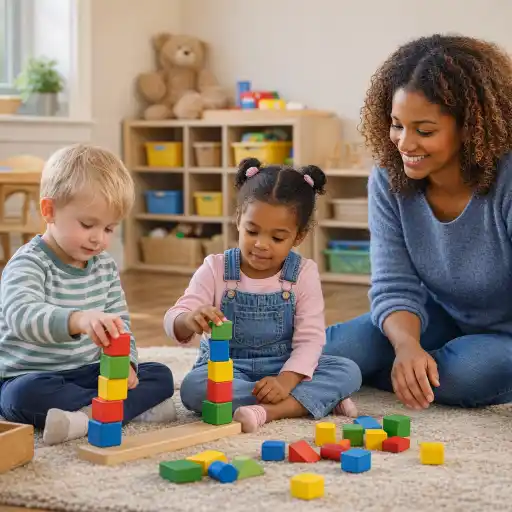
- 😊 Morning greetings and jobs: Let children choose a greeting and rotate responsibilities such as snack helper, plant caretaker, or materials passer.
- 🧩 Guided small-group play: Plan five- to ten-minute activities with a shared goal, such as building a roadway, creating a mural, or preparing pretend food.
- 📚 Read and reflect: Pause during stories to ask, “What does this character want?” and “What could the friends do next?”
- 🏷️ Kindness noticing: Record concrete acts such as inviting a peer, waiting, offering a role, or helping repair a disagreement.
- ⏳ Turn-taking games: Use circle games, passing games, puppets, and cooperative movement activities.
Arrange the environment to support interaction without creating unnecessary competition. Provide multiple materials when possible, define clear center boundaries, and include open-ended props that support shared roles. A well-designed environment can make joining play easier for children who are hesitant, learning English, or managing sensory differences.
Books, puppets, and social stories are especially useful because they move the emotional intensity away from the child. Children can help two puppets solve a problem, identify each character’s feelings, and rehearse language before applying it in the classroom.
How should adults respond when conflict occurs?
Conflict is not evidence that teaching has failed. It is an opportunity to coach skills while maintaining safety. Intervene promptly when children are hitting, biting, throwing objects, or at risk of injury. When safety is not at risk, pause briefly to see whether children can use familiar strategies independently.
A concise four-step response is often effective:
- Stop and protect: “I won’t let you hit. Safe hands.”
- Describe the problem: “You both want the red truck.”
- Validate feelings: “Waiting is hard, and you are disappointed.”
- Offer two or three solutions: “You can use the timer, trade, or choose another truck.”
After children are calm, support repair. Repair might involve returning a material, rebuilding a knocked-down structure, checking on a peer, or practicing a brief apology. Avoid demanding affection or a scripted apology before a child is regulated; genuine repair is more meaningful than forced words.
Adults should avoid long explanations during a meltdown. Use a calm voice, few words, and physical proximity without crowding. Later, revisit the event: “What happened? What could you say next time?” If conflicts repeat, observe patterns related to time, materials, group size, transitions, or sensory demands and adjust the environment.
How can programs make sharing culturally responsive and inclusive?
Sharing is interpreted through family values, language, culture, disability, and personal experience. Some families emphasize collective use of materials; others place stronger emphasis on personal ownership and permission. Neither perspective should be treated automatically as a behavior problem. NAEYC emphasizes that educators must reflect on their own cultural assumptions and understand families as central contexts for children’s development.
Use respectful curiosity with families. Ask what words children use at home for requesting, waiting, helping, and ownership. Incorporate home languages into visual cards and scripts. A child may communicate readiness to share through gesture, sign, eye gaze, or a home-language phrase before using classroom English.
Equity also means adapting the pathway to participation:
- Use picture sequences, gestures, or communication devices for children with language differences.
- Offer quieter play areas and reduce competing materials for children who become overwhelmed.
- Begin with a trusted peer, adult, or puppet before expecting participation in a large group.
- Provide roles such as observer, materials helper, or builder for children who need a gradual entry.
- Ensure expectations do not place greater pressure to give, nurture, or accommodate on girls or particular children.
Document progress through brief observations: what happened, what support was offered, and what the child did next. Share strengths with families, along with one simple home script. Consistency across settings can help children generalize skills without making home practices feel judged.
What common mistakes should providers avoid?
Even caring adults can rely on strategies that solve the immediate conflict but weaken long-term learning. Reflection helps teams replace reactive habits with intentional guidance.
- Forcing immediate sharing: This may stop the dispute but can teach children that adults will remove control. Use waiting, trading, parallel play, or shared roles instead.
- Taking the toy from both children automatically: This can imitate grabbing. Remove a material only when safety requires it or when a clearly explained, short-term boundary is necessary after other supports fail.
- Using moral labels: “Selfish” or “bad friend” creates shame and does not teach a replacement skill. Describe the action and coach the next step.
- Giving long lectures: During high emotion, children need brief language and co-regulation. Teach more fully during calm group time.
- Expecting identical responses from every child: Development, temperament, culture, communication, and disability influence how children participate.
Directors can support consistency by selecting two or three shared scripts, posting them in classrooms, modeling responses during staff meetings, and reviewing observations rather than relying on general impressions. Professional learning such as Social Foundations and Responsive Classrooms Buy Now $24.00 can further support team understanding of social competence, positive guidance, and conflict resolution.
Conclusion: What does respectful sharing instruction look like?
Teaching sharing means building the conditions for cooperation rather than demanding performance on command. Providers can respect children’s ownership, model concise language, use visual turn systems, plan cooperative play, coach conflicts calmly, and adapt supports to individual and cultural needs.
Use this daily checklist:
- Model one useful phrase and one alternative to giving up a toy.
- Use a timer, turn card, or visual sequence during high-interest play.
- Plan one brief cooperative activity with clearly defined roles.
- Praise specific attempts to ask, wait, negotiate, include, or repair.
- Share one strength and one practical script with families.
Progress may appear first as a child waiting for a few seconds, accepting a trade, or asking for help before grabbing. Those small moments are meaningful. With consistent, empathetic coaching, children learn that sharing can include choice, boundaries, fairness, and joyful connection.
Frequently asked questions
Should every child share every toy?
No. Children may protect personal or especially meaningful belongings. Teach permission, waiting, alternatives, and shared materials while maintaining safety.
What if a child refuses repeatedly?
Prime the child before play, rehearse a short script, reduce group size, use visual supports, and observe when refusals occur. Partner with the family and relevant specialists when concerns persist.
When should an adult remove a toy?
Prioritize safety. If no one is at risk, first try coaching, a timer, trading, parallel play, or another material. Any removal should be brief, explained, and followed by teaching.
Can toddlers learn sharing?
Toddlers can practice simple turn-taking, giving, waiting briefly, and playing alongside others, but expectations should reflect developmental readiness. Reliable perspective-taking develops gradually.
How long does improvement take?
Children may show small gains after weeks of consistent practice, while broader changes often take months. Look for increased language, shorter conflicts, more independent problem-solving, and successful repair.
Which courses can support staff development?
Consider Supporting Social Learning: Creating Classrooms that Care Buy Now $24.00, Social Foundations and Responsive Classrooms Buy Now $24.00, Viewing Guidance in a Positive Light Buy Now $24.00, The Best Promotion is Play Buy Now $24.00, and From Tantrums to Triumphs: Equipping Preschoolers with Self-Regulation Skills Buy Now $25.00. Review course details and verify whether a course meets your local professional-development requirements.
- 45 Hour Preschool Methods and Materials
- CDA Bridge Bundle: Preschool
- Pediatric RSV First Aid & CPR/AED
- 45 Hour School Age Methods and Materials
- CDA Bridge Bundle: Family Child Care
- CDA Bridge Bundle: Family Child Care without Portfolio Review
- CDA Bridge Bundle: Infant/Toddler without Portfolio Review
- CDA Bridge Bundle: Preschool without Portfolio Review
- Connections That Count: Building Relationships in Child Care
- Texas Director Credential
- Proporciones de Cuidado Infantil y Tamaños de Grupo por Edad en Maryland (Guía Rápida para Centros y Hogares)
- Proporciones de Cuidado Infantil y Tamaños de Grupo por Edad en Virginia (Guía Rápida para Centros y Hogares)
- How can Georgia preschool teachers use positive guidance to help preschoolers share during indoor play?
- How can rainy day indoor activities help preschoolers learn kindness and cooperation in Georgia?
- Helping Children Learn Kindness, Empathy, and Belonging
- Celebrating Friendship in Child Care on Best Friends Day
- Celebrando la amistad en el cuidado infantil durante el Día de los Mejores Amigos
- How can New York child care programs teach conflict resolution and sharing?
- How can child care providers teach sharing and turn-taking without forcing it?
- How can we effectively teach children to wait, share, and take turns?
- How can we help children learn to wait, take turns, and manage frustration?
- What Does Compassion Look Like in Child Care? 10 Everyday Moments That Matter
- How Can Child Care Providers Teach Children to Share and Take Turns Without Forcing Them?
- How Can Teachers Encourage Sharing Without Forcing It?
- How Can Child Care Providers Teach Young Children to Take Turns?
- How Can Child Care Providers Teach Sharing Without Forcing It?
- How Can Child Care Providers Teach Preschoolers to Wait Their Turn?
- What Should Child Care Providers Do When a Child Refuses to Share?
- What Should Child Care Providers Do When a Child Refuses to Share?
- What Are the Best Ways to Support Children Who Struggle with Sharing?
