Bright & Early North Dakota is updating guidance in July 2026. This short guide helps child care directors and providers get ready. It shows simple steps, training tips, and record checks you can do now. Keep your program strong, safe, and ready for families to trust. Remember: state requirements vary - check your state licensing agency.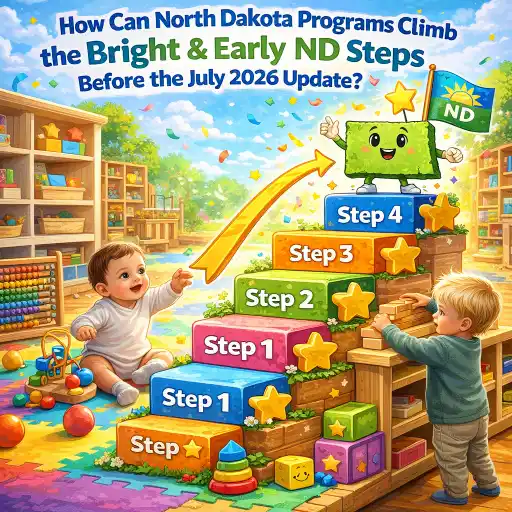
Why this matters: High-quality early care helps children learn and stay healthy. Families look for programs with clear quality signs. Completing the Bright & Early steps shows families your program meets goals for health, learning, and relationships. Good preparation also makes inspections and rating updates easier. Getting ready now saves time and stress later.
What are the Bright & Early ND steps, and why should my program finish them?
2. Benefits for your center:
- 🔹 Families can find your program faster when you finish the steps.
- 🔹 Staff learn clear practices for health and learning.
- 🔹 Programs often see better child outcomes and stronger family trust.
3. What the steps usually look like (simple view):
- Health & safety basics (safe sleep, first aid, clean spaces).
- Learning environment that invites play and discovery.
- Planned activities that build language, creative play, and early math/science.
- Positive, nurturing relationships and strong adult-child interactions.
4. Why finish now? The July 2026 update may change how steps are reviewed. Finishing early gives your team a cushion. Use this time to build strong routines and collect proof of your work. Being ready helps you keep your #quality star and share clear proof with families and licensing.
How do I prepare staff, classrooms, and paperwork for the July 2026 update?
- 🧰 Health & safety: Update safe sleep rules, first aid kits, cleaning logs, and medication records. Many ChildCareEd courses help with health and safety topics and are accepted in ND—see child care courses for North Dakota on ChildCareEd. For a concise overview of the standard health and safety training topics that meet CCDF and state expectations, see our Health and Safety requirements page.
- 🎨 Learning spaces: Look for natural light, child-sized furniture, clear centers for art, blocks, and books. Take photos and date them. These are great proof for ratings.
- 📝 Curriculum & activities: Collect lesson plans, sample child work, and learning goals. Make sure activities promote language, creativity, and early thinking skills.
- 🤝 Relationships: Keep staff notes showing positive interactions, family contacts, and routines that support children’s social skills.
2. File and organize records:
- 📁 Keep staff training certificates in one folder (digital or paper).
- 📅 Keep attendance, health logs, and developmental notes easy to find.
3. Practice observations and coaching: Have managers or peers watch short routines and give kind feedback. Practice helps staff feel confident during formal observations.
4. Small wins add up. Do one classroom and one staff checklist each week. Use short training sessions to fill gaps. This steady work makes big tasks feel doable. Keep your notes for the Bright & Early review and to show families your #quality work.
How can the ND Workforce Registry and ChildCareEd help my staff meet step requirements?
2. Steps to link staff training to their registry record:
- 👥 Have each staff member create or update their Registry profile in the ND Hub. Keep their registry ID handy.
- 📌 Add the registry ID to their ChildCareEd account. ChildCareEd is an approved sponsor and can upload course completions to the registry when the ID is on file. See how ChildCareEd works with the Registry here.
- 📤 Allow time: uploads may take several business days to show on the registry.
3. Choose courses that count. Pick approved trainings that meet Bright & Early expectations (health, safety, curriculum, family partnerships). You can find many ND-accepted courses on ChildCareEd and the state training calendar. Some ChildCareEd courses also help with CDA hours and director training, as explained here.
4. Run reports. Use the registry to print staff training reports for your Bright & Early file or licensing visits. Keeping training tracked in the #registry makes renewals and step reviews simple. And remember: state requirements vary - check your state licensing agency for exact training that counts.
What common mistakes do programs make, and how do we avoid them before July 2026?
1. Mistake: Waiting until the last minute. Fix: Start now with small weekly goals. Do one classroom and one staff training per week.
- ⚠️ Problem: Missing or unorganized records. ✅ Tip: Keep a single folder (digital or paper) with dated photos, lesson plans, certificates, and observation notes. Number items for quick review.
- ⚠️ Problem: Training not linked to the ND Registry. ✅ Tip: Make sure every staff member adds their registry ID to their ChildCareEd account so hours upload automatically. ChildCareEd explains how uploads work on this page.
- ⚠️ Problem: Picking unapproved courses. ✅ Tip: Use courses listed on the ND training calendar or ChildCareEd ND course pages. Many ChildCareEd classes are pre-approved and accepted in North Dakota; see ND courses.
- ⚠️ Problem: Staff feel rushed or unsure. ✅ Tip: Offer short coach sessions, practice observations, and written checklists. Encourage staff with praise for small steps.
FAQs (quick answers directors use):
- Q: How long to link ChildCareEd to the registry? A: Add registry IDs now. Course uploads may take 5–10 business days to appear (ChildCareEd).
- Q: Which topics matter most for Bright & Early? A: Health & safety, learning environment, curriculum, and nurturing relationships are core (Bright & Early ND).
- Q: Can online courses count? A: Yes, when they are state-approved or registry-accepted. Use the ND training calendar and ChildCareEd ND course lists.
- Q: Who can help if I’m unsure? A: Contact your local Child Care Resource & Referral, the ND Bright & Early team, or ChildCareEd support.
As you prepare for the July 2026 updates, prioritizing compliance and administrative efficiency is key to a smooth transition. To ensure your center meets the rigorous Step 1 and 2 criteria, you can utilize specialized Health and Safety Requirement courses  Buy Now $79.00 that cover essential North Dakota mandates like safe sleep, nutrition, and emergency preparedness. Furthermore, with the state’s increasing focus on documentation and the '40-hour attendance rule,' directors can optimize their operations by enrolling in Child Care Management training Buy Now $80.00. These courses provide the leadership tools necessary to organize staff records, manage CCAP attendance tracking, and build the professional business plans required for Bright & Early ND advancement
Final checklist before July 2026:
- 📸 Photos of classrooms and dated evidence.
- 📁 Staff training certificates filed and registry IDs added.
- 📝 Lesson plans and child work samples organized.
- 🤝 Coaching notes and observation records ready.
Take one small step today. Pick one classroom and one staff file to update. Small steps build to big results. Your team is doing important work for children and families—prepare with pride and practical records. #BrightND #registry #training #CDA #quality
1. Bright & Early North Dakota gives programs a step system to show quality. Programs move through steps by improving health and safety, child learning spaces, curriculum and activities, and caring relationships. The University of North Dakota wrote about how programs can complete all four steps and why it helps families find quality care as part of Bright & Early ND.1. Use the ND Early Childhood Workforce Registry to track training. North Dakota’s registry (formerly Growing Futures) helps staff store training, verify education, and run reports for licensing. Read more about the registry and why providers use it on ChildCareEd. The registry now lives in the ND Early Childhood Hub.1. Make a simple checklist for the team. Break tasks into small steps you can finish each week.- 45 Hour Child Growth and Development
- 45 Hours Director-Administration ONLINE
- 45 Hour Preschool Methods and Materials
- 45 Hour School Age Methods and Materials
- CDA Bridge Bundle: Family Child Care without Portfolio Review
- CDA Bridge Bundle: Infant/Toddler without Portfolio Review
- Texas Director Credential
- 45 hour Growth and Development Birth-age 12 ONLINE
- CDA Certification en Español: Recursos y Consejos para Educadores Bilingües
- ⏰📘 ¿Cuáles son los requisitos de capacitación anual en el cuidado infantil en Dakota del Norte?
- 👶 ¿Cuáles son las proporciones y grupos requeridos en Dakota del Norte? 🏫
- Recursos en Español sobre el Sueño Seguro del Bebé
- Lista para Abrir una Guardería en Casa en Dakota del Norte: Cómo Empezar
- Cómo Trabajar en el Cuidado Infantil en Carolina del Norte: Requisitos y Pasos
- Cómo Ser Maestra de Preescolar en Dakota del Norte
- Capacitación Previa al Servicio para Proveedores de Cuidado Infantil en Dakota del Norte
- Las Mejores Ideas de Excursiones para Guarderías en Dakota del Norte
- North Dakota Early Childhood Workforce Registry: What Child Care Providers Need to Know
- How can North Dakota programs climb the Bright & Early ND steps before the July 2026 update?
- How do I add my ND Registry ID to my ChildCareEd account so my training hours upload automatically?
- How Can I Improve My Quality Rating in North Dakota?
- How can North Dakota child care programs plan now for tourism and population surges?
- What Does Quality Documentation Look Like for Step 3 in Bright & Early ND?
- How can child care programs keep kids safe on the Fourth of July in North Dakota?
- How can I prepare my North Dakota program for the July 13 CCDF rule changes?
- How Can North Dakota Providers Show Quality and Attract Families?
- How can I build a simple assessment system for my North Dakota program?
