Your #preschoolers are little scientists. They learn best when they touch, test, build, and ask questions. Simple #STEM invitations that are #handsOn lead to joyful #exploration right in your #classroom. For practical ideas and teacher moves, see Preschool STEM Activities for Hands-On Learning and the activity lists at 10 STEM Ideas for Preschoolers to Explore and Learn.
Why does STEM matter for early learners?
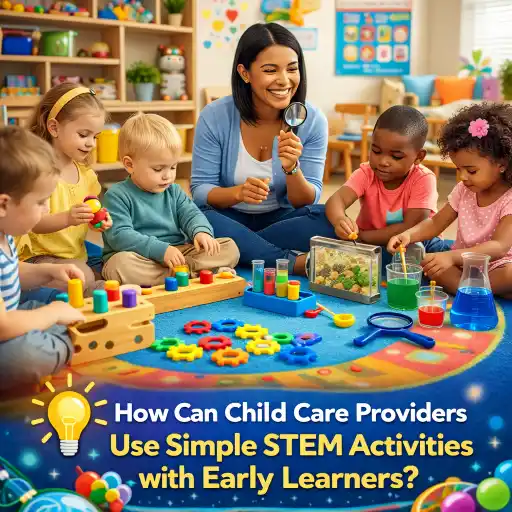
Short answer: STEM supports thinking, language, and confidence. Research and early childhood practice say that science and math in preschool help children practice asking questions, testing ideas, and talking about what they observe. The SEED paper on early science learning explains that inquiry and curiosity are powerful drivers of young learning (see Science in Early Childhood Classrooms).
Why it matters (quick points):
- 🧠 Build thinking skills: Children form guesses, test them, and revise ideas.
- 🗣️ Grow language: Talking about predictions and results builds vocabulary.
- 📐 Early math: Counting, measuring, and sorting are part of many activities.
- 🤝 Social skills: Working together on a building or rescue task boosts cooperation.
- 💪 Confidence: Success and trial-and-error teach persistence.
Child care providers can connect short STEM invitations to daily routines and books. For teacher-friendly training and grounding in practice, explore the ChildCareEd course suggestions in the hands-on article above and related courses like Enhancing STEM Education for Infants and Toddlers  Buy Now $16.00. For Montessori-inspired strategies and activity adaptations specifically designed for infants and toddlers, see Supporting Our Littlest Montessori Scientists.
What simple STEM activities can I try tomorrow?
- 🧪 Color mixing: clear cups, water, food coloring, droppers.
- Ask: "What will happen if we mix blue and yellow?"
- Let children add drops and describe the new color.
- ⚖️ Sink or float: tub of water + classroom objects.
- Predict, test, then sort into two groups.
- 🚗 Ramp races: cardboard ramp + toy cars.
- Change ramp height and compare which car goes farther.
- ❄️ Frozen toy rescue: toys in ice + warm water/dropper/salt.
- 🌱 Planting in clear cups: watch roots and shoots grow.
- 🧲 Magnetic hunt: magnets and mixed items to test what sticks.
- 🫧 Bubble shape testing: shaped wands and soapy water.
- ✈️ Paper airplane trials: fold, fly, measure distance.
- 🌈 Walking water: colored cups and paper towels.
- 🧰 Build-and-test challenge: recycled boxes, tape, and blocks.
For step-by-step printable experiments like the water drop counting activity, see Water Drop STEM Activity Buy Now $0.00. These activities are intentionally simple so children can repeat them and notice more each time.
How do I set up a STEM-friendly space and guide learning without taking over?
- 📦 Prepare materials in labeled bins so children can choose.
- 🪣 Use trays or washable tablecloths for messy experiments.
- 👀 Place the area where adults can supervise easily — state requirements vary - check your state licensing agency.
- 🔁 Rotate a small set of loose parts weekly (cups, droppers, blocks, bottle caps).
- ✅ Post simple rules: materials stay on the table, no tasting, adults pour anything hot.
Teacher moves that help learning (do these in order):
- 👂 Observe first: let children try their ideas.
- ❓Ask one open question: "What do you notice?"
- 🧪 Encourage testing: let them try and compare results.
- ✏️ Invite simple documentation: drawing, tally, or photo.
- 🔁 Repeat and change one thing at a time.
Common mistakes and how to avoid them:
- ❗Too much adult instruction — step back after one question.
- ⚖️ Focus only on right answers — celebrate the process.
- 🧩 Too many materials — offer fewer choices to reduce overwhelm.
- 🧼 Avoiding mess altogether — plan smocks, trays, and simple clean-up.
- 📷 Not documenting — take quick photos and notes so you can plan next steps.
See practical set-up tips in Easy Ways to Add STEM to Your Preschool Classroom and safety notes in STEM for Preschoolers: Simple Experiments.
How can I document learning and involve families?
Documentation shows growth and helps families see learning. Keep it quick and repeatable so staff can do it every day. Try this 3-step documentation routine:
- 📸 Photo: Take a clear photo of the child with their setup or result.
- 📝 Quote: Write one short sentence (child’s words or your observation).
- 📚 Display or file: Add to a class STEM notebook or a wall chart for revisits.
Ways to include families:
- 📧 Send one photo with a short note about the question the child tested.
- 🏠 Share a quick activity to try at home (color mixing or sink/float are great choices).
- 🗣️ Invite family observations at pick-up: ask parents, "What did you notice?"
FAQ (quick answers for busy providers):
- Q: How long should an invitation run? A: 10–20 minutes for a focused invite; longer for multi-day projects.
- Q: Do I need special kits? A: No — everyday items work well; see STEAM Activities Using Everyday Materials.
- Q: How do I include dual-language learners? A: Use gestures, label materials, and accept descriptions in the child’s home language.
- Q: What if staff are short on time? A: Start with one tray and one photo note—small steps add up.
For more activity packs, teacher moves, and course options, visit ChildCareEd activity pages such as Spark Young Minds and course pages like Enhancing STEM Education for Infants and Toddlers Buy Now $16.00.
Conclusion
Start small and celebrate curiosity. Quick next steps you can do tomorrow:
- 🔹 Pick one activity (color mixing or sink/float are easy wins).
- 🔹 Put materials on a tray and add a simple question.
- 🔹 Watch, ask one open question, take one photo, and jot one sentence.
- 🔹 Repeat the activity another day and ask, "What changed?"
You already support big learning every day. These short, playful STEM invitations will help your children grow as confident thinkers. For printable activities and more teacher tips, explore ChildCareEd’s activity pages and courses linked above. Keep it playful, safe, and repeating — and enjoy watching curiosity grow.
Here are easy, low-prep ideas that work in small groups or during free play. Each idea is safe and repeats well. For full lists and printable ideas, see Spark Young Minds: Playful Scientists and the ChildCareEd activity pages.Keep the space simple and visible. A small discovery table or tray system invites independent play and makes cleanup easy. Follow these setup steps:- 45 Hour Child Growth and Development
- 45 Hour Preschool Methods and Materials
- CDA Bridge Bundle: Family Child Care without Portfolio Review
- Art from the Heart for Preschoolers: Open Ended Art Projects that Build Self-Esteem
- CDA Bridge Bundle: Infant/Toddler without Portfolio Review
- CDA Bridge Bundle: Preschool without Portfolio Review
- Texas Director Credential
- Wellness in Action: Teaching Healthy Habits to Children
- Enhancing STEM Education for Infants and Toddlers
- Counting Candy Canes: The STEM of Holiday Fun for Early Learners
- 🎉STEM-sational Fun: How Can You Spark Preschoolers’ Curiosity with Engaging STEM Activities? 🔬🧪🔢
- Proporciones de Cuidado Infantil y Tamaños de Grupo por Edad en Maryland (Guía Rápida para Centros y Hogares)
- Proporciones de Cuidado Infantil y Tamaños de Grupo por Edad en Nueva Jersey (Guía Rápida para Centros y Hogares)
- Proporciones de Cuidado Infantil y Tamaños de Grupo por Edad en Virginia (Guía Rápida para Centros y Hogares)
- How can I use STEM activities in my Preschool and Pre-K classroom?
- How Do Art Activities Support Cognitive Growth in North Dakota Preschoolers?
- Can Toddlers Do STEM in the Sandbox at Minnesota Daycares?
- What are easy STEM activities I can do with preschoolers?
- How can child care providers use simple STEM activities with early learners?
- Diversión fresca de verano: actividades del Día Nacional del Helado para niños
- What Can the Golden Gate Bridge Teach Preschoolers About Connection?
- How can preschool teachers use simple STEM activities to spark big learning?
- Cómo simplificar la capacitación para sus empleados de daycare
- How can pumpkin science create meaningful, hands-on fall learning for preschool classrooms?
- How can leaf-themed art and science activities deepen learning in my child care program?
- How can we encourage scientific thinking through hands-on exploration?
- How can I introduce STEM concepts in early childhood?
- Can You Build a Leaf Bridge? Fall STEM Challenges for Pre-K
- How Can STEM Activities Turn Everyday Preschool Play Into Powerful Learning?
