Hands-on exploration gives young children meaningful opportunities to observe, question, predict, test ideas, and learn from unexpected results. This practical guide helps child care providers and program directors strengthen scientific thinking through playful, low-cost experiences involving water, nature, movement, building, light, sound, and everyday materials. It includes concrete teacher prompts, simple invitations to investigate, strategies for documenting children’s ideas, and guidance for avoiding common pitfalls such as explaining too quickly or focusing only on correct answers. To deepen staff practice, explore ChildCareEd’s self-paced online course Building Early Science Foundations  Buy Now $16.00, which supports developmentally appropriate observation, prediction, experimentation, discovery, and scientific inquiry. By giving preschoolers time to explore and encouraging them to explain what they notice, educators can make science and STEM a natural part of classroom play and daily routines.
Why it matters: Early experiences with inquiry and materials are not trivia — they build the habits of mind that support later learning. Karen Worth and others argue that young children’s curiosity is a powerful catalyst for scientific learning; when guided well, that curiosity becomes the start of inquiry skills and content knowledge (see Science in Early Childhood Classrooms)
Why it matters (practice snapshot): 1) Hands-on invitations build vocabulary, attention, and reasoning while children manipulate real materials (ChildCareEd resources show many repeatable ideas—see What Are Fun and Easy STEM Activities).
What does scientific thinking look like in infants, toddlers, and preschoolers?
Scientific thinking in early childhood shows up as simple but powerful behaviors: asking questions, making predictions, testing ideas, observing changes, and using talk or drawings to explain results. Research frames young learners as natural experimenters—children compare, hypothesize, and design informal tests long before formal school science (see Worth and Brenneman on assessment).
Key observable moves (useful for staff training):
- Notice and describe: Children point, label, and count what they see (e.g., “The ice got smaller.”)
- Predict: Before an activity, they offer guesses (“I think the car will go farther.”)
- Test: They change one thing and watch what happens (ramp angle, weight, or surface).
- Explain & represent: They use drawings, play narratives, or a short sentence to say what happened.
Practical link: For ready-made invitations that highlight these behaviors, see ChildCareEd’s hands-on activity collections like How Can I use STEM Activities in my Preschool and the Preschool STEM Activities for Hands-On Learning.
How do I design short, hands-on invitations that spark real inquiry?
Design invitations (10–30 minutes) that focus on one clear question and a small set of materials. The goal is to invite testing, not to deliver facts. Use everyday objects; many strong activities live in the ordinary (see ChildCareEd’s lists: 10 easy STEM ideas and Water Drop STEM Activity Buy Now $0.00).
Design checklist (enumerated):
- Start with one question: “Which object will float?”
- Limit materials to 4–8 items and one tray for containment.
- Prepare simple recording tools: picture cards, a clipboard, a camera, or a small chart.
- Plan three open prompts: notice, predict, test (see section below on teacher moves).
- Rotate materials weekly to keep interest high.
Examples (quick-launch):
- 🧪 Color mixing with droppers and clear cups — ask “What new color will we make?” (ChildCareEd color-mixing idea).
- ⚖️ Sink or float lab — use a bin, predicted charts, and seed-to-seed comparisons (see Pumpkin Seed Exploration & Sink or Float Lab Buy Now $0.00). For seasonal, nature-based variations that use real pumpkins, pinecones, and leaves to explore buoyancy, measurement, and classification, see autumn-themed STEM projects using natural materials.
- 🚗 Ramp races — change height or wheel type and measure distance (ramp idea).
Safety & logistics: Keep materials age-appropriate, plan for cleanup, and position activities where teachers can supervise. State requirements vary - check your state licensing agency.
What teacher moves support exploration without taking over the experiment?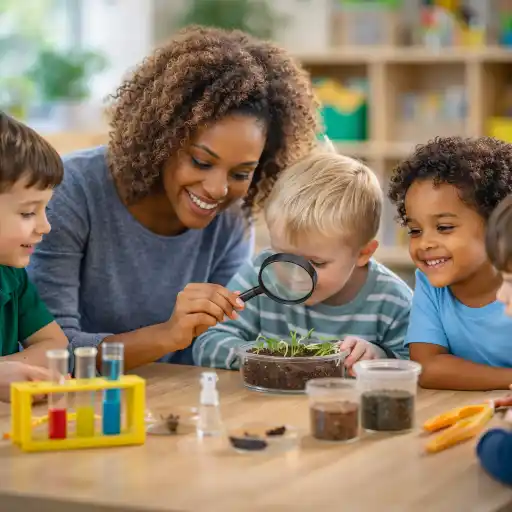
Your role is to scaffold thinking—observe, ask open questions, and offer small challenges that extend ideas. Research and practice emphasize gentle guidance so children retain agency while building skills (Worth; ChildCareEd’s practical guides: STEM in Preschool).
Simple teacher moves (use these repeatedly):
- 👂 Observe first — watch what children try before asking questions.
- ❓Ask open prompts — “What do you notice?” “What do you think will happen?”
- 🧪 Invite testing — “How could we try that?” Then step back while they test.
- 📸 Document — take a quick photo and jot the child’s words to capture thinking.
- 🔁 Extend with one change — “What if we change only the ramp’s height?”
Teacher language matters: use vocabulary that names actions (sink, float, faster, softer) and causal words (because, so, therefore). Let children lead the questions; your prompts should make their thinking visible rather than supply answers (see Little Einstein’s Lab).
How can I document and assess scientific thinking without heavy testing?
Assessment for preschool science emphasizes performance, observation, and classroom-quality measures rather than paper tests. Use brief, repeatable documentation steps that fit daily practice: photos, direct quotes, a short note about the child’s question or prediction, and a return visit to the same invitation to compare results (see assessment review at Assessment for Preschool Science Learning).
Practical documentation steps (enumerated):
- 📸 Photograph the setup and the child's interaction.
- ✏️ Record one sentence or the child’s exact words about the prediction/outcome.
- 🗂️ File entries in a STEM notebook or portfolio for each child.
- 🔁 Repeat the invitation after several days to check for change and deeper reasoning.
- 📊 Use a simple rubric: observed predicting, testing, explaining, and representing.
Tools & resources: ChildCareEd’s “Building Early Science Foundations” materials include ready PDFs and family engagement ideas to share observations with parents (Building Early Science Foundations resources).
What common mistakes do providers make—and how can we avoid them?
Being mindful of common pitfalls helps teams sustain effective science learning. Here are the typical errors and easy fixes.
- ❗Too much adult instruction — Fix: prompt once, then step back. Let children test their own ideas (guidance).
- ⚖️ Overemphasizing right answers — Fix: praise the process and the attempt; ask “How did you find out?”
- 🧩 Too many materials at once — Fix: reduce items to focus the inquiry; rotate extras.
- 🧼 Avoiding mess entirely — Fix: use trays, smocks, and predictable cleanup routines so staff will permit messy exploration (see practical setups in ChildCareEd STEM setup tips).
- 📋 No follow-up — Fix: schedule a short revisit to provoke comparison and reflection.
Why these fixes work: they keep the child as the investigator, focus attention on evidence, and build habits of recording and comparing — the core of scientific practice described in research literature (see Worth and empirical models of promoting scientific thinking).
FAQ (quick for busy providers)
- Q: How long should a STEM invitation last? A: 10–20 minutes for short invites; 30–60 minutes across several days for projects (ChildCareEd timing).
- Q: Do I need special kits? A: No — everyday materials and loose parts are usually best (everyday materials guide).
- Q: How do I include dual-language learners? A: Accept responses in the child’s home language, pair words with images, and use gestures.
- Q: How do we share learning with families? A: Send a photo and a short caption of what the child predicted and discovered; invite home extensions (seed planting, sink/float tests).
Conclusion: Start small, document simply, and celebrate curiosity. One short, well-scaffolded invitation per week, photographed and recorded in a portfolio, yields measurable growth in children’s reasoning and language. For activity banks, teacher moves, and downloadable lesson PDFs, explore ChildCareEd’s science pages: Fun & Easy STEM Activities, Preschool STEM, and Pumpkin Seed Exploration Buy Now $0.00. State requirements vary - check your state licensing agency.
- Teacher-Child Interactions for Stronger CLASS® Outcomes
- Building Early Science Foundations
- Play Safe, Think Big: Literacy Through Play
- Teach with Respect!
- Injury Prevention: Their Safety Is In Your Hands
- Creating Engaging and Meaningful Learning Experiences
- Sensitive Periods in Montessori: Guiding Natural Learning
- Texas Director Credential
- Montessori Cultural Activities: Exploring the World Through Play and Learning
- Pumpkins, Pinecones, and Leaves: Autumn-themed STEM Projects
- CDA Certification en Español: Recursos y Consejos para Educadores Bilingües
- Easy Ways to Add STEM to Your Preschool Classroom
- How can I use STEM activities in my Preschool and Pre-K classroom?
- What are easy STEM activities I can do with preschoolers?
- How can pumpkin science create meaningful, hands-on fall learning for preschool classrooms?
- How can we encourage scientific thinking through hands-on exploration?
- How can I use simple STEM activities to spark curiosity in preschoolers?
- How can blocks, water play, cooking, and outdoor exploration introduce STEM to young children?
- How Can I Use Everyday Materials for Meaningful STEM Exploration in My Preschool Classroom?
- STEM for Preschoolers: Fun Activities That Encourage Curiosity
- What’s Happening Outside? Fall Science Adventures for Preschoolers
- How Can STEM Activities Turn Everyday Preschool Play Into Powerful Learning?
- How Can Child Care Providers Create Low-Cost STEM Activities With Items They Already Have?
- How Do Light vs. Heavy Activities Build Early Measurement Skills?
- How Can Living vs. Non-Living Sorting Spark Early Science Thinking?
- Why Does Sensory Play Matter for Brain Development?
- How Can Preschool Sorting Activities Teach Temperature Concepts Safely?
- How Can Child Care Providers Introduce Hypotheses, Observations, and Conclusions to Children?
- How Do Classification Questions Build Marine Science Vocabulary?
