Simple kitchen activities can teach young children valuable real-world skills while making learning active, social, and memorable. Teacher-led cooking and no-cook food projects can introduce early math through counting and measuring, science through observing changes in ingredients, language through recipes and new vocabulary, and motor development through pouring, stirring, spreading, and scooping. These shared experiences also encourage cooperation, independence, healthy eating habits, and a stronger sense of classroom community. This article provides practical activities, age-appropriate safety procedures, inclusive adaptations, and assessment strategies that help #children build meaningful #skills through #cooking while supporting #nutrition and #safety. To help teachers encourage tasting and long-term healthy choices without pressure, see practical strategies for encouraging healthy eating without bribery or meltdowns.
To plan purposeful cooking experiences, explore ChildCareEd’s self-paced online course Chef’s in the Classroom: Cooking as a Teaching Tool  Buy Now $24.00. The training helps teachers and providers plan, adapt, and implement enjoyable cooking activities that align with children’s developmental needs and extend learning across the curriculum. Providers can also take Food Preparation and Nutrition Buy Now $32.00 to strengthen their understanding of safe food preparation and nutrition guidelines in early childhood settings.
Why this matters:
1) Young children who participate in food preparation demonstrate stronger counting, measuring, and sequencing abilities—core early #math and literacy skills when tied to recipes and picture-step cards (Cooking in the Classroom).
2) Cooking supports healthy eating habits and brain development—important for daily learning and long-term health (CDC).
How do kitchen activities build learning across domains?
1. Enumerated learning outcomes (easy to observe):
- 🍽️ Math: measuring, counting, comparing volumes and early fractions—practice that connects to everyday routines and standards (How to Include Kids in the Kitchen).
- 🔤 Language & literacy: reading recipe steps, sequencing actions, expanding food vocabulary.
- 🔬 Science & STEM: observing changes (mixing, melting, dissolving), making predictions and testing—perfect for short preschool STEM moments (STEM in the Kitchen).
- ✋ Motor & self-help: pouring, spreading, scooping and serving build hand strength and independence.
- 🤝 Social-emotional: turn-taking, sharing, responsive feeding, and self-regulation during family-style serving (Family-style guidance).
Practical link: use short, predictable routines (10–25 minutes), picture recipes and work stations so each child has one clear job. For evidence and classroom examples,s see ChildCareEd’s practical guidance on cooking projects (Cooking in the Classroom course page).
What simple, classroom-friendly recipes and activities can you run tomorrow?
Keep it short, safe, and hands-on. Below are classroom-friendly, low-prep ideas—most are no-cook or low-heat and work well in mixed-age groups (Classroom Cooking Activities):
- 🍓 Fruit salad: wash, tear soft fruit, count pieces, es and mix in bowls. (Prep tip: pre-cut for toddlers.)
- 🥜 Trail mix assembly: portion stations with scoops and small bowls—great for sorting and counting.
- 🥣 Yogurt parfaits: layer fruit, yogurt, and granola to practice sequencing and patterns.
- 🧁 No-bake snack balls: measure, mix, roll—introduces measuring and textures.
- 🍽️ Family-style serving practice: pass bowls, pour from small pitchers,s and practice polite phrases (ND classroom examples).
- 🎨 Food decorating: use fruit and seeds to create faces or patterns—builds creativity and fine motor skills.
Teacher tips (enumerated): 1) Prep ingredients and portion into small bowls. 2) Use picture-step cards for non-readers. 3) Assign one job per child. For printable lesson templates and recipes, see ChildCareEd’s free resources and lesson plan templates (Cooking up Success resources).
How do you plan for safety, allergies, and regulatory compliance?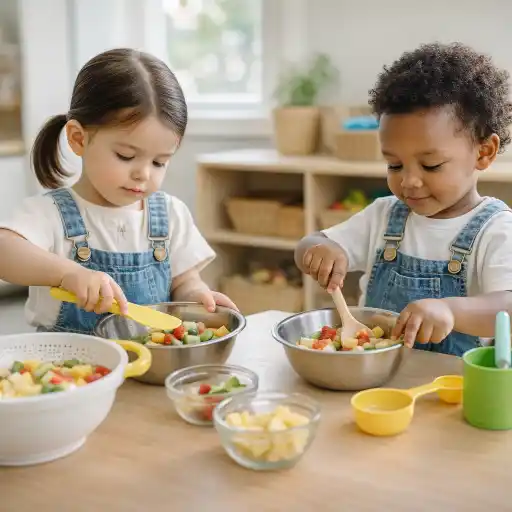
Safety is non-negotiable. Use clear policies, staff training, and simple checks. Remember: state requirements vary - check your state licensing agency.
Key steps (enumerated):
- 🧾 Documentation & permissions: collect family permission slips, ingredient lists, TS and allergy action plans at enrollment (ND guidance).
- 🧼 Food safety: wash hands, sanitize surfaces, refrigerate perishables promptly—follow national guidance for young children (Canada Food Handling).
- ⚠️ Allergies & cross-contact: label containers, use dedicated utensils for allergen-free children, and post emergency plans (Allergy resources).
- 🎓 Staff training & supervision: assign roles, practice active supervision, and run brief role-play drills (Staff tips).
Common mistakes and simple fixes (enumerated):
- ❌ Forgetting to check labels — Fix: designate one staff member to read labels before activities.
- ❌ Overcomplicating activities — Fix: pick one task per child and keep total time under 25 minutes.
- ❌ Ignoring documentation — Fix: use a quick checklist (permissions, allergies, sanitized tools) before each session.
Quick FAQ (enumerated):
- Q: Can toddlers participate? A: Yes—use soft, pre-cut foods and close supervision (Nemours).
- Q: Do cooking activities count for CACFP? A: Serving must meet CACFP meal patterns; cooking as an activity doesn’t change meal credit—check your sponsor.
- Q: How long should activities be? A: 10–25 minutes for preschoolers; shorter for infants/toddlers.
- Q: What if a child refuses to taste? A: Never force; offer small tastes and repeat exposure over time (Picky-eater tips).
How can you adapt cooking activities for inclusion and family engagement?
Cooking is naturally inclusive when you plan roles and adaptations. Use visual supports, adaptive tools, and family recipes to create belonging and cultural relevance.
Practical, enumerated strategies:
- 👩👧👦 Family involvement: send home short permission notes, invite family recipes for taste tests, and share photos and learning goals—this builds bridges and extends learning to home (family ideas).
- ♿ Adaptations for children with disabilities: break tasks into micro-steps, use non-slip bowls, adapted spoons, or glove covers; provide hand-over-hand support as needed (Inclusion quick tips).
- 🌍 Cultural inclusion: rotate recipes from families’ cultural traditions, discuss where foods come from,m and link to social studies learning (Cooking as curriculum).
- 🧑🏫 Differentiation: assign tasks by skill—measuring for older children; washing, stirring, or sprinkling for younger ones.
Small steps help: start with one family-style meal or one inclusive snack project per week. Celebrate contributions and let children share pride in their cultural recipes.
How do you extend cooking into the curriculum and assess children's learning?
Cooking projects are low-prep, high-yield learning labs. Use them to teach measurable objectives and collect quick evidence of learning.
Ways to extend and assess (enumerated):
- 🔢 Math & data: count scoops, compare quantities, record results (e.g., how many spoonfuls) and link to standards—use measuring tools and photos as evidence (What kids learn).
- 📚 Literacy: have children "read" picture recipes, sequence steps, and label ingredients; use observational notes to document vocabulary growth.
- 🔬 Science investigations: ask children to predict outcomes (what happens when sugar dissolves?) and record observations in a class science journal (STEM ideas).
- 🎨 Thematic extensions: connect cooking to social studies (cultural foods), art (plating and design), and SEL (sharing, turn-taking).
- 📝 Assessment tools: use quick checklists—did the child complete their job? Count correct measurements? Use 1–3 icons for independence level. Photograph and add samples to portfolios or family notes.
Example mini-lesson: 1) Objective: practice 1/2 and 1 cup using measuring cups; 2) Activity: make parfait layers; 3) Assessment: teacher checklist + photo in portfolio.
For more curricular connections and templates, see ChildCareEd outcomes and free printable resources (Extend cooking projects).
Conclusion — Quick checklist to try this week:
- 🍽️ Choose one no-cook activity (fruit salad or trail mix).
- 👩🏫 Brief staff (10 minutes): roles, allergy checks, active supervision.
- 📝 Senda family note for permission and invite a recipe from home.
- 🔖 Use a simple checklist to document one learning target (math or language).
- 📚 Reflect: what worked? Adjust for next week and celebrate a child’s small success.
State requirements vary - check your state licensing agency. For deeper training, ChildCareEd offers courses on cooking in the classroom, food safety, nutrition, and family-style service linked above. Small, consistent steps make cooking an accessible, powerful teaching tool in any early childhood program.
- CDA Home Visitor Subject Area 3 Part 3 Birth to 5
- CDA Home Visitor Subject Area 2 Part 3 Birth to 5
- 45 Hour Preschool Methods and Materials
- Texas Teacher 24 hours Annual Renewal 2nd Year
- Montessori Cultural Activities: Exploring the World Through Play and Learning
- Building Early Science Foundations
- Wellness in Action: Teaching Healthy Habits to Children
- CDA: Special Needs: Understanding the Whole Child
- Supporting Families and Caregivers in Language and Literacy
- Healthy Cooking for Picky Kids
- DIY Snow Globes: The Fine Motor Craft That’ll Keep Kids (and Adults) Busy for Hours
- CDA Certification en Español: Recursos y Consejos para Educadores Bilingües
- 🔍 ¿Qué ves cuando observas a un niño aprender?
- 10 Ejemplos de Cómo la Cultura Influye en el Desarrollo Infantil
- Actividades de Fiesta para Niños de Preescolar y Primaria
- Reglas de Cuidado Infantil en Illinois
- Proporciones de Cuidado Infantil y Tamaños de Grupo por Edad en Maryland (Guía Rápida para Centros y Hogares)
- Proporciones de Cuidado Infantil y Tamaños de Grupo por Edad en Nueva Jersey (Guía Rápida para Centros y Hogares)
- Proporciones de Cuidado Infantil y Tamaños de Grupo por Edad en Virginia (Guía Rápida para Centros y Hogares)
- Cómo Celebrar el Día Nacional del Kindergarten
- Cómo Trabajar en el Cuidado Infantil en Carolina del Norte: Requisitos y Pasos
- Cómo Trabajar en el Cuidado Infantil en California: Requisitos y Pasos
- Cómo Ser Maestra de Preescolar en Maryland
- Celebrando la amistad en el cuidado infantil durante el Día de los Mejores Amigos
- Canciones, juegos y preguntas de círculo para niños
- Cómo simplificar la capacitación para sus empleados de daycare
- How Can Simple Cooking Activities Teach Skills in North Dakota Child Care Programs?
- Can simple kitchen activities teach valuable skills to young children in child care settings?
