Food activities can do more than introduce healthy eating—they can also build vocabulary, categorization, and conversation skills. In this article, we’ll explore how hands-on sorting helps children learn about food groups and make meaningful connections through discussion, with support from Nutrition Essentials for Child Care Providers  Buy Now $16.00 and the Picnic Food Categories: Cut-and-Paste Sorting Activity Buy Now $1.49.
Why does hands-on food sorting matter?
Sorting is not merely a way to keep children occupied. It is an early form of classification in which children notice attributes, compare objects, make decisions, and explain a rule. When the materials are familiar foods, the activity also creates a concrete bridge between classroom learning and children’s everyday experiences.
Research-informed early childhood practice emphasizes that children learn through touching, moving, discussing, and revising ideas. A child who places an apple beside a banana is practicing more than recognition: the child is considering similarities, using visual information, and participating in a shared meaning-making process. These experiences support early mathematics, science, vocabulary, and social development.
Food sorting can also introduce nutrition without shame or pressure. Rather than labeling foods as “good” or “bad,” providers can use neutral terms such as fruit, vegetable, grain, crunchy, soft, grown underground, or served at breakfast. The referenced fruit-and-vegetable sorting guidance similarly recommends using classification as a low-pressure way to build familiarity with foods.
- Children practice #language by naming, describing, and comparing foods.
- They build #confidence through successful, hands-on decisions.
- They strengthen #reasoning by explaining and revising categories.
- Providers gain natural openings to discuss variety, growth, culture, and family food traditions.
How should providers choose categories and materials?
Begin with categories children can see and understand. For toddlers and younger preschoolers, color, shape, size, and texture are often more accessible than formal food groups. Older preschoolers may be ready to explore fruits, vegetables, grains, proteins, and dairy, provided the categories are presented simply and flexibly.
Offer a manageable number of items—perhaps five to ten familiar foods—before adding complexity. Use play food, realistic photographs, laminated cards, felt pieces, or clean empty food containers. Real food can provide valuable sensory information, but it requires careful planning for allergies, sanitation, choking prevention, and supervision.
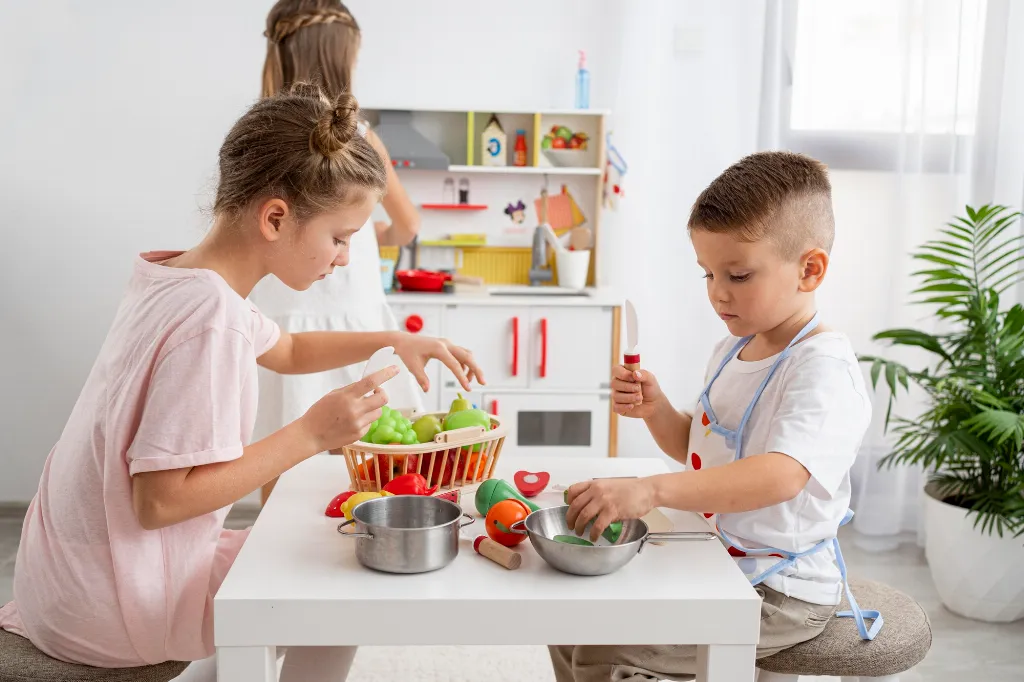
- Sort by color: red, green, yellow, or orange.
- Sort by physical characteristics: round/long, large/small, smooth/bumpy, soft/crunchy.
- Sort by source: plant-based or animal-based.
- Sort by location: grows above ground or below ground.
- Sort by use: breakfast, lunch, snack, or family celebration.
- Sort by food category using child-friendly labels and pictures.
Provide baskets, hoops, trays, or mats with clear visual labels. Tongs, scoops, and large manipulatives add fine-motor practice, while bilingual labels, photographs, tactile objects, and communication boards make participation more accessible. The course Early Mathematics Through Play Buy Now $24.00 can help providers intentionally connect sorting, comparison, patterns, and classification to broader mathematical learning.
How can conversation deepen the learning?
The educational value of sorting grows when adults listen carefully and extend children’s thinking. Instead of asking only, “Where does this belong?” invite children to describe what they notice and explain their reasoning. Conversation should feel like inquiry rather than an assessment test.
- “What do you notice about this food?”
- “How are the apple and carrot alike?”
- “What is different about these two foods?”
- “Where might this food grow?”
- “What could we call this group?”
- “Could we sort these foods another way?”
Accept gestures, home-language words, drawings, pointing, and alternative communication as legitimate responses. For children learning English, repeat key vocabulary naturally and pair words with photographs or objects. For children with communication differences, offer choices such as “soft or crunchy?” without limiting every interaction to forced-choice questions.
Use children’s explanations as the starting point for clarification. A tomato may be placed with vegetables because it is commonly used in salads and cooking. You can affirm the child’s reasoning and explain that foods may be classified in different ways: botanically, a tomato is a fruit; in everyday meal planning, people often group it with vegetables. The goal is accurate knowledge alongside intellectual flexibility.
Mealtimes and snack routines provide additional opportunities for meaningful talk. The referenced talking-food guidance recommends discussing colors, origins, family preferences, and ingredients while using open-ended questions and active listening.
How can providers make the activity inclusive and culturally responsive?
Food is connected to culture, family identity, sensory experience, access, health, and personal history. A respectful activity represents the children and families in the program without assuming that one menu, cuisine, or eating pattern is universal. Invite caregivers to share food names, recipes, planting traditions, or stories about meals that matter to their families.
Avoid using sorting to rank families’ choices or to pressure children into tasting. Sensory food education is most effective when children may look, smell, touch, describe, sort, or observe without being required to eat. The referenced sensory food education resource emphasizes two protective principles: no one has to try, and no one has to like.
- Use food-neutral language such as “everyday foods” and “sometimes foods” only when it supports the lesson, not as a moral judgment.
- Include familiar foods alongside less familiar examples.
- Offer picture cards or play food for children with allergies or sensory sensitivities.
- Provide adaptive tongs, larger cards, nonslip mats, and varied seating positions.
- Invite children to contribute vocabulary from home languages.
Food safety must remain central. Review allergy and medical plans, read labels, prevent cross-contact, supervise closely, and modify food size and texture according to age and ability. State requirements vary - check your state licensing agency, particularly when activities involve tasting, preparation, sanitation, allergy accommodations, or classroom meals.
How can directors extend sorting into curriculum and assessment?
Directors can help staff move beyond an isolated worksheet by embedding food sorting within a sequence of connected experiences. A week might include sorting food pictures, reading a gardening story, planting herbs, graphing colors, opening a pretend market, and preparing a safe no-cook snack. The same concept can then support science, literacy, mathematics, dramatic play, health, and family engagement.
- Create a farmers’ market with baskets, price tags, food cards, and multilingual labels.
- Sequence the journey from seed to plant to harvest to preparation.
- Graph children’s preferred colors or textures without implying that one preference is healthier.
- Invite families to share a recipe, food photograph, or name for a familiar ingredient.
- Use tongs and scoops to strengthen hand control while children classify items.
- Document children’s comments, strategies, questions, and changes in thinking.
Assessment should focus on process rather than whether a child ate a particular food. Observe whether the child notices attributes, maintains a category rule, uses descriptive vocabulary, takes turns, handles materials safely, or creates a second classification. Brief notes such as “sorted foods by growing location and explained that carrots grow underground” provide stronger evidence than a completed page alone.
Common mistakes include turning the activity into a quiz, using rigid “healthy/unhealthy” labels, pressuring children to taste, offering only unfamiliar foods, overlooking accessibility, and forgetting safety checks. When a category becomes confusing, treat the uncertainty as productive inquiry. Children are learning that classification depends on the question being asked.
Conclusion: How can hands-on sorting and conversation teach food categories?
Hands-on food sorting teaches categories most effectively when children can touch, move, compare, talk, and reconsider their ideas. Start with simple, visible attributes; gradually introduce food groups and growing patterns; and use open-ended conversation to make children’s thinking visible.
The strongest experiences are playful, inclusive, culturally responsive, and pressure-free. They support classification, early mathematics, vocabulary, fine-motor coordination, collaboration, and food familiarity without turning nutrition into a moral judgment. With thoughtful materials, safe procedures, and intentional documentation, a small sorting invitation can become a meaningful part of the curriculum.
Frequently asked questions
Should children taste the foods?
No. Tasting may be offered when safe and appropriate, but looking, touching, smelling, sorting, and talking are valid forms of participation.
What is the best age to introduce food categories?
Toddlers can begin with color, shape, and size. Preschoolers can gradually explore food groups, sources, textures, and multiple classification rules.
How many foods should be included?
Start with five to ten familiar items. Add more only when children are comfortable maintaining the sorting rule and conversation remains engaging.
How can I include children with allergies?
Use photographs, play food, or clean non-food materials when appropriate; follow each child’s medical plan; and consult program policies before using edible items.
How can directors support consistent practice?
Provide shared materials, model neutral language, include sorting in planning meetings, and use short observation notes to guide future adaptations.
Additional ChildCareEd courses for providers
- Food Preparation and Nutrition Buy Now $32.00—supports knowledge of food storage, preparation, allergies, and foodborne illness prevention.
- Healthy Habits From the Start Buy Now $35.00—connects nutrition with child growth, classroom practice, and family education.
- Inclusive Lessons for Preschoolers Buy Now $16.00—offers practical strategies for adapting materials and lessons for diverse learners.
- Basic Health & Safety and Breastfeeding Awareness
- Creating Engaging and Meaningful Learning Experiences
- Staff Supervision, Observation & Feedback
- Texas Director Credential
- Building Vocabulary
- Wellness in Action: Teaching Healthy Habits to Children
- Montessori Cultural Activities: Exploring the World Through Play and Learning
- CDA Infants/Toddlers: Smart Nutrition & Feeding
- CDA Certification en Español: Recursos y Consejos para Educadores Bilingües
- ¿Cómo puedo usar escenarios de juego de roles de primeros auxilios en mi aula?
- Retraso del Habla en la Guardería: Cómo Pueden Ayudar los Proveedores
- How can I teach colors, shapes & numbers through play in Michigan classrooms?
- Emotion Sorting Activities for Social-Emotional Learning
- Emotion Sorting for Kids: Learning Feelings Through Play
- Made by Me! Labor Day Crafts for Preschoolers That Celebrate Hard Work
- How Can Cut, Sort, and Glue Activities Strengthen Early Learners’ Development?
- Rosh Hashanah Sensory Bin Ideas: Apples, Honey, Shofars, and Sweet New Year Play
- How Can Child Care Providers Nurture Critical Thinking in Young Children?
- Why Is Animal Bingo a Great Way to Introduce Habitats and Classification?
- Why Is Wild vs. Farm Animal Sorting a Favorite Preschool Activity?
- What Can Hot vs. Cold Sorting Teach Preschoolers About Safety?
- How Can Sorting Activities Strengthen Early Thinking Skills?
- How Do Animal Classification Activities Build Early Science Thinking?
- How Does Word Sorting Build Phonics and Vocabulary Skills?
- How Can Themed Vocabulary Strengthen Beginning-Sound Awareness in Preschool?
- How Can Providers Talk About Food Variety Without Shaming Children’s Lunches?
- How Can You Plan a Food-Learning Activity for Children with Different Dietary Needs?
- How Can We Explore Animal Habitats Beyond Farm-and-Wild Labels?
