Can a sensory bin help children explore Rosh Hashanah while building language, fine-motor, and social-emotional skills? With thoughtful materials and respectful framing, apples, honey, bees, and shofars can become an engaging invitation to learn about Jewish traditions and new beginnings. For deeper guidance on inclusive, play-based curriculum design, explore From Play to Planning: Building Culturally Competent, Child-Centered Curriculum  Buy Now $55.00, which can strengthen planning practices and support professional learning hours where applicable.
Sensory play is most effective when it is intentional rather than merely entertaining. A well-designed bin gives children opportunities to fill, scoop, compare, describe, pretend, cooperate, and revisit ideas. Research-informed sensory-play resources identify fine-motor practice, vocabulary growth, creative play, and tactile exploration as meaningful benefits; see the practical guidance in taste-safe sensory bin fillers and sensory bin base ideas.
Why does a Rosh Hashanah sensory bin matter in early childhood?
Rosh Hashanah is the Jewish New Year. For young children, educators can introduce accessible themes such as welcoming a new beginning, offering kind wishes, noticing family traditions, and reflecting on how people grow. Apples dipped in honey are commonly associated with hopes for a sweet new year, while the shofar is traditionally sounded during the holiday. These symbols should be presented accurately and modestly: “Some Jewish families…” is more inclusive than suggesting that every family celebrates in exactly the same way.
A sensory bin also allows children to enter the experience at different levels. One child may sort apples by color, another may quietly touch the filler, and another may create an imaginative bee-and-honey story. This flexibility supports #inclusion and respects children who observe, participate briefly, or choose an alternative experience.
- Connect play to language, early math, science, and social-emotional learning.
- Use authentic images, books, and family input rather than stereotypes.
- Offer observation, conversation, drawing, movement, and pretend play as choices.
ChildCareEd’s guidance on teaching a sweet new year similarly recommends simple language, optional participation, and connections to kindness and family traditions.
How can providers prepare an apple-and-honey sensory bin?
Begin with one base and a limited number of purposeful props. A simple setup might include a shallow washable bin, large plastic or wooden apples, yellow fabric squares or sealed containers representing honey, bee figures, scoops, cups, tongs, and a small basket. Add picture cards showing an apple, honey, bee, and honeycomb for children who benefit from visual support.
For a taste-safe option, providers may use plain oats, cornmeal, or homemade oobleck made from cornstarch and water. A yellow tint can suggest honey without using actual food. Oobleck is inexpensive and invites children to notice how a material changes when pressed, scooped, or released. However, “taste-safe” does not mean risk-free: inspect ingredients, consider allergies, supervise closely, and follow program policies.
For a non-food bin, choose shredded paper, large pom-poms, washable fabric, or clean natural materials. Non-food alternatives may be preferable when food use conflicts with program policy, sanitation expectations, allergies, or family preferences. Keep the invitation uncluttered:
- One sensory base
- Two or three categories of props
- Tools that promote scooping, transferring, sorting, or grasping
- A few open-ended prompts
Place the bin on a tray or washable mat. Invite children with language such as, “You can explore the apples and the pretend honey. What do you notice?” Avoid turning the experience into a test.
What apple, honey, and bee activities build developmental skills?
The same bin can support multiple learning domains when adults observe and extend children’s thinking. Children can sort red, green, and yellow apples; count them into baskets; compare which basket has more; or arrange them from smallest to largest. These actions make early mathematics concrete. Add a balance scale for comparing weight or invite predictions about which objects feel heavier.
Language grows when educators model descriptive words such as smooth, rough, sticky, dry, heavy, light, full, empty, sweet, and sour. Ask open questions rather than questions with one correct answer:
- “How does the material move when you pour it?”
- “What could the bees be doing near the honeycomb?”
- “How could we make sure two friends both have a turn?”
Fine-motor development is supported through pinching, grasping, scooping, pouring, and using tongs. Social-emotional learning emerges as children negotiate space, exchange tools, and practice kind words. Educators can connect the play to Rosh Hashanah by saying, “Some families eat apples and honey to wish for a sweet year. What is a kind wish you have for our classroom?”
Documentation should focus on children’s thinking, not on whether they reproduce a holiday symbol. Record vocabulary, sorting strategies, peer interactions, sensory preferences, and emerging problem-solving. These observations can inform future #planning and family communication.
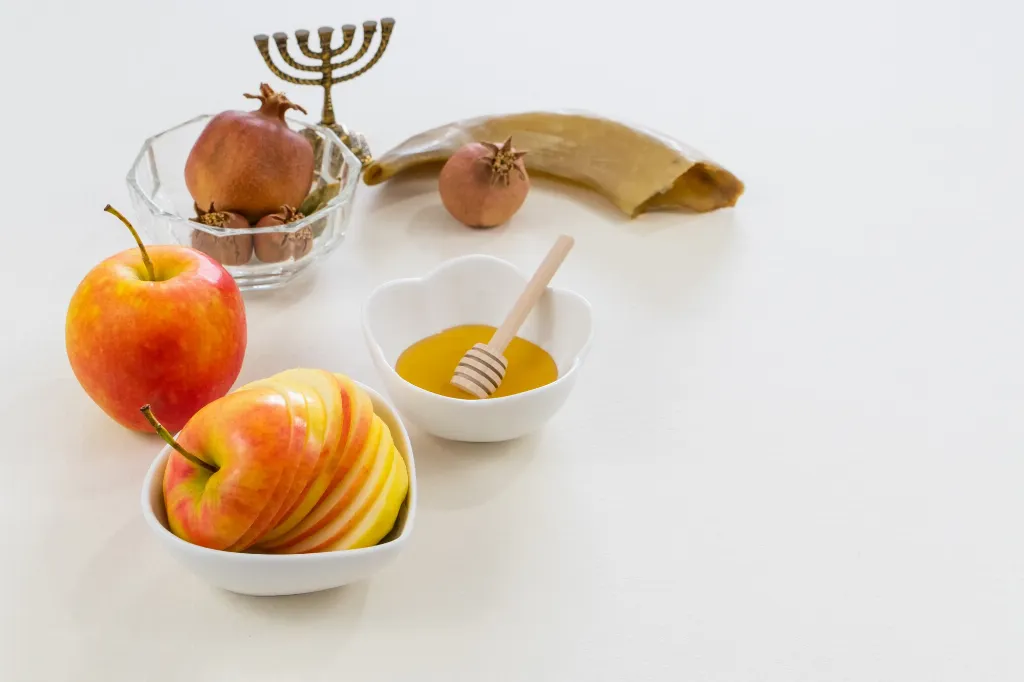
How can shofars be included in a calm, respectful sensory invitation?
The shofar deserves a distinct approach because it is not simply a generic noisemaker. It is a ram’s horn traditionally sounded during Rosh Hashanah and carries religious and cultural meaning. Begin with a photograph, a child-safe replica, or a teacher demonstration. Use brief, prepared language: “Some Jewish families hear a shofar during Rosh Hashanah. The sound can be loud, so we can listen from a comfortable distance.”
A shofar-themed tray might include cardboard or paper-tube models, textured brown paper, a basket, and picture cards. Children can explore shape, decorate a pretend instrument, or create sound patterns with rhythm sticks instead of blowing into shared objects. If a recording is used, keep it short and tell children before playing it. Provide headphones, distance, or a quiet alternative for children with sensory sensitivities.
Invite inquiry without requiring religious performance:
- “What do you notice about its curved shape?”
- “How did the sound make your body feel?”
- “What quiet sound could we make to signal a new beginning?”
Never pressure a child to listen, blow, pray, or repeat Hebrew words. If teaching “Shanah Tovah,” explain that it is a greeting wishing someone a good year, and consult families or reliable Jewish educational resources for pronunciation and context. The Jewish Educator Portal’s classroom guidance emphasizes culturally welcoming teaching that avoids assumptions and harmful stereotypes.
How can providers adapt sensory bins for infants, toddlers, and preschoolers?
Developmental adaptation is essential. Infants require direct supervision and materials selected according to mouthing, grasping, and choking risk. Instead of loose fillers, offer a sealed sensory bag containing yellow gel or water, large fabric apples, or a sturdy textured board. Adults can narrate: “You are pressing the soft bag,” while watching for fatigue or overstimulation.
Toddlers may use large apples, cups, and scoops with a small amount of contained filler. Keep the activity brief and model simple boundaries such as “Materials stay in the bin.” Preschoolers can sort, count, compare, create stories, dictate wishes, and collaborate on a pretend orchard or honey stand. Kindergarten children may investigate pollination, create sound patterns, or compare Rosh Hashanah with other ways families mark new beginnings.
Adaptation also includes sensory access, communication, and mobility:
- 🌟 Offer tools with different handles, textures, and sizes.
- Use picture cards, gestures, home-language words, or communication devices.
- Provide a dry alternative for children who avoid wet or sticky textures.
- Place materials at a reachable height and ensure adequate space for positioning.
- Invite parallel play rather than requiring children to share one crowded bin.
Food safety requires special care. Do not give honey to children under 12 months because of the risk of infant botulism. For older children, check allergies, dietary restrictions, family consent, sanitation procedures, and program policy before tasting. State requirements vary - check your state licensing agency.
What common mistakes should educators avoid when planning these bins?
A frequent mistake is using too many materials. A crowded bin can overwhelm children and make learning goals difficult to observe. Begin with a simple invitation and add one prop only when children’s play suggests a meaningful extension. Another mistake is treating the holiday as a craft theme without explaining its significance. A short, accurate conversation and authentic book or image can provide more depth than several disconnected projects.
Educators should also avoid presenting one practice as universal. Jewish families differ in beliefs, observance, language, and traditions. Invite family contributions without asking one child or family to speak for an entire culture. Avoid requiring food tasting, participation in religious practice, or public disclosure about personal mistakes.
- Safety pitfall: small loose parts with children who mouth objects. Better: use large props, sealed bags, or direct one-to-one supervision.
- Cleaning pitfall: dyed materials on carpet or porous surfaces. Better: use washable mats, contained trays, and clearly labeled storage.
- Inclusion pitfall: one sensory pathway for everyone. Better: offer dry, tactile, visual, auditory, and observational choices.
- Cultural pitfall: stereotypes or inaccurate explanations. Better: consult families and reputable Jewish educational sources.
After the activity, clean tools, discard contaminated filler, and document what children discovered. A short reflection—what engaged children, what created barriers, and what to change next time—turns a seasonal activity into stronger professional practice.
How can child care providers extend learning beyond the sensory bin?
Extend the invitation through a small-group read-aloud, apple-print art, a kindness tree, or a family greeting-card station. Children might dictate a wish for the new year, create an apple face showing an emotion, or build a honeycomb with hexagonal blocks. These extensions connect cultural learning with literacy, art, geometry, emotional expression, and community building.
Family partnerships make the experience more authentic. Send a neutral note explaining that the class is learning about Rosh Hashanah as a Jewish New Year and ask families whether they would like to share a greeting, story, image, or tradition. Participation should remain optional. Include children who celebrate other holidays, secular new years, birthdays, moves, or other meaningful beginnings.
Directors can support consistency by creating a reusable seasonal kit with labeled materials, safety notes, vocabulary cards, and adaptation ideas. Staff can meet briefly afterward to discuss supervision, children’s responses, and cultural accuracy. The ChildCareEd resource Rosh Hashanah Activities for All Ages Buy Now $0.00 offers additional age-spanning ideas for connecting babies through kindergarteners with kindness, new beginnings, and sweet wishes. For NYC educators balancing seasonal programming with holiday-related demands, guidance on navigating the holiday season and supporting work-life balance may also be helpful.
For providers seeking focused professional development, Montessori Cultural Activities: Exploring the World Through Play and Learning Buy Now $24.00 can deepen understanding of hands-on cultural learning, while Effective Approaches for Autism and Inclusion Buy Now $55.00 can support adaptations for diverse sensory and communication needs.
Conclusion: What makes a Rosh Hashanah sensory bin meaningful?
A meaningful Rosh Hashanah sensory bin combines cultural respect, developmentally appropriate materials, careful supervision, and open-ended play. Apples, pretend honey, bees, honeycombs, and shofars can invite children to sort, count, describe, listen, imagine, cooperate, and reflect on new beginnings. The strongest experiences do not require every child to participate in the same way; they create multiple pathways for curiosity and belonging.
Keep the setup manageable, explain traditions accurately, consult families, protect children from choking and allergy risks, and observe the learning that unfolds. Most importantly, frame Rosh Hashanah as one Jewish tradition rather than a universal classroom experience. With this approach, the sensory bin becomes more than a seasonal center: it becomes a thoughtful opportunity to nurture #curiosity, language, fine-motor development, empathy, and respect for diverse families.
- CDA Home Visitor Subject Area 3 Part 3 Birth to 5
- CDA Home Visitor Subject Area 2 Part 3 Birth to 5
- The ABCs of Behavior: Turning Challenges into Learning Opportunities
- Pediatric RSV First Aid & CPR/AED
- CDA Bridge Bundle: Family Child Care without Portfolio Review
- CDA Bridge Bundle: Infant/Toddler without Portfolio Review
- Effective Approaches for Autism and Inclusion
- 45-Hour Infant and Toddler Curriculum
- Play with Purpose: Supporting Children with Autism
- Creating Engaging and Meaningful Learning Experiences
- 🪁¿Cómo puede el juego apoyar de manera poderosa a los niños con autismo?🧩
- 😤💬 ¿Qué Le Digo a un Niño que Acaba de Morder a Otro?
- Cuáles Son las Señales de Alerta en el Desarrollo Infantil que Todo Educador Debe Conocer?
- ❄️ ¿Qué actividades al aire libre funcionan bien para los niños de Illinois en cada estación? 🌷🍂
- ¿Cómo explicar los colores a un niño ciego? Actividades con tacto, sonido y emociones
- Rosh Hashanah Classroom Activities: A “Sweet New Year”
- ¿Cuáles son las mejores actividades del Día de la Tierra para niños en casa o en el aula?
- ¿Cuál es la diferencia entre un certificado CDA y la credencial CDA?
- ¿Cómo puedo usar escenarios de juego de roles de primeros auxilios en mi aula?
- Actividades de Motricidad Gruesa que Desarrollan el Equilibrio, la Coordinación y la Fuerza
- 10 Ejemplos de Cómo la Cultura Influye en el Desarrollo Infantil
- Horas de Capacitación Anual para Proveedores de Cuidado Infantil en Maryland
- Lista para Abrir una Guardería en Casa en Dakota del Norte: Cómo Empezar
- Actividades de Otoño Fáciles para Preescolares esta Temporada
- Consejos de Supervisión Activa para Salones de Preescolar y el Juego al Aire Libre
- Calabazas, hojas y manzanas: actividades de otoño para preescolares
- Celebrando la amistad en el cuidado infantil durante el Día de los Mejores Amigos
- Canciones, juegos y preguntas de círculo para niños
- Rosh Hashanah Kindergarten Lesson Plans: 5 Days of Apples, Kindness, and New Beginnings
- Rosh Hashanah Sensory Bin Ideas: Apples, Honey, Shofars, and Sweet New Year Play
