When a child says “no thanks” to a new food, fall’s apples, pumpkins, and squash can still offer opportunities for exploration without pressure to taste. Start with the Picnic Food Categories: Cut-and-Paste Sorting Activity Buy Now $1.49 for a picture-based food conversation, then extend it with seasonal food images children can describe, compare, or sort. For deeper learning about feeding challenges, food safety, and nutrition, explore Nutrition Essentials for Child Care Providers  Buy Now $16.00. For practical cooking activity ideas, consider Chef’s in the Classroom Buy Now $24.00. Read on for ways to welcome participation and nurture curiosity at each child’s pace.
Why are no-pressure fall food activities worth trying?
For a child who does not want to taste, simply being near an unfamiliar food can be meaningful progress. Eating involves more than flavor: children notice how food looks, smells, feels, sounds, and changes when handled. A pumpkin’s ridged skin, the scent of cinnamon, or the sound of a crisp apple snapping can help make an unfamiliar food less mysterious, without requiring a bite.
Pressure can turn exploration into a test. Instead, providers can offer gentle, repeated opportunities and accept a child’s choice to watch, point, use a tool, or move away. Head Start’s guidance on child feeding practices emphasizes positive eating environments and responsive feeding: adults provide food and support, while children’s cues and autonomy are respected. A sensory activity is not a promise that a child will taste or accept a food; it is an opportunity to learn and build familiarity.
Fall ingredients are especially useful because their colors, shapes, textures, and seasonal stories lend themselves to play and curriculum connections. Activities can also support language, fine-motor skills, early science, and group collaboration. Keep the goal clear: joyful, safe exploration—not a particular number of bites.
How can you make the activity feel safe and child-led?
Plan activities away from the pressure of a meal when possible, and let children know plainly that tasting is optional. Begin with a familiar ingredient or familiar tool, then add one new sensory feature at a time. A child who dislikes sticky textures might prefer tongs; another may want to look from across the table before joining. Both are valid ways to participate.
- Offer small amounts to reduce waste and avoid overwhelming the activity space.
- Use neutral invitations: “Would you like to look, smell, or move it with a spoon?”
- Describe what you observe rather than judging: “The apple skin is smooth,” or “The pumpkin feels bumpy.”
- Allow children to stop, wash their hands, or use utensils instead of touching food directly.
- Model relaxed curiosity without asking repeatedly whether a child will taste.
Adults can join in, but should avoid turning the activity into a hidden tasting test. For ideas on sensory exploration that does not demand eating, see supporting picky eaters without stress or pressure. That respectful stance helps protect trust: a child can explore the food and still decline it.
Which fall activities invite exploration without tasting?
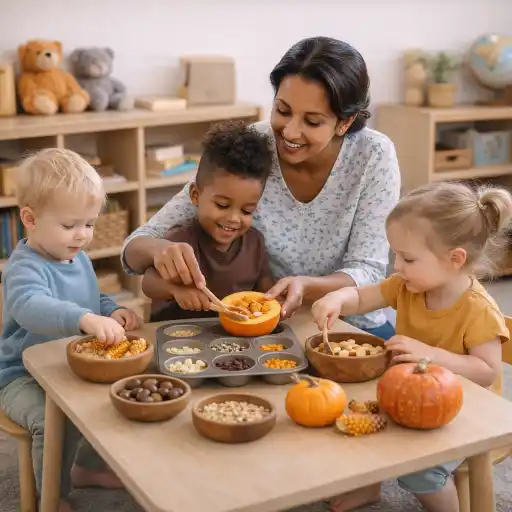
Choose activities that make seasonal foods interesting through sight, touch, smell, sound, and movement. These can be short, small-group experiences, or part of a learning center. Offer tools and alternatives so participation does not depend on touching food directly.
- 🍎 Apple investigation: Compare red, green, and yellow apples. Invite children to sort them by color, wash them, inspect the skin, or listen to an adult slice one. Ask what they notice about the inside and outside.
- Pumpkin discovery tray: Provide a cut pumpkin for supervised observation. Children can look at the seeds and strands, use a spoon to scoop, or compare the firm skin with the soft interior. Keep seeds and small pieces out of reach of children who may mouth them.
- Fall food prints: Use cut apples or sturdy squash pieces as stamps with washable, non-food paint. Children can explore the shape and pattern without eating the produce.
- Seasonal sorting: Sort pictures or clean, intact produce by color, size, or texture. Talk about what grows in gardens or orchards and what changes in autumn.
- Smell and describe: Offer cinnamon, apple, or pumpkin in closed containers or from a comfortable distance. Invite children to describe the scent—or simply observe.
Build in an easy opt-out, and avoid blindfolds or surprise exposures. Predictability helps many children feel secure. Food-based play should be developmentally appropriate, closely supervised, and adapted to individual needs.
How can providers adapt activities for different sensory comfort levels?
Children’s responses to food textures, smells, and appearance vary widely. A child may enjoy looking at pumpkin seeds but feel uneasy when they stick to a hand; another may prefer crunchy sounds but dislike strong aromas. Rather than interpreting refusal as defiance, observe what the child is communicating and adjust the distance, tool, texture, or level of participation.
Offer a participation ladder without insisting that children move up it. They might watch, name a color, move a food with tongs, touch it with a tool, smell it, or choose to leave the station. The sequence is not a requirement or a race. Celebrate engagement in a low-key way: “You noticed the seeds,” rather than “Good job, now take a bite.” For additional perspective on food play and sensory-based feeding differences, remember that exploration can be worthwhile even when tasting does not happen.
- For children avoiding touch, offer tongs, scoops, gloves, picture cards, or sealed sensory bags.
- For children sensitive to smell, use closed containers or place the food farther away.
- For children who prefer predictability, show the ingredients and explain each step before starting.
- For children who communicate nonverbally, offer clear visual choices and respect gestures or signs that mean “stop.”
When a child has persistent feeding difficulties, marked distress, or concerns involving growth, swallowing, or nutrition, discuss observations with the family and encourage consultation with the child’s health care provider. Classroom play is supportive, but it is not a substitute for individualized clinical guidance.
How do you keep seasonal food activities safe and inclusive?
Before planning, review children’s allergy and dietary information, family instructions, program policies, and safe food-handling procedures. Wash produce and hands, clean surfaces and tools, and supervise closely. Consider choking risks: whole nuts, hard seeds, and small or firm food pieces may be unsafe for young children. Use age-appropriate materials and follow your program’s food-safety and choking-prevention practices.
Food is closely connected to culture, family routines, and identity. Avoid presenting one food tradition as universal or describing foods as “good” or “bad.” Invite families to share seasonal foods, names, stories, or preparation traditions if they wish, while respecting privacy and dietary boundaries. Use familiar foods from the children’s communities alongside less familiar examples, and provide picture-based or non-food alternatives when food handling is not suitable.
State requirements vary - check your state licensing agency, especially when activities include food preparation, tasting, allergies, sanitation, or meals. Directors can help staff by clarifying procedures, ensuring supplies are available, and planning activities that fit staffing and supervision needs. Safety and inclusion are not add-ons; they make participation possible.
How can you reflect on progress and partner with families?
Assess the activity by what children explored and learned—not by whether they ate. Brief notes can help staff notice patterns over time: a child chose to smell cinnamon, handled an apple with tongs, or stayed near the group while pumpkin was discussed. These observations can guide future invitations without labeling a child or promising that acceptance will follow.
Communicate with families in a supportive, factual way. Share the activity, the child’s chosen form of participation, and any relevant safety details. Avoid framing tasting as a success metric or suggesting families pressure a child at home. A family may offer helpful information about cultural foods, sensory preferences, allergies, or strategies that make new experiences feel predictable.
Consider repeating an activity with small changes over several days: look at a whole apple one day, sort apple colors another day, and use apple shapes in art later. Repetition can provide familiarity while preserving choice. Keep portions minimal if food is used, and avoid waste by planning only what is needed. For further professional learning, On My Plate: Children’s Nutrition Buy Now $24.00 covers children’s nutrition, meal planning, portions, and practical preparation considerations.
Conclusion: What should providers remember about fall food play?
How can fall food activities support children who are not ready to taste? By making seasonal foods familiar through low-pressure, multi-sensory experiences and respecting each child’s pace. Looking, sorting, listening, smelling, or moving food with a utensil can all be meaningful participation; tasting is never the only measure of progress.
- Offer playful, predictable choices with an easy way to opt out.
- Use neutral language and avoid pressure, bribes, and surprise tasting.
- Adapt for sensory preferences, developmental needs, allergies, and cultural context.
- Follow supervision, food-safety, and choking-prevention practices, and partner with families.
Small, respectful invitations help children feel safe enough to stay curious. This autumn, let exploration—not a bite—be the accomplishment worth noticing.
- CDA Home Visitor Subject Area 3 Part 3 Birth to 5
- CDA Home Visitor Subject Area 2 Part 3 Birth to 5
- Birth to Five CDA Credential with Portfolio Review
- CDA Bridge Bundle: Family Child Care without Portfolio Review
- CDA Bridge Bundle: Infant/Toddler without Portfolio Review
- CDA Bridge Bundle: Preschool without Portfolio Review
- Texas Director Credential
- CDA: Stand With Respect and Professionalism
- Every Moment Matters: Schedules and Transitions
- National Eat Your Vegetables Day June 17
- How to Include Kids in the Kitchen
- CDA Certification en Español: Recursos y Consejos para Educadores Bilingües
- 🔍 ¿Qué ves cuando observas a un niño aprender?
- 💛🧩 ¿Cómo puedo hacer que mi enseñanza sea inclusiva para los niños con autismo?
- Proporciones de Cuidado Infantil y Tamaños de Grupo por Edad en Virginia (Guía Rápida para Centros y Hogares)
- Cómo Celebrar el Día Nacional del Kindergarten
- Lista para Guardería en Casa en Texas: Cómo Iniciar una Guardería en el Hogar
- Temas y Actividades para el Día Nacional del Kindergarten para Proveedores
- Apoyo en Preescolar para Retrasos del Habla: Estrategias Simples que Ayudan
- Sweet National Ice Cream Day Activities Kids Will Love
- How can Georgia farm field trips teach young children about animals and food?
- Calabazas, hojas y manzanas: actividades de otoño para preescolares
- Celebrando la amistad en el cuidado infantil durante el Día de los Mejores Amigos
- Canciones, juegos y preguntas de círculo para niños
- How Can Farm-to-Table Experiences Teach Toddlers Where Food Comes From?
- What’s for Snack Again? Easy Daycare Ideas Kids Won’t Get Bored With
- How Can Fall Food Activities Support Children Who Aren’t Ready to Taste?
