When the weather cools and familiar animals seem to disappear, children have a compelling science question: do they sleep, store food, or travel? A hands-on picture sort can help your group compare these strategies while practicing observation and reasoning; for broader guidance on planning purposeful investigations, explore ChildCareEd’s Basic Science in Early Childhood Buy Now $25.00. This two-hour training focuses on meaningful experiences that support children’s scientific reasoning, giving you a useful next step as you plan the winter inquiry.
Why is winter preparation a meaningful science topic for young children?
Seasonal change is something children can notice directly: daylight shifts, temperatures drop, and leaves fall. Asking what these changes mean for animals connects children’s everyday observations to a larger scientific idea—living things respond in different ways when their habitats and food sources change. This makes the topic approachable without reducing it to a list of facts.
Winter animal investigations also build skills across developmental domains. When children look closely at images, compare details, and explain where a card belongs, they practice #observation, classification, vocabulary, and early reasoning. Acting out a bird’s journey adds movement and collaboration; designing a pretend food store or shelter invites planning and creative problem-solving.
For providers and directors, this topic is practical to implement with a few photographs, picture cards, books, and open-ended prompts. The National Park Service’s Preparing for Winter lesson describes several strategies animals use, including migration, dormancy, food storage, and staying active. Use such resources to ground classroom conversation in accurate examples while keeping the experience playful and responsive to children’s questions.
What do “sleep, store, or travel” mean in an animal picture sort?
A three-category sort gives children a simple entry point into a topic with many variations. “Sleep or become dormant” can represent animals whose activity and bodily processes change during colder periods. “Store food” highlights animals that gather or cache food to use later. “Travel” introduces migration—seasonal movement to another area, often connected to food, climate, or reproduction.
Keep the category names child-friendly, and explain that they are broad classroom labels, not complete scientific descriptions. Some animals stay active and use other adaptations, such as thicker coats, camouflage, sheltered places, or changing diets. You might add a fourth category, “stay active or use another strategy,” or invite children to notice that a card needs more information.
- Choose a small group of animal images with captions or clear visual clues.
- Model your thinking aloud: “This picture shows a squirrel with nuts. I wonder if it is storing food.”
- Ask children to explain their choices rather than treating the sort as a speed or right-answer contest.
- 🧭 Add a simple map or movement path to help children represent where a migrating animal goes.
ChildCareEd’s How Animals Prepare for Winter picture cards Buy Now $2.00 are designed for ages 3–6 and support small-group discussion and comparison. Their captions can help educators emphasize that animal behaviors vary and that examples are possibilities, not rules for every animal.
How can educators explain hibernation and dormancy accurately?
Children may describe any winter rest as hibernation, so begin with a clear but accessible distinction: hibernation is not simply the same as a person taking a long nap. In true hibernation, an animal’s body can undergo significant changes that help conserve energy. Other species have periods of reduced activity or winter sleep that are not the same as true hibernation. Because terms and examples can be complex, use age-appropriate language and consult reliable wildlife references when selecting animals for a lesson.
A helpful prompt is, “What might happen when it is harder to find food?” Then look together at photographs or nonfiction illustrations of a specific animal and its shelter. Invite children to build a burrow, den, or other protected space with blocks, fabric, and large, safe materials. Ask what the structure might help with, and invite children to revise it after considering wind, cold, or an animal’s needs.
Be careful not to teach that all bears, or all animals in a broad group, behave in one identical way. Winter behavior can vary by species, place, and conditions. If a child says, “The bear sleeps all winter,” affirm the curiosity and extend it: “Some bears rest for long periods. Let’s find out whether that is the same as true hibernation.” This approach values the child’s idea while opening a path to more careful #inquiry.
How can migration and food storage become hands-on learning?
Migration is seasonal movement from one habitat to another. It is not always a simple trip south, and the reasons and routes differ among species. A safe classroom route game can make the idea visible: mark two habitat areas, then invite children to move animal pictures or puppets between them in response to story prompts such as “Food is becoming harder to find here.” Pause to ask what clues might influence an animal’s movement.
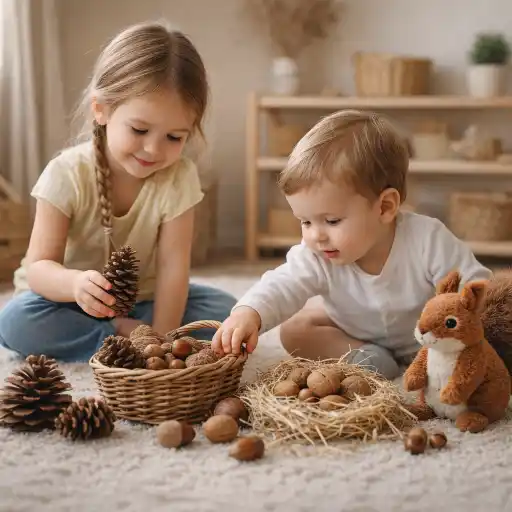
Food storage is another concrete strategy for dramatic play and sorting. Children can gather large pretend seeds or paper “acorns” and place them in a designated storage area, then discuss why an animal might collect food before winter. Keep the distinction clear between pretending and factual claims: the goal is to model a survival challenge, not to suggest every animal stores food.
- Trace a real migration example on a map, using photographs or an age-appropriate nonfiction book.
- Have children create a path using yarn, blocks, or paper arrows, then retell the journey in sequence.
- Offer pretend food and ask children to plan where an animal might keep it for later.
- Connect movement, shelter, and food to the broader idea of habitat and changing seasonal needs.
For an additional classroom resource, Woodland Animal Information Cards: How Animals Prepare for Colder Weather Buy Now $1.50 introduces examples such as squirrels gathering food and Canada geese migrating. Select only examples you can explain accurately, and invite children to ask what evidence would help them learn more.
How can you make the activity inclusive, purposeful, and safe?
Plan the sort so children can participate in different ways. Some may describe an animal aloud; others may point, gesture, move a card, draw, or communicate in a home language. Offer visual labels and a few cards at a time, and adjust the activity for children’s ages, interests, and abilities. A child who prefers movement might walk a migration path, while another can move a toy animal along it from a seated position.
Use the sort as an invitation to think, not a test of recall. Notice whether children compare images, offer a reason, change their minds after hearing new information, or ask a follow-up question. Record a brief quote or photograph of the process and use it to plan the next experience. If children are fascinated by shelters, return to den building; if they wonder where birds go, revisit maps and books.
Choose materials carefully, supervise actively, and follow program policies. Avoid small items that pose a choking risk, especially when younger children are nearby. When planning outdoor observation or using particular materials, state requirements vary - check your state licensing agency. The focus remains on thoughtful #play, meaningful conversation, and access for every child.
What common misconceptions should educators avoid?
One common pitfall is presenting “sleep, store, or travel” as an exhaustive list. Animals may remain active, change their diet, grow thicker coats, use sheltered habitats, or pass winter in a particular life stage. The three categories work well as a first comparison, but explain that nature is more diverse than a simple sort.
A second pitfall is assigning one behavior to every member of a broad group. Not every bird migrates, and winter behavior can differ among species and locations. Likewise, everyday words such as “sleep” may blur important differences between hibernation, dormancy, and winter rest. Use precise, child-friendly phrasing and confirm examples with reputable wildlife sources, such as the National Park Service or a state wildlife agency.
Finally, avoid correcting children in a way that closes down their curiosity. If a guess is incomplete, acknowledge the reasoning and investigate together: “That’s an interesting possibility. What could we look at to find out?” The Illinois Department of Natural Resources’ winter wildlife overview illustrates how strategies can vary across animal groups, including mammals, birds, reptiles, amphibians, and insects. Such variation is a reason to keep discussion open, not a reason to overwhelm preschoolers with technical detail.
Conclusion: How can children compare the ways animals prepare for winter?
Children can explore how animals prepare for winter by sorting pictures into broad strategies—resting or becoming dormant, storing food, and traveling—then considering other adaptations and exceptions. A strong activity combines accurate examples with open-ended conversation, movement, maps, and opportunities to build or represent an animal’s needs.
Start small: introduce a question, offer a few clear images, and invite children to explain what they notice. Treat their ideas as the beginning of an investigation, not a quiz. With careful language and responsive planning, this seasonal topic can strengthen #curiosity, vocabulary, collaboration, and early scientific reasoning. To deepen your planning skills, explore ChildCareEd’s Basic Science in Early Childhood Buy Now $25.00 training.
Related ChildCareEd learning: For additional professional development, explore Building Early Science Foundations  Buy Now $16.00, Tomorrow’s Einsteins: Infant and Toddler Science Buy Now $16.00, Enhancing STEM Education for Infants and Toddlers Buy Now $16.00, and Children at the Wheel: Emergent Curriculum Buy Now $25.00.
- Reducing the Risk of Sudden Infant Death Syndrome
- What Makes Me Special: An Overview of Autism and ADHD
- Money Matters in Medicine
- Engaging Indoor Activities for Inclement Weather
- Texas Teacher 24 hours Annual Renewal 2nd Year
- CDA Infants/Toddlers: Benefits to Observing
- Staff Supervision, Observation & Feedback
- Texas Director Credential
- Injury Prevention: Their Safety Is In Your Hands
- DIY Snow Globes: The Fine Motor Craft That’ll Keep Kids (and Adults) Busy for Hours
- CDA Certification en Español: Recursos y Consejos para Educadores Bilingües
- 💛🧩 ¿Cómo puedo hacer que mi enseñanza sea inclusiva para los niños con autismo?
- Recursos en Español sobre el Sueño Seguro del Bebé
- Capacitación en Salud y Seguridad Preventiva en Línea para Proveedores de Cuidado Infantil
- Proporciones de Cuidado Infantil y Tamaños de Grupo por Edad en Nueva Jersey (Guía Rápida para Centros y Hogares)
- Proporciones de Cuidado Infantil y Tamaños de Grupo por Edad en Virginia (Guía Rápida para Centros y Hogares)
- Lista para Abrir una Guardería en Casa en Carolina del Norte: Cómo Empezar
- Lista para Guardería en Casa en Illinois: Cómo Iniciar una Guardería en el Hogar
- Lista para Guardería en Casa en Texas: Cómo Iniciar una Guardería en el Hogar
- Por Qué la Supervisión Activa Es Clave para la Seguridad en el Cuidado Infantil
- Retraso del Habla en la Guardería: Cómo Pueden Ayudar los Proveedores
- Canciones, juegos y preguntas de círculo para niños
- Cómo simplificar la capacitación para sus empleados de daycare
- Fall Detectives: 10 Questions Pre-K Kids Can Investigate This Season
- No Snow? No Problem! How Can You Create Winter Sensory Activities for Every Childcare Classroom?
- How Can Play Help Children Understand How Animals Survive Winter?
- How Can Winter Storytime Questions Build Preschool Vocabulary and Comprehension?
- How Can You Make Winter Classroom Activities Accessible for Children With Sensory and Mobility Differences?
- How Do Animals Prepare for Winter—and How Can Children Explore Their Strategies?
