Simple Counting Activity for Preschoolers
Looking for a simple, developmentally appropriate counting activity that builds number sense and fine motor control? This brief guide explains why the activity works, materials and setup, step-by-step instructions, assessment strategies, and ways to adapt for mixed-ability groups. For practitioners who want deeper theory and curriculum alignment, consider ChildCareEd's No Such Thing as Boring Math  Buy Now $24.00 or Letter & Number Planning in Child Care Buy Now $24.00 (both excellent for integrating math into daily routines). This article also links to classroom-ready extensions and practical assessment ideas for preschool teachers and directors.
How do I run the counting activity step by step?
Use low-cost, easily available materials to minimize setup time and maximize repeated use. Gather tongs (or clothespins), a selection of small pom-poms or counters in contrasting colors, and pre-cut construction-paper trays or numbered mats. Prepare number mats by writing numerals 1–10 on separate cards or drawing circles to indicate target quantities. Sanitize manipulatives according to your program's health policy and store them in clearly labeled containers for rotation.
Run the activity as a teacher-led small-group or as a center so children can practice independently. Follow these steps:
- Invite 3–5 children to a table and demonstrate how to use tongs to pick up a pom-pom and place it on the matching card.
- Model one-to-one correspondence by touching each pom-pom and counting aloud—"one (tap), two (tap), three (tap)."
- Ask children to use the tongs and place the correct number of pom-poms on the mat that shows the numeral, encouraging them to count as they place each item.
- Prompt children to say the numeral and the total (cardinality): "There are four pom-poms on the 4 card."
- Differentiate by offering numerals 1–3 for emerging counters and 6–10 or two-digit combinations for children ready for extension.
- Rotate children through the center; for independent practice, provide a self-checking visual (dots matching numeral) so children can verify their work.
What early learning goals does this support?
This activity intentionally targets multiple objectives in the preschool mathematics domain: number recognition, one-to-one correspondence, cardinality, subitizing practice with small sets, and emergent computation when combining sets. It also strengthens fine motor coordination through pincer and hand-to-eye control, which supports later pencil grasp and emergent writing. For strategies that explicitly build fine motor skills alongside numeracy, see the ChildCareEd article "Increasing Fine Motor Skills in the Early Childhood Education Classroom" and the classroom math activity "Preschool Arithmetic Activity."
How can I extend or adapt the activity for different learners?
Adaptations increase accessibility and depth of learning:
- For toddlers or children with limited fine motor control, substitute scoops or larger counters and reduce target numerals to 1–3.
- For children ready to deepen reasoning, ask comparative questions: "Which card has more? Which has fewer?" and invite children to create and record simple addition sentences (e.g., 3 + 2 = 5).
- To support dual-language learners, pair numerals with pictorial cues and provide a word bank with number words; this scaffolds vocabulary while teaching math concepts.
- Use the activity as a gateway to thematic investigations (e.g., count and sort by color for a graphing extension). For daily-use ideas, consult "How Can I Use Fun Math Activities for Preschoolers Every Day?" and "How can I use simple math activities for preschoolers every day?"
How should teachers assess learning from this activity?
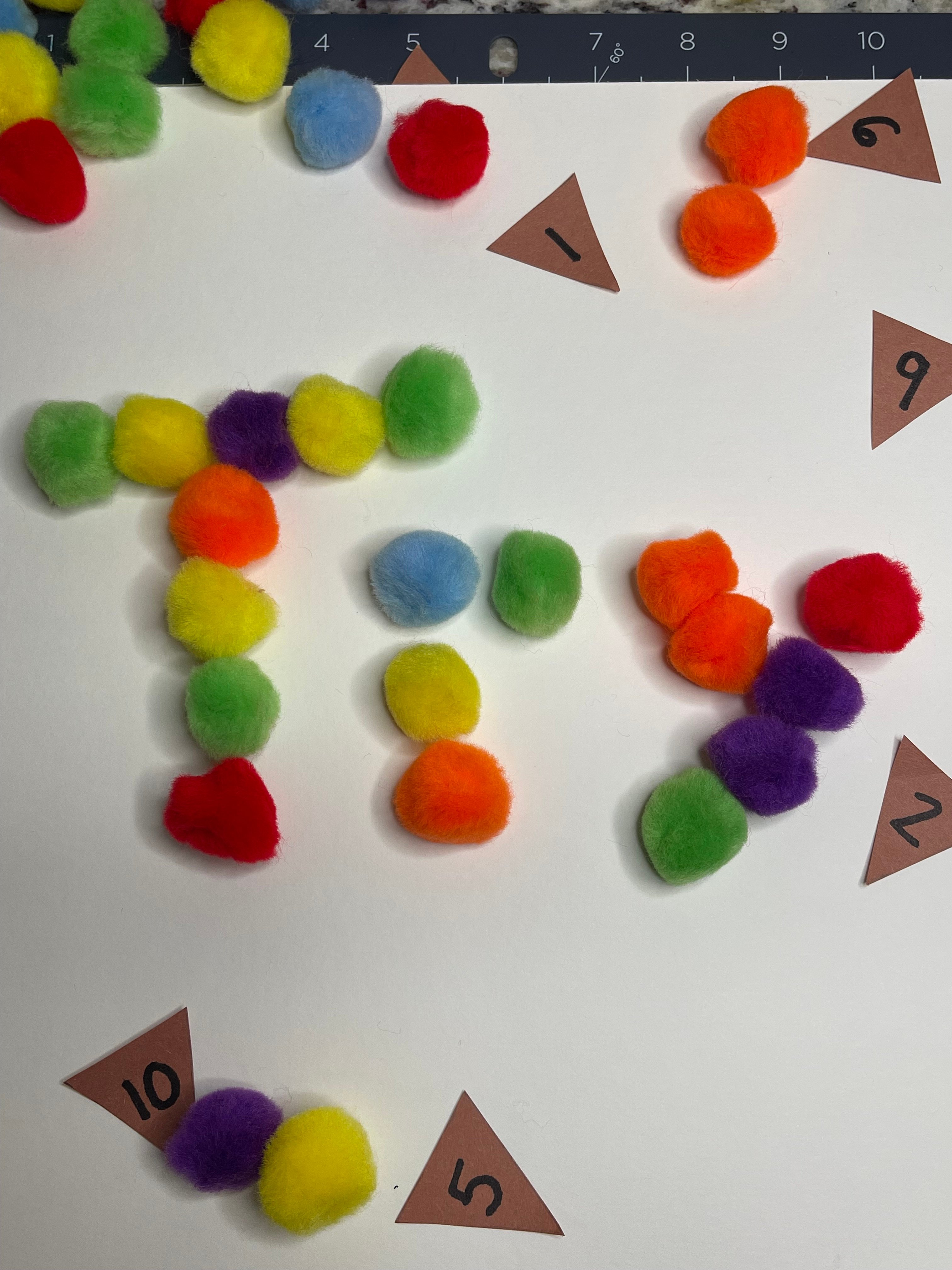
Use brief, formative checks during the activity: note whether a child uses one-to-one correspondence reliably, names numerals when prompted, or requires counting-by-finger cues. Record a quick anecdotal note or a video clip (with family permission) to document gains over multiple sessions. Use a simple checklist aligned with your program goals—numeral recognition, accurate counting to 10, and fine motor control—and revisit the same task weekly to chart progress. For planning that aligns to curriculum and lesson design, see ChildCareEd's "Math Foundations in Early Childhood Buy Now $16.00" and the article "Learning Through Creative Daycare Activities."
How can families and caregivers use this counting activity at home?
Families can reinforce classroom learning with a short, predictable home routine that emphasizes counting as a meaningful part of everyday life. Suggest one or two-minute mini-activities tied to daily transitions (putting away toys, setting out utensils, stepping on numbered floor spots) so children practice one-to-one correspondence in varied contexts. Encourage caregivers to narrate counting actions aloud and to ask simple comparative questions—"Do you have more blocks or more cars?"—to build language for mathematical reasoning. Offer adaptations for small homes or limited materials: use socks, cereal pieces, or buttons instead of pom-poms; substitute a spoon or cup if tongs are not available; and reduce target numbers for younger children. Help families document progress with a single weekly check: ask the child to place the correct number of items on a plate and name the numeral; caregivers can record a tally or brief anecdote to share with teachers. Provide a quick parent handout that models the steps (demonstrate, scaffold, let child try, ask a question, praise effort) and include suggestions for dual-language households (pair the numeral with the number word in both languages and a picture). For creative extensions that combine counting with art and classification, see the ChildCareEd article "Creativity & Logic Activities" and the classroom-art connection in "How Do Art Activities Support Cognitive Growth in North Dakota Preschoolers?."
Rotate small groups to limit crowding, pre-count manipulatives so all students have similar opportunities, and model correct tong use to avoid accidental pinching. Maintain sanitation by washing manipulatives per program policy and store small items out of reach when not in supervised play. Scaffold independence by providing self-check visuals and clear written/visual instructions at the center.
Summary: How will this counting activity help my preschool learners?
When implemented intentionally, this counting center promotes essential numeracy skills, supports fine motor development, and offers numerous differentiation pathways for mixed-ability classrooms. It is low-cost, adaptable, and aligns with developmentally appropriate practice. For deeper coursework that connects theory to practice, consider registering for ChildCareEd's No Such Thing as Boring Math, Letter & Number Planning in Child Care, or Math Foundations in Early Childhood. This activity pairs well with lesson plans and assessment templates available on ChildCareEd. If you operate in North Dakota, consult the North Dakota Department of Human Services — Child Care Licensing for current provider regulations and training requirements; contact your licensing specialist or visit the ND DHS Child Care Licensing website to confirm training hours, staff qualifications, and health/safety rules. Providers should verify state and local licensing requirements.
- Early Mathematics Through Play
- Lesson Planning for Preschoolers
- Montessori Made Simple: For Today's Teachers
- Hidden in Plain Sight: Depression in Young Children
- 45 Hour Preschool Methods and Materials
- Art from the Heart for Preschoolers: Open Ended Art Projects that Build Self-Esteem
- 45-Hour Infant and Toddler Curriculum
- CDA: Communication: Keep It Simple
- Connections That Count: Building Relationships in Child Care
- Teaching Math to Young Children
- Actividades de Motricidad Gruesa que Desarrollan el Equilibrio, la Coordinación y la Fuerza
- How to Celebrate the Fourth of July in Your Center or Daycare
- How can I teach colors, shapes & numbers through play in Michigan classrooms?
- A Simple Guide to Toddler and Preschool Lesson Plans
- How can child care providers use simple STEM activities with early learners?
- How can North Dakota providers celebrate America’s 250th in age-appropriate ways?
- Superhero Activities for Preschoolers: Play, Create, and Learn
- How Can I Use Fun Math Activities for Preschoolers Every Day?
- Child Care Lesson Plans by Age Group: Simple Ideas for Providers
- How can I use simple math activities for preschoolers every day?
- Connecting Generations: Activities for Preschoolers and Seniors
- How Can Simple Cooking Activities Teach Skills in North Dakota Child Care Programs?
- Can your program go screen-free with engaging analog activities?
- Can Counting Activities Really Feel Like Play?
- Why Is Wild vs. Farm Animal Sorting a Favorite Preschool Activity?
- How Can Child Care Providers Integrate Counting into Seasonal Art Activities?
- What Should You Do When a Child Changes Their Vote on the Classroom Graph?
- How Can November Classroom Activities Help Preschoolers Build School Readiness Skills?
- How Can Hands-On Fall Math Teach More, Fewer, and Equal?
