When preschoolers reach for the same toy, “take turns” may settle the moment—but sharing objects equally can also turn that moment into meaningful mathematics. The Early Mathematics Through Play Buy Now $24.00 course helps child care providers connect counting, number sense, and problem-solving to hands-on classroom experiences, strengthening practice while supporting professional learning goals. Read on for a simple way to turn fair sharing into a playful investigation of how children count, compare, and reason.
Why teach sharing as mathematics as well as a social skill?
“Taking turns” is useful when children need sequential access to a desired item. But when a group has several objects to distribute, children can also explore what it means to make groups fair. This reframes a familiar classroom challenge as a chance to think together: Who is receiving a share? How can we check that the groups match? What happens if one object remains?
Equal-group experiences bring social understanding and early math into the same activity. Children must attend to others’ groups, track objects, compare quantities, and explain their ideas. Research with preschool-aged children found that number knowledge was uniquely associated with fair-sharing behavior and that a brief counting intervention improved sharing in the study context. This finding supports offering children concrete counting strategies; it does not mean that every disagreement is a math problem or that counting alone resolves conflict.
Use the experience to model respectful problem-solving, not to label a child selfish or unfair. A calm invitation—“Let’s see what we notice”—keeps the focus on shared inquiry and gives children room to revise their strategy.
How do equal groups support one-to-one correspondence?
One-to-one correspondence means matching one number word to one object, counting each object once and only once. In a sharing activity, children can practice this by moving one item at a time to each person or container. The action gives counting a purpose: each counted object is being assigned to a group.
Try a small-group activity with three toy animals and a modest collection of large, safe counters. Invite children to give each animal one counter, then repeat the cycle until the objects are distributed. Say, “One for this animal, one for that animal, one for this one,” and point as you speak. Then ask children to continue, if ready.
- Start with two or three recipients and a small quantity.
- Place groups far enough apart to make each destination visually clear.
- Model “touch, count, move” slowly; avoid rushing or taking over.
- Invite children to recount or check the groups if they are unsure.
Young children may say the number sequence correctly while skipping an object or counting one twice. That is a normal learning opportunity. A prompt such as “Which object will you count next?” helps the child coordinate the words, movement, and objects without turning the interaction into a test. Counting and cardinality guidance from Young Mathematicians explains these linked skills and emphasizes modeling accurate one-to-one counting.
How does sharing develop quantity awareness?
After distributing objects, pause to compare the groups. Ask, “Does each animal have the same number?” “Which group has more?” or “How could we check?” Children can look, match items across groups, or count each collection. These different approaches help them connect visible arrangements with quantity, rather than relying only on a teacher’s judgment.
When children count a group and understand that the last number word tells how many objects are there, they are demonstrating cardinality. Sharing gives that idea an immediate purpose: children can count each group and use the total to decide whether the distribution is equal. A child who says, “They both have four,” is communicating a comparison as well as a count.
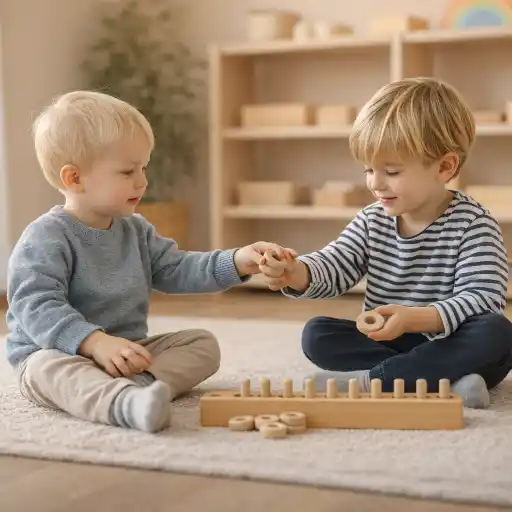
Use language that makes the mathematical relationships visible:
- “This group has more; what do you notice?”
- “These groups have the same number.”
- “Let’s count each group and compare.”
- “One group has one fewer. What might we change?”
Children’s answers may include pointing, moving objects, drawing, or speaking in a home language. Each can show mathematical thinking. For an engaging classroom resource, Share the Acorns: Preschool Equal-Groups Math Mats Buy Now $1.50 invites children ages 3–5 to place acorns in squirrel, basket, or hollow spaces, compare groups, and consider leftovers.
How can educators guide leftovers and fairness without imposing one answer?
Equal sharing becomes especially thought-provoking when the total cannot be divided evenly. If three children share eight pretend acorns, children may make groups of two and notice that two acorns remain. Instead of immediately supplying a solution, ask, “What do you notice?” and “What could we do with the two that are left?” Children might decide to save them, share them in another way, or change the number of recipients.
Mathematical equality and social fairness are related, but they are not always identical. Equal quantities may be a useful goal for a particular activity, yet context matters: children may have different needs, preferences, or time with materials. DREME’s discussion of fair sharing and sharing fairly encourages educators to consider equity beyond identical distribution. The adult’s role is to help children reason, ensure that everyone is heard, and intervene when needed to maintain safety and inclusion—not to insist on one formula in every situation.
- 🧺 Use a simple story: “Three squirrels found eight acorns. How might they share them?”
- Invite children to test an idea with objects, then explain what they observe.
- Ask whose perspective is represented and whether everyone feels included.
- Accept more than one reasonable solution when the context allows it.
This approach supports both mathematical reasoning and a respectful classroom community.
How can providers adapt, observe, and extend the activity?
Keep the learning goal consistent while adjusting materials, quantities, language, or motor demands. Some children may be ready to count one item into each group; others may first compare two small collections or match objects by sight. Provide larger pieces for easier grasping, a stable mat to define each group, picture cues, gestures, or a partner model. Choose materials that are safe for the children in your care, supervise closely, and follow program safety practices—especially when using small loose parts.
Observe strategy rather than speed. A brief note can guide the next experience: “Sam placed one counter in each of three bowls, then counted each group to check.” Or: “Riley counted aloud but returned an item to a bowl already counted; next time, offer a transfer tray.” These notes describe what the child did without turning a developing skill into a fixed label.
- For emerging counters, use two groups and a few large objects.
- For children ready for more, compare groups with more, fewer, or the same, or explore one leftover.
- Invite children to draw the groups or tell a sharing story of their own.
- Repeat the activity with blocks, pretend food, or classroom materials to see whether strategies transfer.
Common pitfalls include rushing to correct children, using too many objects at once, and treating equal amounts as the only possible meaning of fairness. Slow down, make the groups visible, and use open questions. State requirements vary - check your state licensing agency when aligning classroom practices or professional development with local expectations.
Conclusion: How can fair sharing become a meaningful early math experience?
Fair sharing can be more than a reminder to wait. When children distribute objects one at a time, they practice one-to-one correspondence; when they count and compare groups, they build quantity awareness and cardinality; when they discuss leftovers and possible solutions, they engage in early mathematical reasoning. These skills develop through repeated, playful experiences—not through pressure to produce one correct response immediately.
Start with a small collection and a real classroom question. Offer hands-on materials, model careful counting, invite children to compare and explain, and observe the strategies they use. Keep fairness responsive to context and children’s perspectives. With your guidance, a familiar sharing moment can become an inclusive opportunity for children to think, communicate, and grow as mathematicians.
Explore five relevant ChildCareEd courses
- Early Mathematics Through Play Buy Now $24.00 — connect number sense and reasoning to play and routines.
- Math Foundations in Early Childhood
 Buy Now $16.00 — explore hands-on strategies for early math learning.
- No Such Thing as Boring Math Buy Now $24.00 — plan math experiences through play and exploration.
- Letter & Number Planning in Child Care Buy Now $24.00 — plan developmentally appropriate math and literacy activities.
- CDA Subject Area 2 Buy Now $80.00 — consider ways to support children’s physical and intellectual development, including math.
- Turning Behavior Around for Toddlers and Preschoolers
- Early Mathematics Through Play
- The ABCs of Behavior: Turning Challenges into Learning Opportunities
- Birth to Five CDA Credential with Portfolio Review
- No Such Thing as Boring Math
- Letter & Number Planning in Child Care
- Enhancing STEM Education for Infants and Toddlers
- Every Moment Matters: Schedules and Transitions
- Bridging Cultures: Family Communication & Collaboration
- Supporting Families and Caregivers in Language and Literacy
- Professional Development & Teddy Bear Activities
- CDA Certification en Español: Recursos y Consejos para Educadores Bilingües
- How can Georgia preschool teachers use positive guidance to help preschoolers share during indoor play?
- How Can Oklahoma Early Educators Turn Daily Observations into Better Classroom Support?
- Celebrando la amistad en el cuidado infantil durante el Día de los Mejores Amigos
- National Ice Cream Day: Sweet Activities for Preschoolers
- What are the most important school readiness skills for preschoolers?
- How Does Guided Play Build School-Ready Skills in New York Preschoolers?
- How can New York child care programs teach conflict resolution and sharing?
- How Can Simple Cooking Activities Teach Skills in North Dakota Child Care Programs?
- How can child care providers teach sharing and turn-taking without forcing it?
- How can we effectively teach children to wait, share, and take turns?
- How Can Child Care Providers Teach Children to Share and Take Turns Without Forcing Them?
- How Can Child Care Providers Teach Young Children to Take Turns?
- How Can Color-Coded Practice Reinforce Early Division Skills?
- What Are the Best Ways to Support Children Who Struggle with Sharing?
- How Can Montessori Grace and Courtesy Shape More Meaningful Classroom Celebrations?
- How Can After-School Programs Support Math Learning for Children with IEPs?
- What Can Preschool Board Games Teach Beyond Taking Turns?
- How Can Fair Sharing Build Early Math Skills Beyond “Take Turns”?
