A child may recite “one, two, three” with confidence and still be unsure how to make a group of three. The next step is to connect number words with visible, buildable quantities; the Math Foundations in Early Childhood  Buy Now $16.00 course offers practical strategies for strengthening number sense through hands-on learning and play. Read on for a clear way to notice what the child understands and choose a supportive next move.
Why is counting aloud different from showing how many?
Counting aloud is a useful beginning, but it does not automatically show that a child understands quantity. A child might know the stable number sequence while still having difficulty coordinating one number word with each object, recognizing that the final number tells how many are in the set, or connecting a written numeral to an amount. These ideas develop in related but distinct ways.
When a child counts a set accurately and then cannot show that amount with counters, drawings, fingers, or another model, treat the moment as information—not failure. The child may be working on the bridge between spoken number names and cardinality, or may need a more concrete way to represent the amount. As Young Mathematicians explains about counting and cardinality, children build several linked skills: number sequence, one-to-one correspondence, knowing the total, and connecting quantity to numerals.
This distinction matters because repeating the counting sequence alone may not address the gap. A useful question is not only “Can the child count?” but “What can the child do with the quantity after counting?” That shift helps providers plan learning that is specific, warm, and developmentally appropriate.
What should providers observe before choosing the next activity?
Begin with a brief, low-pressure observation. Offer a small group of familiar objects and invite the child to count them. Then ask, “How many are there altogether?” and “Can you show me that many?” Notice the process as well as the answer. Does the child touch each object once? Does the child recount when asked for the total? Can the child make a matching set from a larger collection? Does the child recognize the same amount when objects are spread out?
Formative assessment works best when it happens in ordinary play and conversation, not only during a formal check.
- Ask the child to count a small set, then state the total without recounting.
- Invite the child to give you a specific number of objects from a larger pile.
- Rearrange a counted set and ask whether the amount changed.
- Record the strategy: for example, “counted five objects one by one; needed support to make a matching set.”
These observations help identify whether the next focus should be one-to-one correspondence, cardinality, matching, or visual recognition.
How can you help a child connect number words to quantities?
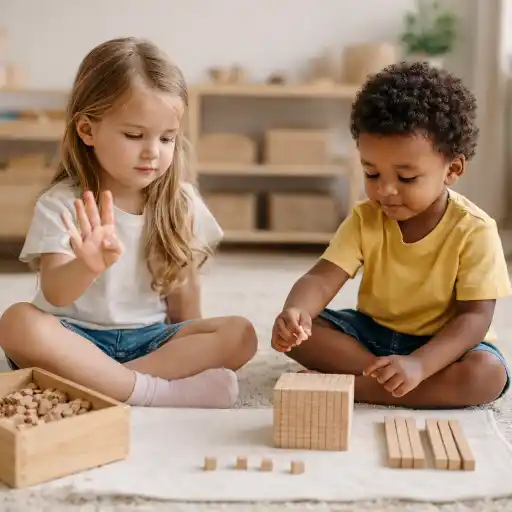
Start with real, movable objects and small amounts. Model matching one spoken number to one action: “One bear goes here; two bears; three bears.” Let the child move, touch, or place each item. After the count, pause and emphasize the total: “You counted three bears. There are three bears altogether.” This restating supports the idea that the last number names the entire set.
Then invite the child to build the same quantity in another way. If there are three blocks, can the child show three fingers, place three counters in a row, or draw three marks? Using several representations helps make the relationship more flexible without demanding that every response look identical.
As children gain confidence, introduce structured visual models such as dot cards or a ten-frame. A ten-frame gives each counter a defined space and makes the collection easier to see and check. The visual arrangement can also support noticing groups—for instance, seeing five as a full row, or six as five and one.
- Begin with one to three objects if larger amounts feel overwhelming.
- Use familiar materials: toy animals, blocks, large counters, or snack items.
- Count slowly while moving one object for each number word.
- Ask, “How do you know?” and welcome pointing, gestures, words, or a model as answers.
How can a ten-frame or worksheet support the next step?
A ten-frame is useful when it extends hands-on exploration rather than replacing it. Its two rows of five spaces organize amounts and let children compare a numeral, a spoken number, and a visible set. First build the amount with physical counters; then transfer the same quantity to the frame. Ask the child to explain or show how the frame matches the objects.
The Ten-Frames: Show the Number (1-10) Practice Worksheet Buy Now $1.49 gives beginning counters a simple opportunity to draw dots for numbers one through ten, with an answer key included. Use it as a short representation or reflection task after children have had a chance to build each quantity. A practical sequence is:
- Build a number with counters or other safe manipulatives.
- Match it to a numeral card or say the number together.
- Place the same number of counters on a ten-frame.
- Draw dots on the worksheet and compare the drawing with the model.
- Invite the child to tell, point, or demonstrate how many are shown.
Keep attention on the quantity and the child’s reasoning, not perfect handwriting or identical dot placement. Adapt the experience with larger materials, verbal responses, or adult modeling when needed. 🧩 A familiar frame with a small change in challenge can help children focus on the math rather than learning new directions.
What playful practice and next steps are most helpful?
Short, repeated experiences across the day often provide meaningful practice. Use counting and showing in classroom routines so quantity has a real purpose: place four cups at a table, bring three blocks to a friend, or find two books for a reading corner. In play, roll a die and build a matching tower, feed toy animals a chosen number of pretend snacks, or draw a numeral card and park that many cars.
Choose the next challenge from what you observe. If a child skips objects, slow down and practice moving one object per number word. If the child counts correctly but cannot state the total, model and repeat cardinal language. If the child can build a set but does not connect it to the numeral, pair quantities with number cards and say the number together. If the child can show small amounts, explore dot patterns or “one more” with counters.
- Keep practice brief, playful, and free of pressure to respond quickly.
- Offer multiple ways to participate: placing, pointing, drawing, speaking, or choosing.
- Observe progress over time rather than treating one response as a fixed ability.
- Use materials appropriate to children’s ages and supervise small objects carefully.
For a broader foundation in play-based math instruction, explore ChildCareEd’s Early Mathematics Through Play Buy Now $24.00, No Such Thing as Boring Math Buy Now $24.00, Letter & Number Planning in Child Care Buy Now $24.00, and CDA Subject Area 2 Buy Now $80.00. These English-language courses address early math and classroom learning from complementary angles. State requirements vary - check your state licensing agency when determining whether a course meets a particular training requirement.
Conclusion: What comes next when a child can count but cannot show the quantity?
When a child counts correctly but cannot show the quantity, the next step is to make the number visible and meaningful—not simply to practice reciting the sequence again. Observe how the child counts and responds, then offer small sets of real objects, one-to-one placement, clear cardinal language, and opportunities to represent the amount in different ways.
Ten-frames and a brief worksheet can help connect concrete materials to drawings and numerals when used in that order. Keep activities playful, adapt the materials and response options, and use each observation to plan a manageable next challenge. With patient practice, children can build the bridge from saying a number to understanding and showing what it represents.
- 🤯 ¿Por qué este niño está teniendo un comportamiento difícil de repente?
- 😫🧸 ¿Qué hacer cuando un bebé no quiere dormir la siesta en el aula?
- 🚨 Reporte Obligatorio en Nevada
- Qué capacitación se requiere para ser director de cuidado infantil en Texas?
- Que es Título 22 en California?
- ¿Cómo solicito la licencia para una guardería en California?
- Regulaciones de Licenciamiento de Cuidado Infantil en California para Centros y Hogares de Cuidado Infantil Familiar
- Proporciones de Cuidado Infantil y Tamaños de Grupo por Edad en Maryland (Guía Rápida para Centros y Hogares)
- Ejemplos de Crianza Respetuosa vs. Crianza Permisiva
- Capacitación Previa al Servicio para Proveedores de Cuidado Infantil en Dakota del Norte
- Kindergarten Songs for Circle Time: 15 Sing-and-Move Ideas That Sneak in Learning
- How Can Child Care Providers Make Counting and Simple Operations Playful?
- Why Can a Child Compare Two Piles but Struggle with Greater-Than Symbols?
- A Child Counts Correctly but Cannot Show the Quantity: What Comes Next?
- A Child Counts Correctly but Cannot Show the Quantity: What Comes Next?
- How Can Preschoolers Build Towers of the Same Height with Different Numbers of Blocks?
- What Do Missing-Number Problems Reveal About a Child’s Math Strategy?
- Why Can a Child Skip Count by Twos but Not by Sixes?
- How Can Preschoolers Learn to Recognize Small Quantities Without Counting?
