Children’s animal conversations often start with “farm” and “wild,” but their questions quickly lead to a richer world of habitats, animal needs, and overlapping categories. The Montessori Cultural Activities: Exploring the World Through Play and Learning  Buy Now $24.00 course can help you plan hands-on, inquiry-rich experiences that connect science with play, language, and culture; pair it with Basic Science in Early Childhood Buy Now $25.00 for practical strategies to nurture children’s questioning and observation. Use the ideas below to turn a familiar sorting mat into a launchpad for deeper learning.
Why look beyond the farm-and-wild categories?
Farm and wild are useful first labels, but they describe an animal’s relationship with people more than the full range of places it can live. A habitat is an environment that provides resources and conditions an animal needs, such as food, water, shelter, and space. Forests, oceans, deserts, ponds, grasslands, and polar regions each offer different possibilities for life.
When educators widen the conversation, children can move from recalling labels to noticing patterns and asking questions: What does this animal need? How does its body help it live there? Could it live somewhere else? These questions support early science habits—observation, comparison, explanation, and willingness to revise an idea. They also invite children to bring in experiences from books, family stories, neighborhood walks, and visits to farms or nature centers.
A farm-versus-wild sort can still be a valuable starting point. The wild-versus-farm sorting activity offers a concrete way to introduce classification. The key is to present its two groups as one way of organizing information, not as a complete map of animal life.
- Builds early #science reasoning through noticing and explaining.
- Expands #habitats and animal vocabulary in context.
- Encourages children to consider different perspectives and evidence.
How can a farm-and-wild sorting mat become a starting point?
The ChildCareEd Sorting Mat - Wild Animal or Farm Animal Buy Now $1.49 provides eight familiar examples: bear, zebra, tiger, and lion alongside cow, pig, horse, and sheep. Children cut, sort, and glue the pictures, practicing classification while building vocabulary and observation skills. Rather than treating the mat as an answer sheet, use it as an invitation to explain and extend thinking.
Before sorting, let children study each image. Ask what they notice about the animal, what they already know, and what clues might help place it. After completing the two groups, revisit the cards with new questions: Where might the animal find food? What kind of shelter or space does it need? Could a horse live outside a farm setting? What would we need to learn before deciding?
Make the activity more accessible and reusable by preparing some pieces in advance or using laminated cards, magnets, or hook-and-loop dots. Children can point, place, name, gesture, or explain their choices. The classification goal remains central even if cutting and gluing are not the right access route for every child.
- Invite children to explain a choice before offering a correction.
- Keep the original two categories visible, then add habitat cards nearby.
- Record surprising questions for follow-up reading or investigation.
How can children explore habitats and overlapping categories?
Once children have explored farm and wild animals, introduce several habitat pictures or simple mats—such as ocean, forest, desert, pond, and grassland. Invite children to place animal figures or photos where they think they belong, then explain the clues behind each decision. Some animals use more than one environment, and that complexity is an asset: it gives children a reason to compare, reconsider, and seek reliable information.
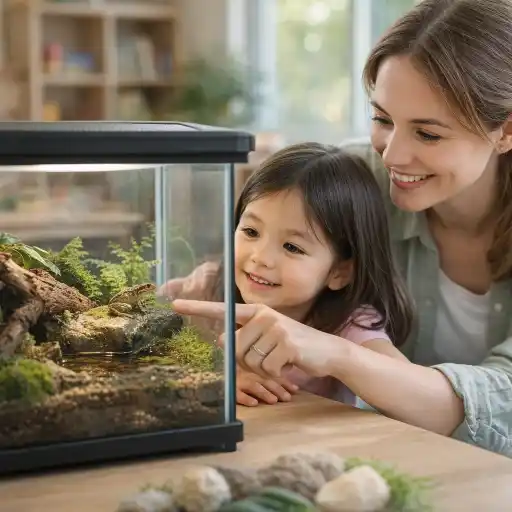
Offer open-ended prompts rather than aiming for a single fast answer. “What makes this place a good home?” “What might the animal eat here?” and “Could it use another habitat at a different time?” keep attention on evidence and animal needs. Resources for distinguishing wildlife from domesticated animals can help clarify that “wild” concerns whether animals are domesticated, while habitat refers to where and how they meet their needs.
Try a small-group investigation:
- 🦊 Set out animal figures, habitat photographs, and a few natural or classroom materials.
- Ask children to build a place that could meet an animal’s needs.
- Invite them to move the same animal to a second setting and explain what changes.
- Use a picture book or reliable reference to check questions together.
These discussions align with hands-on approaches to preschool habitat learning, where sorting, sensory exploration, literacy, and creative work can reinforce one another.
How can educators connect habitat inquiry to language, math, and play?
Habitat investigations naturally support learning across domains. Model precise, accessible words—habitat, shelter, compare, similar, different, and observe—while children handle pictures and materials. Expand rather than dismiss their ideas: if a child says, “The bear lives in the woods,” you might respond, “You’re thinking of a forest habitat. What could the bear find there?” For multilingual learners, pair spoken labels with photographs, gestures, home-language words, or family contributions.
Math can enter through authentic questions. Count how many animals children placed in each habitat, compare groups, or make a simple class graph. Children can sort the same animals another way—by movement, body covering, or size—to discover that categories depend on the question being asked. A habitat walk, sensory bin, block-built animal home, or drawing can carry the conversation beyond the mat. These varied invitations reflect the cross-curricular possibilities in preschool habitat activities.
Use play to let children test ideas. In the block area, they might build a pond beside a farm or create a woodland shelter. Ask questions that invite explanation without taking over the play:
- “What does your animal need in this place?”
- “How could we tell whether this habitat works?”
- “What would you change if the animal needed more water or shelter?”
These exchanges grow #vocabulary, #curiosity, and confidence in communicating ideas.
How can providers include every learner and assess understanding?
Inclusive design offers more than one way to participate. Some children may sort by pointing or eye gaze; others may use gestures, communication devices, home languages, drawing, or spoken explanations. Offer sturdy, large images, pre-cut pieces, fewer choices, extra processing time, partner options, and a quieter workspace when helpful. Adapt the materials without reducing the intellectual invitation: every child can observe, make a choice, and contribute an idea.
Assess children’s thinking as it unfolds, not only the finished mat. Notice whether a child observes details, uses a category consistently, explains a placement, asks a question, or changes an idea after discussion. Brief notes, children’s words, photos of constructed habitats, or dictated explanations can document progress and guide next steps.
Common pitfalls are easy to avoid with intentional facilitation:
- Do not teach “wild” as another word for dangerous; clarify that it refers to animals not domesticated.
- Avoid implying that every animal has only one possible habitat or that farm/wild labels answer every question.
- Do not treat a different answer as a mistake before hearing the child’s reasoning.
- When unsure, model inquiry: “Let’s find out together.”
Use observations to decide whether children are ready for more habitats, a second sorting rule, or more time with familiar animals. #inclusion is strengthened when different forms of participation and reasoning are welcomed. State requirements vary - check your state licensing agency if connecting professional learning to a local requirement.
Conclusion: How do we move beyond simple animal labels?
Farm and wild categories give young children a concrete beginning, but they are only one lens for understanding animals. Providers can use the Sorting Mat - Wild Animal or Farm Animal to spark observation and discussion, then extend that thinking to habitats, animal needs, and multiple ways to classify. Open-ended questions, accurate resources, play-based extensions, and accessible materials turn a quick sort into a meaningful investigation.
The central goal is not to make every child memorize a fixed answer. It is to help children notice, wonder, explain, and revise their ideas with care. By treating uncertainty as an invitation to investigate, educators make room for deeper science learning—and for children’s natural delight in discovering the world.
- Positive Attention: Interactions & Supervision of Infants & Toddlers
- Lesson Planning for Preschoolers
- Children at the Wheel: Emergent Curriculum
- CDA Bridge Bundle: Family Child Care without Portfolio Review
- CDA Bridge Bundle: Infant/Toddler without Portfolio Review
- CDA Bridge Bundle: Preschool without Portfolio Review
- Texas Director Credential
- ❤️ ¿Cómo ayudan los educadores a las familias a acceder a los servicios que necesitan?
- 💛🧩 ¿Cómo puedo hacer que mi enseñanza sea inclusiva para los niños con autismo?
- 📖 ¿Cómo puedo hacer que la hora del cuento sea la parte más poderosa de mi día?
- 🚌❄️ Ideas de excursiones en Dakota del Norte
- 🚌🌄 Ideas de excursiones atractivas en Nevada
- 🚌❤️ Ideas de excursiones en Illinois
- 🚌🍑 Ideas de excursiones en Georgia
- Proporciones de Cuidado Infantil y Tamaños de Grupo por Edad en Virginia (Guía Rápida para Centros y Hogares)
- Las Mejores Ideas de Excursiones para Guarderías en Dakota del Norte
- Las Mejores Ideas de Excursiones para Guarderías en Georgia
- Canciones, juegos y preguntas de círculo para niños
- Cómo simplificar la capacitación para sus empleados de daycare
- Animal Relay Race for Kids: 10 Wild Ways to Race Without Running
- How Can Fun Bingo Games Teach Colors, Shapes, and Animals to Preschoolers?
- Why Is Animal Bingo a Great Way to Introduce Habitats and Classification?
- Why Is Wild vs. Farm Animal Sorting a Favorite Preschool Activity?
- How Do Animal Classification Activities Build Early Science Thinking?
- How Can Child Care Providers Introduce Reptiles Through Art, Observation, and Conversation?
- How Can Word-Finding Games Strengthen Preschoolers’ Animal Vocabulary?
- How Can We Explore Animal Habitats Beyond Farm-and-Wild Labels?
