When children ask, “Is this an ocean animal?” they are doing more than naming pictures—they are comparing evidence, building language, and beginning to think like scientists. Try Creating the Natural Outdoor Classroom  Buy Now $16.00 to strengthen nature-based learning environments and gain practical ideas for turning outdoor observations into meaningful science conversations.
Why do classification questions matter in early marine science?
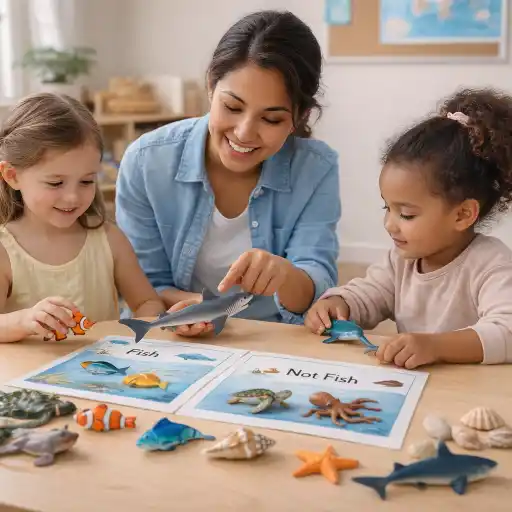
Classification questions invite children to decide which things belong together and explain why. In an ocean-themed investigation, children may group a whale, octopus, shark, turtle, penguin, dog, horse, cow, and lion according to whether each is an ocean animal. The question appears simple, yet it requires children to draw on prior knowledge, notice relationships, and communicate a rule.
This process supports early scientific reasoning without requiring formal taxonomy. Children observe, compare, categorize, defend an idea, and remain open to revising it. These habits connect science with oral language, executive function, mathematics, and social learning. The animal classification guidance emphasizes that young children benefit from hands-on grouping and opportunities to sort the same materials in more than one way.
Marine classification is especially motivating because many children already have strong informal knowledge. They may know that whales live in water, that penguins have feathers, or that dogs live with people. Rather than treating these ideas as complete or incorrect, educators can use them as starting points for inquiry.
- 🦀 Builds observation, comparison, and explanation.
- Expands vocabulary about animals, habitats, and body parts.
- Encourages children to listen to different perspectives.
- Creates a bridge between everyday language and scientific language.
How can “ocean animal or not?” develop precise vocabulary?
Vocabulary grows most effectively when words are tied to visible features and meaningful conversation. Begin with a small set of cards and introduce words such as ocean, marine, habitat, mammal, fish, bird, reptile, shell, fin, flipper, tentacle, feather, fur, and scale. Use each word in context rather than presenting a disconnected list.
For example, when a child places the turtle in the ocean category, respond: “You noticed that this sea turtle has flippers and lives in a marine habitat.” If a child places the penguin outside the category because it cannot fly, ask, “What other features do you notice? Where does this bird spend time?” Such responses extend language while preserving the child’s willingness to reason.
Classification questions also encourage relational words: same, different, both, unlike, belongs, does not belong, because, compare, and evidence. These terms help children explain relationships between ideas. A teacher might model a sentence frame: “I think the ___ belongs with the ocean animals because ___.” Children can complete the frame verbally, through gestures, drawings, home-language responses, or communication devices.
Use photographs, realistic figures, books, and gestures to support multilingual learners and children who benefit from visual communication. Repetition is valuable: revisit the same words during read-alouds, outdoor observations, dramatic play, and sensory experiences. A resource such as Ocean Animal or Not? Buy Now $1.49 provides a concrete cut-and-sort context for this vocabulary work.
Which questions encourage deeper marine science thinking?
The quality of adult questions determines whether sorting becomes a worksheet task or an inquiry. Begin with observation questions: “What do you see?” “What covers its body?” and “How does it move?” Then move toward reasoning: “Why did you put these together?” “Could this animal belong in two groups?” and “What evidence supports your idea?”
Children should encounter more than one reasonable classification system. A penguin may be grouped with ocean animals, birds, animals with feathers, or animals that swim. A turtle may fit a group based on habitat, body covering, movement, or animal type. Explaining that categories depend on the question helps children understand that science involves purposeful organization rather than memorizing one permanent answer.
- “Which animals live in salt water?”
- “Which animals have fins, flippers, or tentacles?”
- “Which animals can move in water and on land?”
- “Which card was difficult to place, and why?”
- “What could we observe, read, or investigate next?”
Use uncertainty productively. If children disagree about whether a penguin is an ocean animal, acknowledge both ideas and ask what additional information might help. This approach models scientific humility and makes room for evidence-based discussion. For a broader foundation in inquiry-based teaching, Basic Science in Early Childhood Buy Now $25.00 offers strategies for planning experiences that support questioning, investigation, and reasoning.
How can providers connect marine vocabulary to play and the environment?
Classification becomes more memorable when children encounter the vocabulary across settings. In the science center, provide large animal figures, habitat photographs, sorting mats, magnifiers, and clipboards. In blocks, invite children to build a reef, shoreline, or aquarium. In dramatic play, children can become marine biologists, divers, veterinarians, or ocean rescuers and use words such as observe, protect, habitat, and investigate.
Outdoor spaces can extend marine science even when the program is far from the coast. Children can classify local animals, plants, rocks, or found objects and then compare their categories with ocean animals. A puddle, pond, or water table can prompt questions about freshwater and saltwater environments. Children might notice that different habitats provide food, shelter, space, and protection.
Keep the environment accessible and intentional:
- Display animal photographs with picture labels and home-language terms.
- Rotate a few carefully selected materials instead of overwhelming the space.
- Offer seated, standing, partner, and floor-based ways to participate.
- Use large pieces, magnetic cards, Velcro, or tongs when cutting is a barrier.
- Invite families to share marine stories, animal names, or community experiences.
The course Creating the Natural Outdoor Classroom Buy Now $16.00 can help directors and providers think intentionally about colors, sounds, textures, and discoveries in learning environments. State requirements vary - check your state licensing agency when connecting professional learning to local requirements.
How should educators document vocabulary and classification growth?
Assessment should capture children’s reasoning, not merely whether they placed a card in the expected group. Observe whether a child notices relevant characteristics, uses descriptive words, explains a category rule, listens to peers, and revises an idea after new information. A child who changes a placement after learning about habitat is demonstrating flexible scientific thinking.
Brief, objective notes may include:
- “Maya grouped the whale and turtle because both live in the ocean.”
- “Luis used fin and shell during the discussion and pointed to photographs for support.”
- “Amina created a second group for animals with feathers.”
- “Jordan revised the penguin’s placement after discussing swimming and habitat.”
Photographs, dictated explanations, drawings, and audio recordings can document language development. Revisit the sort later and ask children whether they would keep or change their groups. Directors can support consistent practice by providing a shared observation template with three prompts: What did the child notice? What vocabulary did the child use? What might we investigate next?
Classification also lends itself to early mathematics. Children can count each category, compare more and fewer, create a picture graph, or measure animal figures. These extensions reinforce vocabulary while showing children that categories can generate questions and data.
What common mistakes should educators avoid?
The first mistake is treating classification as a right-or-wrong quiz. Rapid correction may cause children to stop explaining their thinking. Instead, ask, “What is your rule?” and acknowledge reasonable evidence before introducing a new perspective.
A second mistake is using “ocean animal” as if it were a formal biological group. It is a habitat-based category, and many animals use more than one habitat. Clarify the purpose of the sort: “Today we are grouping animals by whether they live in or depend on the ocean.” This prevents oversimplification.
A third mistake is relying only on names. Naming whale or octopus is useful, but children need opportunities to describe traits, habitats, and movement. Add one short reasoning prompt after each placement rather than turning the activity into a vocabulary drill.
Finally, avoid inaccurate generalizations. Not every bird flies, not every animal has one habitat, and not every animal seen near water is a marine animal. When the answer is uncertain, model investigation: “We have a question. What evidence could help us find out?”
- Keep the number of cards manageable.
- Use realistic images and accurate language.
- Accept multiple categories when children can explain them.
- Provide communication and motor adaptations.
- Connect the activity to books, play, observation, and family knowledge.
Conclusion: How do classification questions build marine science vocabulary?
Classification questions build marine science vocabulary because they give children a reason to use words in service of thinking. When children decide whether an animal belongs in an ocean group, they observe features, compare examples, connect animals with habitats, and explain evidence. The most productive goal is not perfect taxonomy; it is growing confidence with scientific language and flexible reasoning.
Use a simple teaching cycle: present a small set of animals, invite an initial sort, ask for explanations, introduce precise vocabulary, reorganize the materials using a new rule, and document children’s ideas. Pair the Ocean Animal or Not? Buy Now $1.49 resource with books, dramatic play, sensory exploration, and outdoor investigations. With intentional prompts and inclusive materials, a playful marine sort can become a powerful foundation for science, language, and lifelong curiosity.
Additional ChildCareEd courses to explore:
- Basic Science in Early Childhood Buy Now $25.00 — supports inquiry-based science planning.
- Building Early Science Foundations Buy Now $16.00 — focuses on curiosity, exploration, and discovery.
- Inclusive Lessons for Preschoolers Buy Now $16.00 — offers strategies for adapting activities for every learner.
- Lesson Planning for Preschoolers Buy Now $24.00 — connects activities to intentional, developmentally appropriate planning.
- Science of Reading Foundations in the Pre-K Classroom
- CDA Home Visitor Subject Area 3 Part 3 Birth to 5
- CDA Home Visitor Subject Area 2 Part 3 Birth to 5
- Building Bridges for Dual Language Learners: For Workforce Solutions
- TEAM: Together Everyone Achieves More
- Staff Supervision, Observation & Feedback
- Texas Director Credential
- Building Vocabulary
- Classroom Tools for Emergent Literacy
- 👶 ¿Cuáles son las proporciones y grupos requeridos en Dakota del Norte? 🏫
- Curso Gratis De Cuidado Infantil Con Certificado
- Celebra El Cumpleaños de Dr. Seuss En Tu Guardería Con Actividades Fáciles y Divertidas!
- Recursos en Español sobre el Sueño Seguro del Bebé
- Curso de Comunicación de 9 Horas de Maryland
- Capacitación en Salud y Seguridad Preventiva en Línea para Proveedores de Cuidado Infantil
- ¿Qué preguntas aparecen en el examen CDA para preescolar?
- ¿Qué Preguntas Vienen en el Examen CDA de Nacimiento a los Cinco Años?
- Lista para Abrir una Guardería en Casa en Virginia: Cómo Empezar
- Lista para Abrir una Guardería en Casa en Carolina del Norte: Cómo Empezar
- Lista para Guardería en Casa en Illinois: Cómo Iniciar una Guardería en el Hogar
- Lista para Guardería en Casa en Texas: Cómo Iniciar una Guardería en el Hogar
- Capacitación Previa al Servicio para Proveedores de Cuidado Infantil en Dakota del Norte
- Las Mejores Ideas de Excursiones para Guarderías en Texas
- How can Washington aquariums and marine field trips spark curiosity for young children?
- Cómo simplificar la capacitación para sus empleados de daycare
- Why Is Animal Bingo a Great Way to Introduce Habitats and Classification?
- How Do Classification Questions Build Marine Science Vocabulary?
- How Can Ocean Animal I Spy Combine Counting, Visual Scanning, and Ocean Science?
- How Can Ocean Art Build Marine Vocabulary and Curiosity in Young Children?
